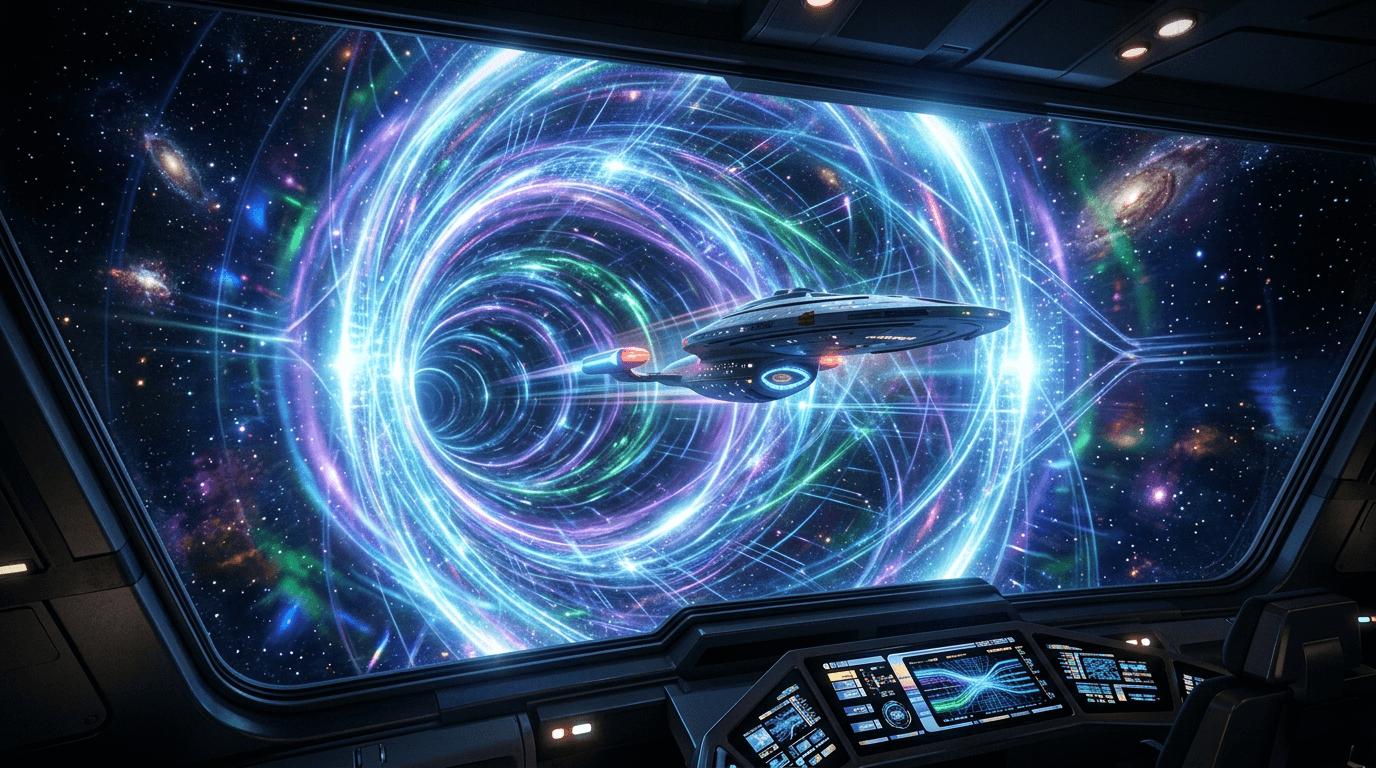
Transwarp Drive
Transwarp drive represents a speculative advancement beyond conventional warp propulsion systems, imagined as a method of achieving velocities that dwarf traditional faster-than-light travel. While standard warp drive concepts in science fiction involve warping spacetime around a vessel to achieve superluminal speeds, transwarp technology theoretically operates by creating and maintaining stable corridors through subspace—a hypothetical domain beneath normal spacetime. These transwarp conduits function as artificial wormholes or shortcuts through the fabric of space itself, allowing vessels to traverse vast interstellar distances in fractions of the time required by conventional warp systems. The concept distinguishes itself from traditional warp mechanics by fundamentally altering the topology of space rather than simply manipulating local spacetime curvature. In fictional frameworks, particularly within Star Trek narratives, transwarp technology is often depicted as requiring immense energy generation capabilities and sophisticated spatial manipulation techniques that remain beyond the reach of most civilizations.
The strategic significance of transwarp drive in science fiction narratives lies in its potential to revolutionize interstellar logistics, military deployment, and exploration. A civilization possessing functional transwarp technology would gain decisive advantages in projecting power across galactic distances, establishing rapid communication networks, and accessing remote resources. The Borg Collective's fictional monopoly on transwarp capabilities in Star Trek canon illustrates how such technology becomes a force multiplier, enabling a distributed intelligence to coordinate actions across thousands of light-years with unprecedented efficiency. This narrative element reflects broader strategic thinking about how breakthrough transportation technologies reshape geopolitical—or in this case, galactic—power dynamics. Contemporary research into exotic propulsion concepts, including Alcubierre warp drive theory and traversable wormhole physics, provides tangential real-world context, though these remain purely theoretical exercises constrained by extreme energy requirements and unresolved questions about exotic matter.
From a scientific plausibility standpoint, transwarp drive faces formidable theoretical obstacles that distinguish it from even optimistic projections of future propulsion systems. The creation of stable subspace corridors would require not only the existence of additional spatial dimensions or domains—concepts explored in string theory and M-theory—but also the ability to manipulate these domains with precision and sustain them against natural collapse. Current physics offers no pathway to generating or stabilizing such structures, and the energy scales involved would likely exceed anything achievable with known or foreseeable power generation methods. The concept of a persistent transwarp network, as depicted in fiction, would additionally require solving maintenance and navigation challenges across interstellar distances. While quantum entanglement and theoretical wormhole physics provide mathematical frameworks that superficially resemble some transwarp concepts, the gulf between mathematical possibility and engineering reality remains vast. Any movement toward transwarp-like capabilities would require revolutionary breakthroughs in our understanding of spacetime topology, exotic matter generation, and energy manipulation—developments that, if they occur at all, likely remain centuries distant.
Research this in Signals
Signals turns a topic into a sourced research record you can inspect and rerun. Your first scan is free, and this one starts with Transwarp Drive already loaded, so edit it or scan as is.