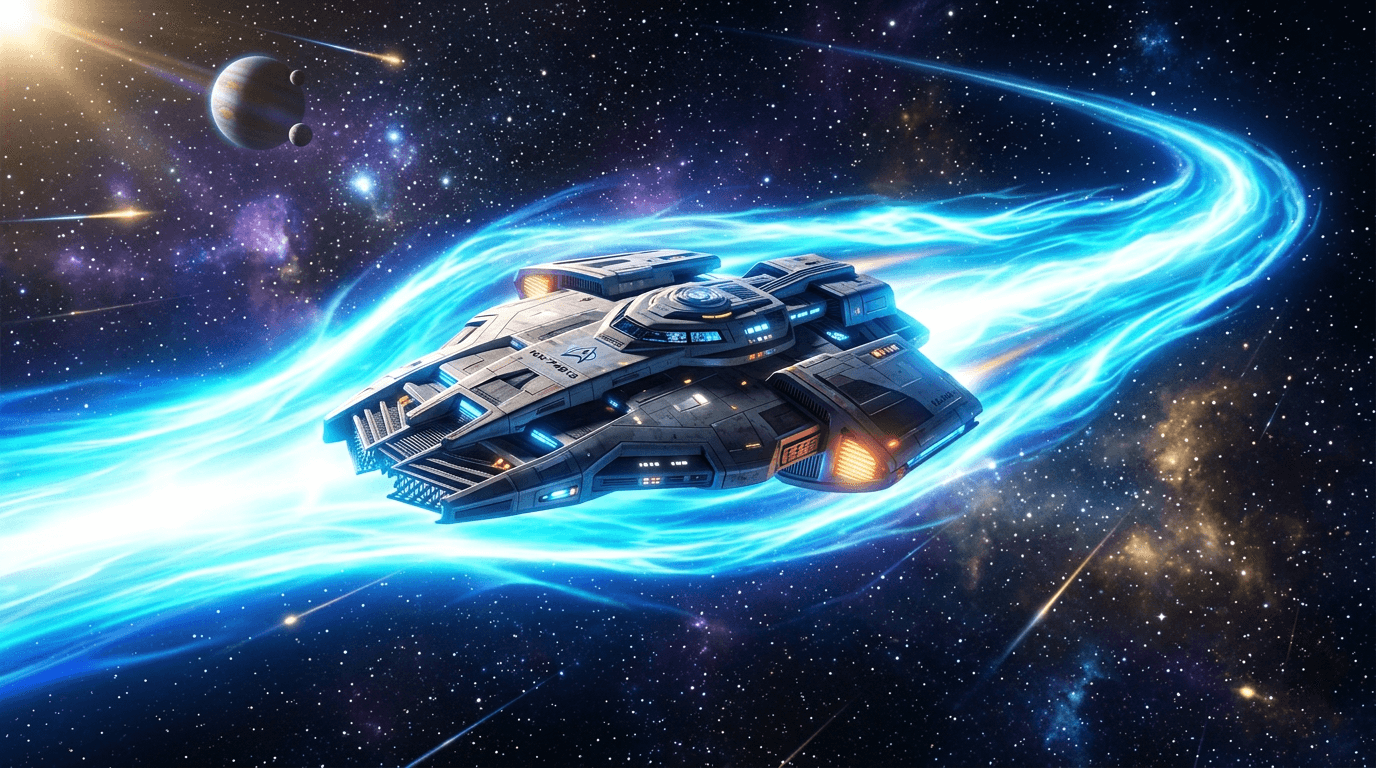
Soliton Wave Rider
The Soliton Wave Rider represents a speculative departure from conventional faster-than-light propulsion concepts, imagining a system where vessels traverse interstellar distances by riding sustained compression waves through subspace rather than generating their own warp fields. In this framework, massive planetary-scale emitters generate a self-sustaining soliton wave—a solitary wave packet that maintains its shape and energy profile across vast distances without dispersing. The ship itself requires only minimal onboard systems: specialized field generators that create a coupling interface with the wave's compression gradient, positioning equipment to maintain optimal alignment within the wave structure, and emergency systems for catastrophic scenarios. This approach draws conceptual inspiration from real physics phenomena like optical solitons in fiber optics and oceanic rogue waves, though extending such principles to hypothetical subspace mechanics remains firmly in the realm of speculative fiction. The fundamental appeal lies in dramatically reducing the mass and energy requirements aboard individual vessels, potentially transforming the economics of interstellar commerce in narrative scenarios where such technology exists.
Within science fiction frameworks and speculative strategic planning, the Soliton Wave Rider serves as a thought experiment about infrastructure-dependent transportation paradigms. Unlike self-contained warp-capable vessels that represent individual technological sovereignty, this system creates dependencies on fixed planetary installations—raising questions about control, access, and the political economy of interstellar travel. The concept appears in discussions about how civilizations might optimize resource allocation, concentrating expensive wave-generation technology at major hubs rather than duplicating it across every vessel. This infrastructure model parallels historical transitions in terrestrial transportation, from individual sailing vessels to railroad networks requiring extensive fixed infrastructure. The technology also introduces narrative constraints that drive dramatic tension: ships committed to a wave trajectory cannot easily abort or divert, wave instabilities can escalate into catastrophic energy buildups threatening both vessel and destination, and the requirement for reception facilities at endpoints creates strategic vulnerabilities. These limitations make the concept particularly useful in scenario planning exercises exploring the trade-offs between efficiency and flexibility in hypothetical transportation networks.
From a plausibility perspective, the Soliton Wave Rider concept requires multiple speculative assumptions that currently lack experimental foundation. Real soliton waves exist in various physical systems—from water channels to optical fibers to plasma physics—but extending this to a hypothetical "subspace" medium assumes the existence of physics beyond current standard models. The notion that such waves could maintain coherence across light-years contradicts our understanding of wave dispersion, though proponents of the fictional technology might invoke exotic properties of the imagined subspace medium. The energy requirements for planetary-scale wave generation would presumably be astronomical, raising questions about whether the infrastructure investment could ever justify the per-vessel savings. Critical constraints include the apparent impossibility of mid-journey course corrections, the catastrophic failure modes associated with wave instability, and the vulnerability of depending on reception infrastructure at destinations. For this concept to move from pure fiction toward even theoretical consideration, fundamental breakthroughs would be required in our understanding of spacetime structure, the discovery of manipulable extra-dimensional frameworks, and experimental demonstration of sustained soliton-like phenomena in exotic media. Until such developments emerge, the Soliton Wave Rider remains a creative narrative device for exploring infrastructure-dependent transportation paradigms rather than a near-term technological prospect.
Research this in Signals
Signals turns a topic into a sourced research record you can inspect and rerun. Your first scan is free, and this one starts with Soliton Wave Rider already loaded, so edit it or scan as is.