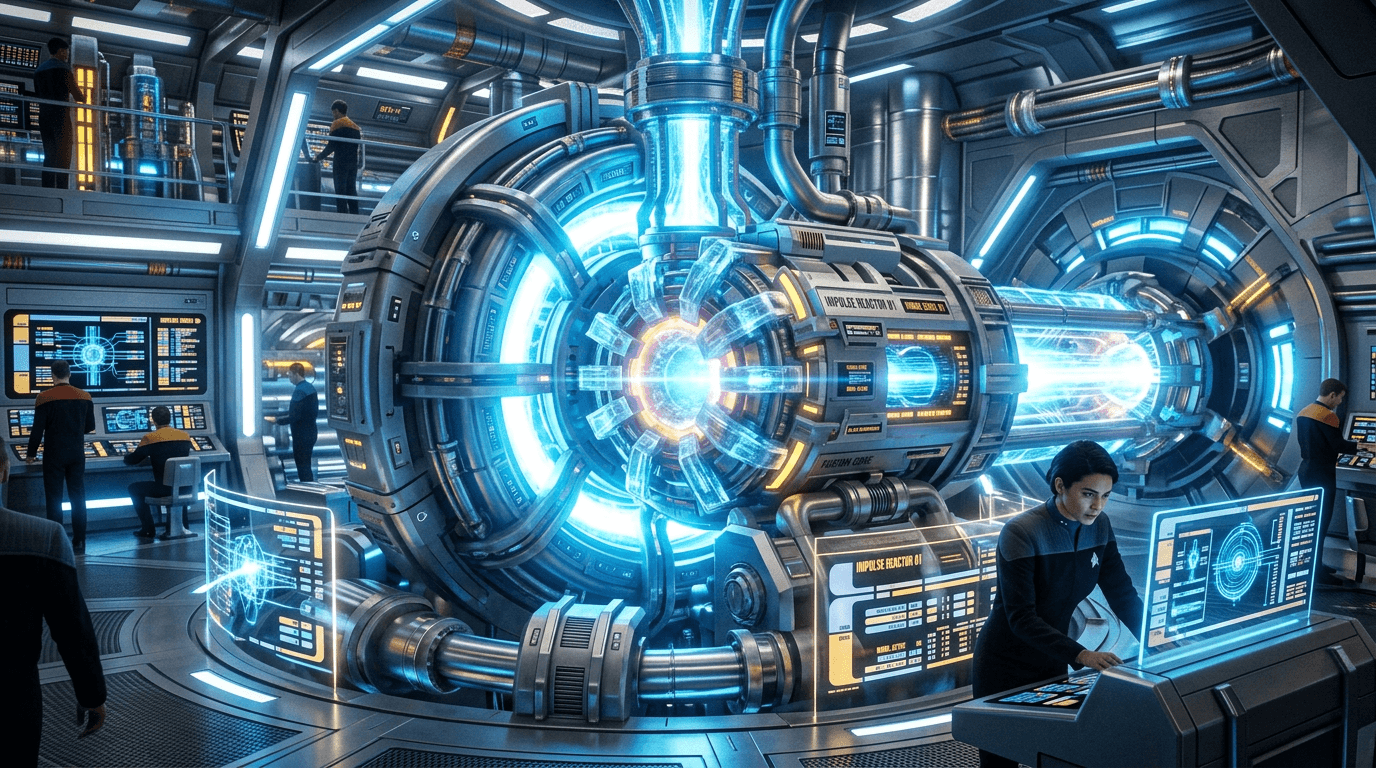
Impulse Drive
The impulse drive represents a speculative propulsion architecture that bridges conventional chemical rockets and faster-than-light systems in science fiction narratives. Unlike warp drives that theoretically manipulate spacetime, impulse systems work within established physics by harnessing fusion reactions—typically deuterium-based or matter-antimatter annihilation in more advanced variants—to expel reaction mass at extreme velocities. The concept assumes breakthroughs in magnetic confinement, direct energy conversion, and thermal management that would allow sustained fusion burns over extended periods. In fictional depictions, these drives accelerate starships to substantial fractions of light speed, often cited as 0.25c to 0.75c, making them practical for interplanetary travel within a solar system while avoiding the complexity or energy requirements of superluminal technologies. The engineering challenge centers on achieving thrust-to-weight ratios sufficient for tactical maneuvering while managing the enormous power outputs involved.
Within speculative military and exploration scenarios, impulse drives serve critical narrative and strategic functions. They enable responsive positioning during orbital operations, planetary approaches, and combat engagements where instantaneous warp jumps would be tactically unsound or physically impossible near gravitational wells. This creates dramatic tension in fictional contexts, as vessels must balance speed against fuel consumption, structural stress, and the relativistic effects that emerge at higher velocities. Real-world fusion propulsion research, including projects exploring magnetic confinement fusion rockets and pulsed plasma systems, provides conceptual anchors for these narratives. Organizations studying advanced propulsion have examined fusion-based architectures as potential solutions for deep-space missions, though current experimental reactors remain far from the power densities and efficiency levels depicted in fiction. The impulse drive concept also introduces the need for relativistic compensation systems—fictional technologies that counteract time dilation, inertial effects, and mass increase as velocities approach light speed, elements that add technical verisimilitude to storytelling.
The plausibility of impulse-class propulsion hinges on resolving formidable engineering barriers that remain largely theoretical. Sustained fusion reactions with net energy gain have proven elusive in terrestrial laboratories, and scaling such systems for spacecraft propulsion would require revolutionary advances in materials science, energy storage, and waste heat rejection. The relativistic compensation mechanisms frequently mentioned in fiction have no counterpart in known physics; special relativity's effects cannot be "compensated" but only accommodated through mission planning and automated systems. Nevertheless, the impulse drive concept usefully explores the middle ground between chemically-limited rockets and purely speculative warp technologies. As fusion energy research progresses and concepts like magnetic nozzles and direct fusion drives receive continued study, elements of the impulse drive framework may inform actual mission architectures for interplanetary travel, even if the dramatic acceleration profiles and tactical agility of fictional systems remain beyond practical reach for the foreseeable future.
Research this in Signals
Signals turns a topic into a sourced research record you can inspect and rerun. Your first scan is free, and this one starts with Impulse Drive already loaded, so edit it or scan as is.