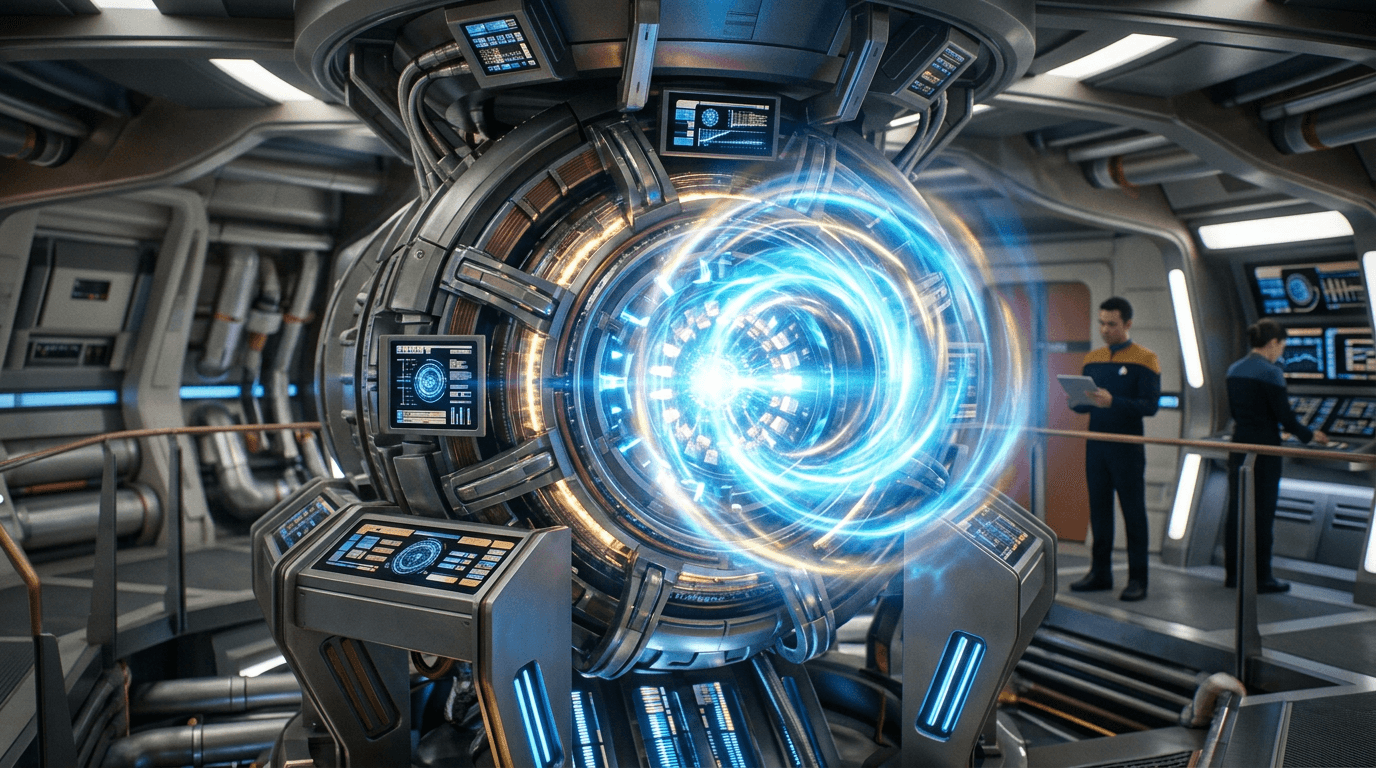
Quantum Slipstream Drive
The quantum slipstream drive represents one of the most ambitious theoretical propulsion concepts in speculative physics, building on hypothetical extensions of quantum field theory and exotic spacetime geometries. Unlike conventional warp drive concepts that compress and expand spacetime around a vessel, slipstream technology is imagined to create a self-sustaining quantum tunnel through a hypothetical substrate called subspace—a lower-energy dimensional manifold theorized to exist beneath normal spacetime. The drive system would generate an intense, highly focused quantum field that effectively "parts" this substrate, creating a temporary corridor of reduced spacetime resistance. The vessel would then surf along the boundary layer of this tunnel, achieving velocities that could theoretically exceed conventional warp speeds by a factor of twenty or more. This mechanism draws conceptual inspiration from real quantum tunneling phenomena observed at subatomic scales, though extrapolating such effects to macroscopic spacecraft remains purely speculative. The drive's operation would require extraordinary energy densities and precise field geometries, with even minor fluctuations potentially collapsing the slipstream corridor or ejecting the vessel into unpredictable regions of spacetime.
In science fiction narratives, quantum slipstream drives serve as a narrative device for exploring the tension between technological ambition and operational risk. The technology appears in scenarios where civilizations push beyond established propulsion limits, often with mixed results that highlight the dangers of experimental systems deployed before full understanding is achieved. This reflects broader themes in speculative fiction about the costs of rapid technological advancement and the hubris of assuming mastery over fundamental physics. From a strategic perspective, such a capability would revolutionize interstellar logistics, military response times, and exploration timelines, compressing galactic-scale distances into manageable journey durations. However, the technology's inherent instability—requiring constant real-time adjustments to maintain tunnel coherence—introduces vulnerability that balances its extraordinary speed advantage. Real-world research into exotic propulsion concepts, including studies of the Alcubierre metric and theoretical investigations into extra dimensions, provides distant conceptual anchors for such speculation, though none suggest practical implementation pathways for slipstream-like systems.
The plausibility of quantum slipstream technology hinges on multiple unverified assumptions about the nature of spacetime and quantum mechanics at cosmic scales. Current physics offers no evidence for a subspace substrate, and the energy requirements for manipulating spacetime at the scales described would likely exceed anything achievable with known or foreseeable power generation methods. The concept assumes that quantum tunneling principles—well-established at atomic scales—could somehow scale up to affect entire spacecraft and the surrounding spacetime geometry, a leap unsupported by theoretical frameworks. Navigation challenges depicted in fictional treatments reflect genuine concerns about any hypothetical faster-than-light system: without faster-than-light sensors to probe the path ahead, maintaining course stability would be extraordinarily difficult. For such technology to move from pure speculation toward theoretical possibility, fundamental breakthroughs would be required in our understanding of quantum gravity, the dimensional structure of spacetime, and the relationship between quantum mechanics and general relativity. Until such advances emerge, quantum slipstream drives remain firmly in the realm of narrative exploration rather than engineering development, serving as thought experiments about the ultimate limits of propulsion technology and the challenges any civilization might face when attempting to transcend the conventional boundaries of spacetime travel.
Research this in Signals
Signals turns a topic into a sourced research record you can inspect and rerun. Your first scan is free, and this one starts with Quantum Slipstream Drive already loaded, so edit it or scan as is.