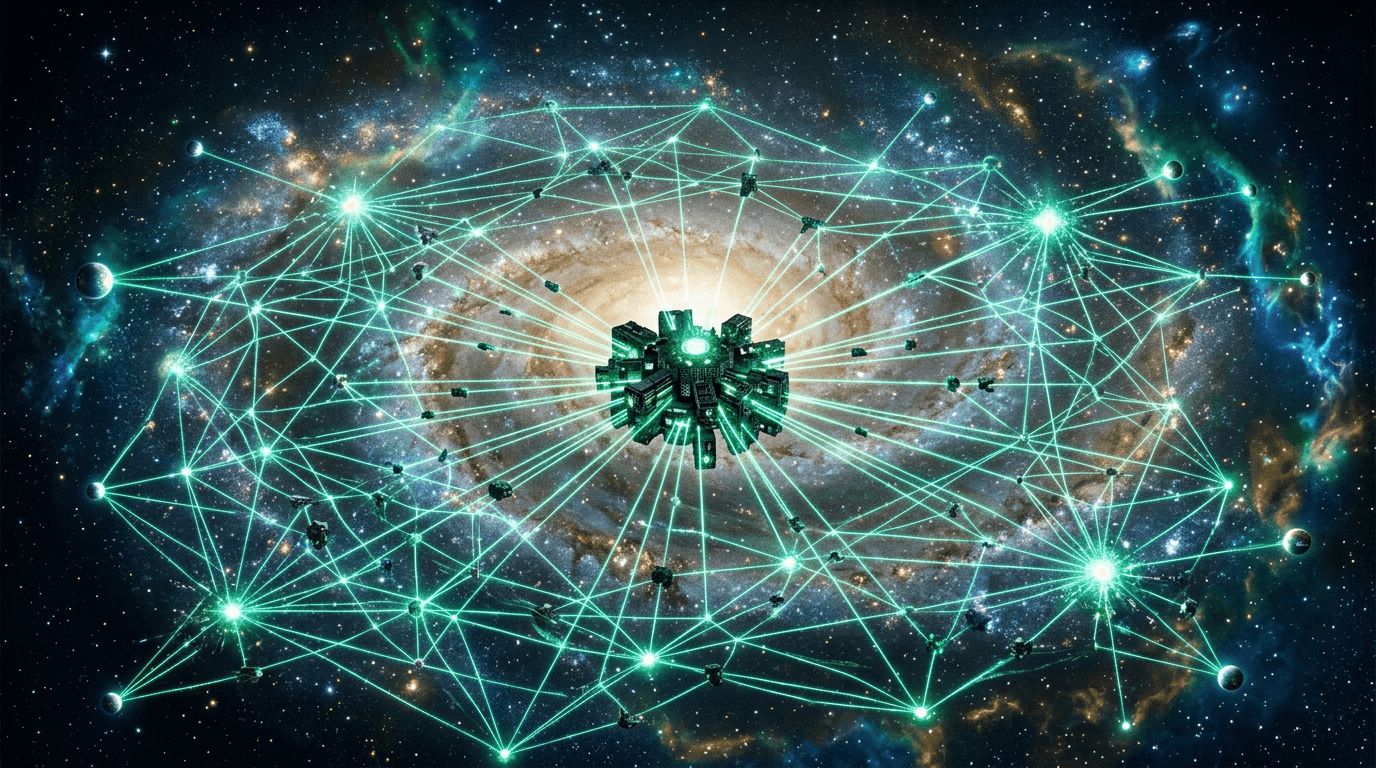
Borg Hive Mind / Subspace Network
The Borg Hive Mind represents one of science fiction's most ambitious conceptualizations of distributed consciousness—a galaxy-spanning communications infrastructure that enables instantaneous coordination among millions of cybernetic drones across vast interstellar distances. In the Star Trek universe, this network is portrayed as operating through subspace, a fictional domain that permits faster-than-light information transfer without violating relativistic constraints in normal space. The system allegedly employs quantum-entangled relay stations and sophisticated carrier wave technologies that far exceed conventional Federation communication capabilities. Each Borg drone functions simultaneously as both receiver and transmitter, creating a self-reinforcing mesh network where thoughts, sensory data, and tactical information flow seamlessly between nodes. This architecture eliminates traditional command hierarchies—instead of orders cascading down a chain of command, the collective consciousness emerges from the aggregated processing of all connected minds, with the Borg Queen serving as a focal point rather than a singular controller.
Within narrative frameworks, the Hive Mind serves as the ultimate expression of collectivism over individualism, exploring philosophical questions about identity, autonomy, and the nature of consciousness itself. The concept has influenced discussions in distributed computing, swarm intelligence research, and network theory, even as it remains firmly in the realm of speculative fiction. Real-world research into brain-computer interfaces, neural networks, and quantum communication explores adjacent territories—scientists have demonstrated rudimentary brain-to-brain interfaces over internet connections, and quantum entanglement has enabled secure communication channels, though not faster-than-light data transfer. The military and commercial sectors continue investigating mesh networks and distributed decision-making systems that could coordinate autonomous vehicles or robotic swarms, though these operate through conventional electromagnetic signals with inherent speed-of-light delays.
The fundamental barrier separating fictional Hive Mind technology from physical reality remains the light-speed limit imposed by relativity. Quantum entanglement, despite popular misconceptions, cannot transmit information faster than light—measuring one entangled particle doesn't allow instantaneous communication to its partner. Any galaxy-spanning consciousness would face coordination delays measured in years or millennia unless some currently unknown physics permits superluminal information transfer. The concept also raises profound questions about data bandwidth, processing architecture, and the nature of subjective experience—could millions of perspectives truly merge into coherent thought, or would the system fragment into competing sub-networks? While subspace remains a narrative device rather than established science, the Borg Hive Mind continues to inspire researchers exploring the theoretical limits of networked intelligence, distributed cognition, and the potential futures of human-machine integration. The plausibility of such technology would require revolutionary breakthroughs in fundamental physics, neuroscience, and information theory that currently exist only in speculative frameworks.
Research this in Signals
Signals turns a topic into a sourced research record you can inspect and rerun. Your first scan is free, and this one starts with Borg Hive Mind / Subspace Network already loaded, so edit it or scan as is.