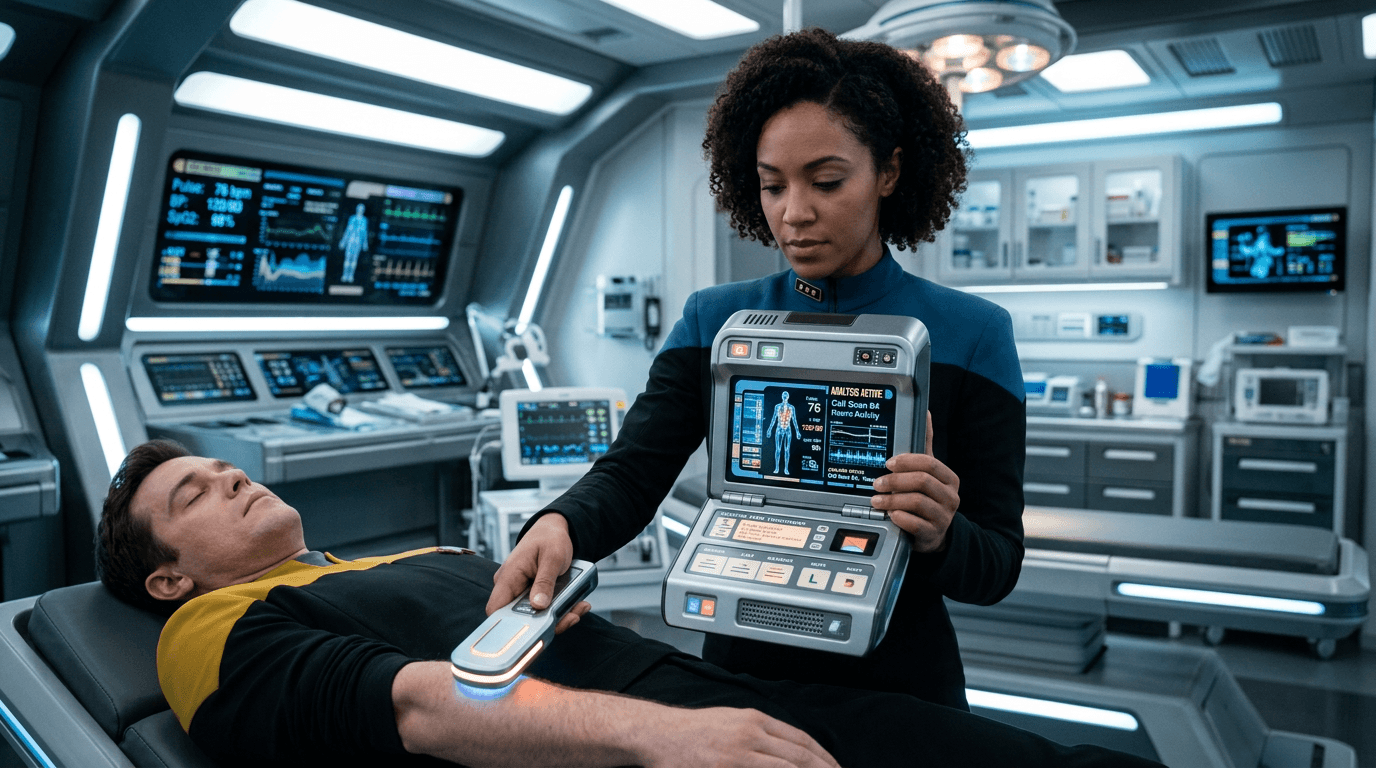
Medical Tricorder
The medical tricorder represents a convergence of multiple diagnostic technologies into a single handheld device capable of performing comprehensive biological analysis without invasive procedures. In its most ambitious fictional form—popularized by Star Trek—the device combines biosensors, molecular scanners, and computational analysis to detect everything from viral infections to internal injuries within seconds. The conceptual mechanics involve non-invasive scanning technologies that could theoretically include advanced spectroscopy, electromagnetic field detection, chemical vapor analysis, and possibly quantum sensing to map physiological states at cellular or molecular resolution. While no current device matches this fictional capability, the concept has inspired decades of research into miniaturized diagnostics, with real-world efforts focusing on integrating multiple sensor types—such as pulse oximetry, electrocardiography, and bioimpedance measurement—into increasingly compact form factors. The fundamental challenge lies in achieving comprehensive diagnostic accuracy without direct tissue sampling or imaging equipment that currently requires substantial infrastructure.
Within medical futures discourse and technology development roadmaps, the tricorder concept serves as an aspirational benchmark for point-of-care diagnostics, particularly in resource-limited settings, emergency response, and space exploration scenarios. Research initiatives have explored various pathways toward tricorder-like functionality, including breath analysis for metabolic markers, optical sensors for blood chemistry, and acoustic imaging for internal assessment. The concept addresses critical healthcare challenges: reducing diagnostic delays, enabling medical care in remote locations, and decreasing reliance on centralized laboratory infrastructure. Defense and space agencies have shown particular interest in portable diagnostics that could support personnel in extreme environments where traditional medical facilities are unavailable. The narrative appeal extends beyond pure functionality to represent democratized medical knowledge—a device that could theoretically make expert-level diagnosis accessible to non-specialists, though this raises important questions about medical decision-making, liability, and the irreplaceable value of clinical judgment.
Current scientific understanding suggests that while individual diagnostic capabilities continue advancing rapidly, true tricorder functionality faces substantial constraints. Non-invasive detection of specific pathogens, toxins, or cellular abnormalities remains extremely challenging without direct sampling, as biological signals must penetrate skin and tissue while maintaining sufficient specificity to distinguish between thousands of potential conditions. Machine learning approaches show promise in pattern recognition across multiple sensor inputs, but training such systems requires vast datasets linking sensor readings to confirmed diagnoses. Regulatory frameworks for medical devices also present barriers, as comprehensive diagnostic claims require extensive clinical validation. Near-term plausibility centers on devices that excel at specific diagnostic tasks—such as detecting particular infectious diseases or monitoring chronic conditions—rather than universal scanning. Significant breakthroughs in quantum sensing, advanced spectroscopy, or entirely novel detection principles would be necessary to approach the fictional device's capabilities. The concept remains valuable as a design goal that drives incremental progress toward faster, more accessible, and less invasive diagnostic tools, even if the complete vision remains speculative.
Research this in Signals
Signals turns a topic into a sourced research record you can inspect and rerun. Your first scan is free, and this one starts with Medical Tricorder already loaded, so edit it or scan as is.