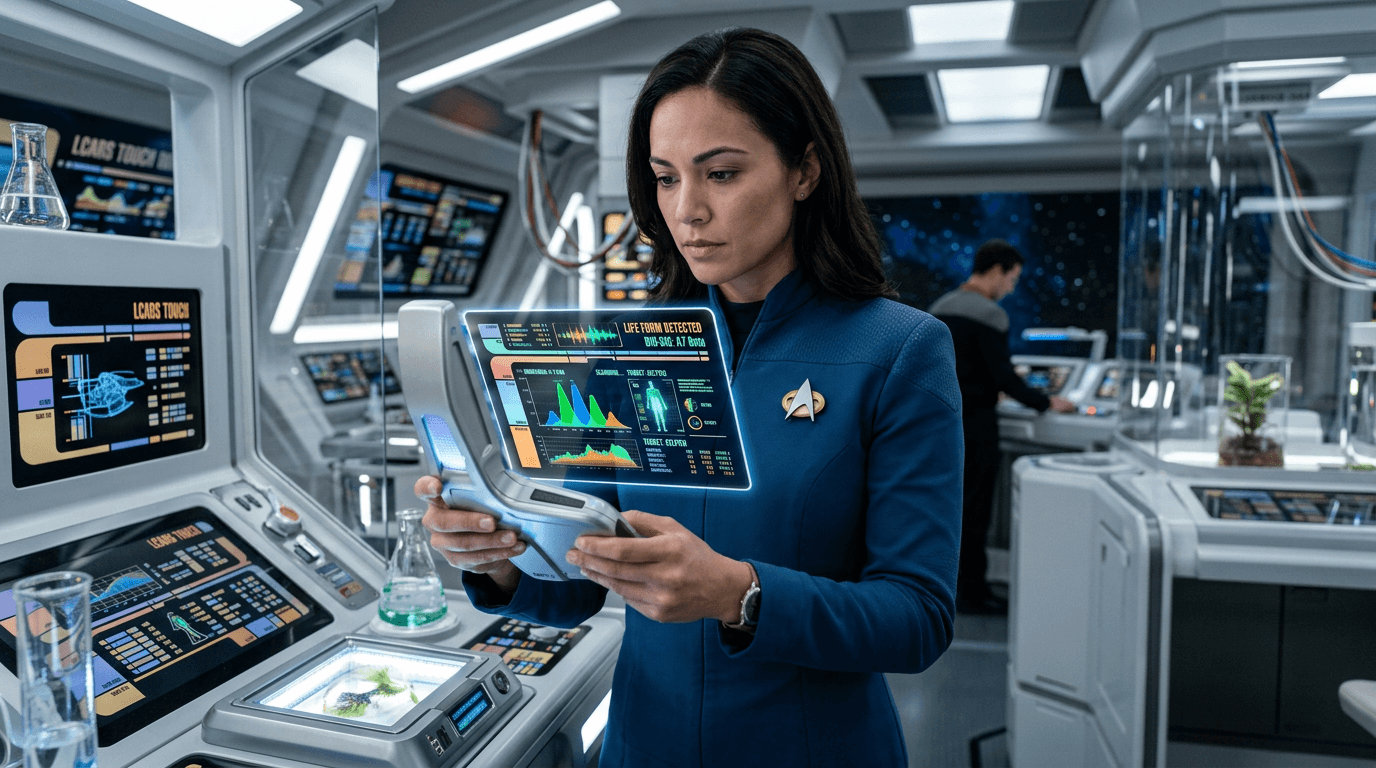
Bio-Signature Scanner
Bio-signature scanners represent a convergence of multiple sensing modalities into integrated systems designed to detect, classify, and track living organisms through their distinctive biological markers. The conceptual framework draws from real-world biosensor technology, thermal imaging, and electromagnetic field detection, extrapolating these capabilities to science fiction scenarios where instantaneous life detection across barriers becomes routine. In fictional narratives, these devices typically combine infrared spectroscopy to identify metabolic heat patterns, electromagnetic sensors tuned to detect neural activity and bioelectric fields, and chemical analyzers capable of recognizing organic compounds or atmospheric disturbances caused by respiration. Some speculative designs incorporate quantum entanglement principles or subspace field detection to explain their ability to penetrate solid matter—mechanisms that remain firmly in the realm of narrative convenience rather than established physics. The technology assumes that all life forms generate detectable signatures across multiple spectra simultaneously, creating unique "fingerprints" that sophisticated pattern-matching algorithms can isolate and classify even in complex environments.
Within science fiction storytelling, bio-signature scanners serve critical dramatic and operational functions that justify their ubiquity across space exploration narratives. They enable rapid threat assessment in unknown environments, facilitate rescue operations by locating survivors through debris or planetary crust, and provide non-invasive population surveys for xenobiological research. The technology appears prominently in military and security contexts, where distinguishing friend from foe or detecting concealed adversaries becomes paramount. Real-world parallels exist in thermal imaging for search and rescue, environmental DNA sampling for biodiversity assessment, and medical diagnostic tools that detect biomarkers in breath or skin emissions. Current research in standoff detection technologies explores chemical sensing at distance, while synthetic biology advances our understanding of universal metabolic signatures that might theoretically be detectable. However, the fictional capability to instantly differentiate thousands of species or track individual organisms through meters of rock vastly exceeds anything approaching near-term feasibility.
The plausibility of bio-signature scanning depends heavily on which specific capabilities are claimed and the physical barriers involved. Detecting large-scale thermal signatures or atmospheric chemical changes associated with biological activity represents straightforward extensions of existing technology. The more challenging assumptions involve penetrating dense materials without massive power requirements, achieving species-level identification without extensive reference databases, and maintaining sensitivity across the enormous range of potential biochemistries that alien life might employ. Fundamental physics constrains electromagnetic penetration through conductive materials, while quantum mechanics limits the precision with which biological processes can be remotely characterized without direct sampling. For bio-scanners to approach their fictional capabilities, breakthroughs would be needed in metamaterial sensor arrays, quantum sensing technologies, and computational biology sufficient to model biosignatures from first principles rather than empirical catalogs. The most scientifically defensible applications remain atmospheric analysis for biosignature gases, thermal mapping for large organism detection, and perhaps electromagnetic sensing of neural activity at close range—capabilities that might prove valuable for robotic exploration missions or disaster response, even if the tricorder-style universal life detector remains speculative.
Research this in Signals
Signals turns a topic into a sourced research record you can inspect and rerun. Your first scan is free, and this one starts with Bio-Signature Scanner already loaded, so edit it or scan as is.