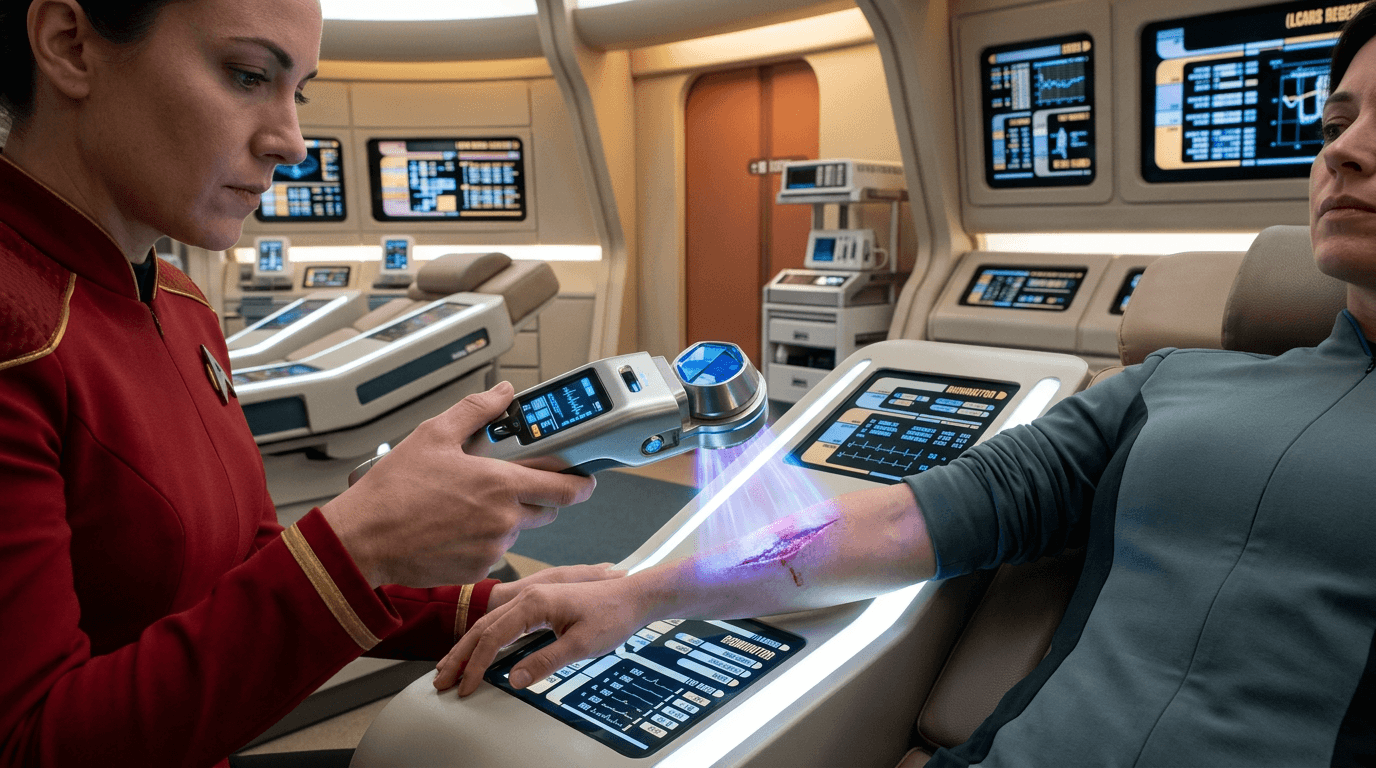
Dermal Regenerator
The dermal regenerator represents a speculative medical technology designed to accelerate wound healing through directed energy fields that stimulate cellular regeneration at rates far exceeding natural biological processes. As imagined in science fiction narratives, the device emits a controlled bio-field or targeted energy beam that interacts with damaged tissue at the cellular level, triggering rapid mitosis and organized tissue reconstruction. The theoretical mechanism assumes the ability to precisely modulate cellular growth factors, guide stem cell differentiation, and coordinate the complex biochemical cascades involved in wound healing—all within a compact, handheld form factor. This concept extends beyond current medical capabilities by proposing near-instantaneous tissue repair without scarring, suggesting a level of control over cellular processes that remains firmly in the realm of speculation. The device's purported ability to calibrate for different biochemistries implies an advanced understanding of comparative physiology and real-time tissue analysis that would require breakthroughs in biosensing, computational biology, and energy delivery systems.
Within science fiction narratives, the dermal regenerator serves as a crucial plot device that enables characters to recover from injuries that would otherwise incapacitate them, maintaining narrative momentum while acknowledging physical vulnerability. Its ubiquity in fictional medical kits reflects optimistic assumptions about future healthcare accessibility and the miniaturization of complex medical interventions. The concept resonates with real-world research directions in regenerative medicine, including work on growth factor therapies, electrical stimulation of wound healing, and tissue engineering scaffolds. Current medical technologies such as low-level laser therapy, ultrasound-assisted wound healing, and platelet-rich plasma treatments represent early steps toward accelerated healing, though they operate on timescales of days or weeks rather than minutes. The dermal regenerator's fictional portrayal also raises strategic questions about medical logistics in remote or resource-limited environments, where such technology would theoretically reduce the need for extensive surgical facilities and lengthy recovery periods.
The plausibility of dermal regenerators hinges on several unresolved scientific challenges. While researchers have demonstrated that electrical fields, specific wavelengths of light, and biochemical signals can influence healing rates, the coordinated acceleration of all healing phases—hemostasis, inflammation, proliferation, and remodeling—remains beyond current capabilities. Scar-free healing in adult humans would require preventing fibrotic tissue formation while maintaining structural integrity, a balance that natural biology achieves only in fetal development. The energy requirements for such rapid cellular activity would likely generate significant heat, creating thermal management challenges in a handheld device. Advances in bioelectric medicine, optogenetics, and our understanding of cellular signaling networks could incrementally move toward controlled tissue regeneration, but the minute-scale healing depicted in fiction would require revolutionary breakthroughs in energy delivery, cellular control mechanisms, and real-time biological feedback systems that currently exist only in speculative frameworks.
Research this in Signals
Signals turns a topic into a sourced research record you can inspect and rerun. Your first scan is free, and this one starts with Dermal Regenerator already loaded, so edit it or scan as is.