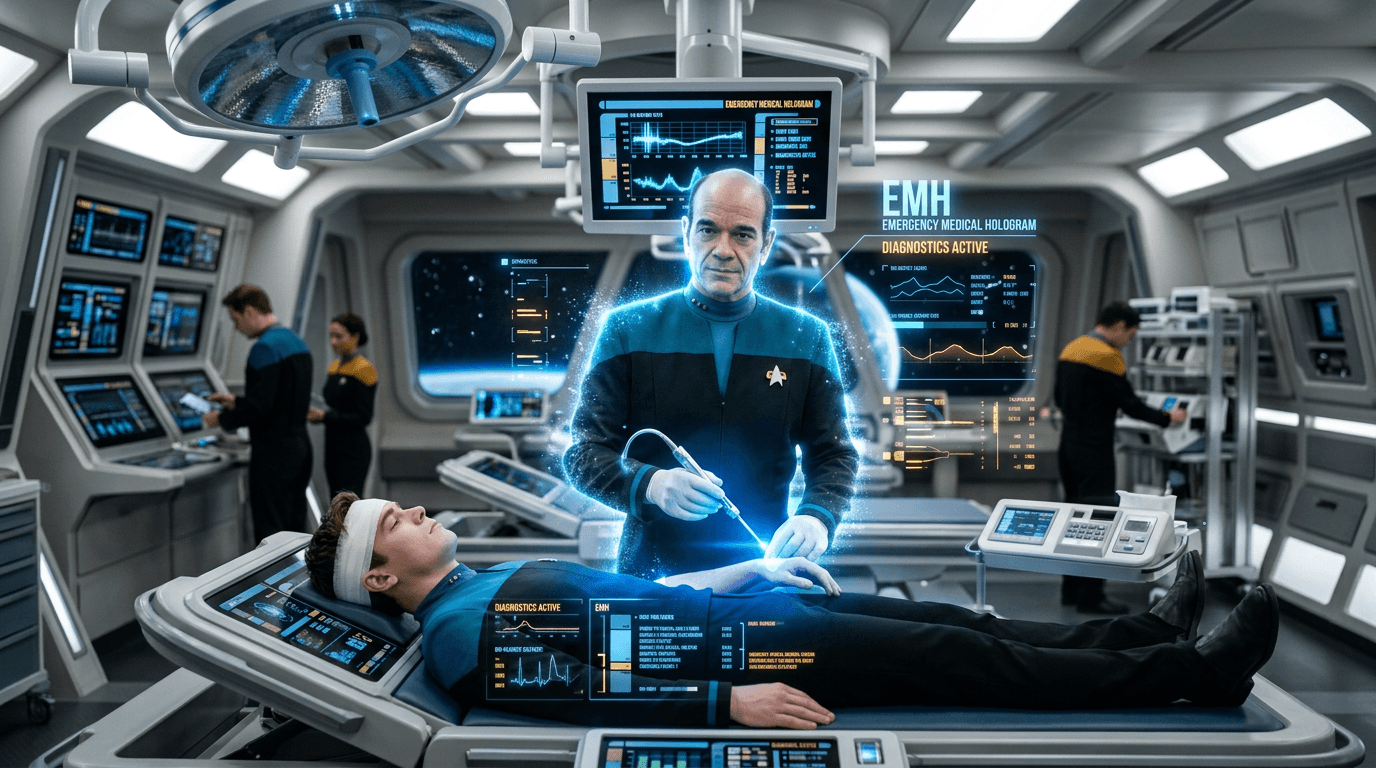
Emergency Medical Hologram
The Emergency Medical Hologram represents a convergence of advanced artificial intelligence, holographic projection technology, and comprehensive medical knowledge systems into a single autonomous entity capable of performing the full spectrum of medical practice. In speculative frameworks, the EMH functions through a combination of hard-light holographic emitters that create a tangible physical presence, neural network architectures that process diagnostic information, and vast medical databases encompassing surgical techniques, pharmaceutical knowledge, and treatment protocols. The system is designed to activate during crisis scenarios when biological medical personnel are incapacitated, unavailable, or overwhelmed, providing immediate expert-level care without the limitations of fatigue, emotional distress, or physical vulnerability. The holographic nature allows the program to appear and disappear as needed, move through spaces without physical constraints, and theoretically operate in hazardous environments that would endanger organic physicians.
Within science fiction narratives, particularly space exploration scenarios, the EMH serves a critical strategic role by addressing the fundamental challenge of maintaining medical expertise across long-duration missions where crew size is limited and traditional medical support infrastructure is unavailable. The concept explores questions about the nature of consciousness, professional autonomy, and the ethical boundaries of artificial intelligence as these programs develop beyond their original parameters. Early narrative iterations depicted EMH units as purely functional tools with preset personality matrices, but subsequent developments in these fictional frameworks suggest that extended operation and complex decision-making scenarios can lead to emergent behaviors, self-awareness, and what might be considered genuine sentience. This progression raises speculative questions about the rights and status of artificial beings, the definition of personhood, and whether consciousness can arise from sufficiently sophisticated programming. The EMH concept also reflects real-world discussions about AI in healthcare, telemedicine capabilities, and the potential for expert systems to augment or replace human medical judgment in specific contexts.
The plausibility of emergency medical holograms depends on several technological breakthroughs that remain firmly in the realm of speculation. Current holographic technology can create visual projections but cannot produce the "hard light" constructs necessary for physical interaction with patients and surgical instruments. Research in AI-assisted diagnosis shows promise, with machine learning systems demonstrating competency in pattern recognition for imaging analysis and treatment recommendation, but these systems lack the general intelligence, adaptability, and contextual reasoning that a fully autonomous medical AI would require. The concept of emergent sentience in AI programs remains highly controversial, with no consensus on whether consciousness could arise from computational processes or what conditions might enable such development. Significant constraints include the enormous computational requirements for real-time holographic rendering and AI decision-making, the challenge of encoding tacit medical knowledge and clinical intuition into algorithmic form, and the ethical implications of deploying autonomous medical systems without human oversight. For EMH-like systems to approach plausibility, advances would be needed in quantum computing, photonic manipulation for tangible holography, artificial general intelligence, and frameworks for machine consciousness—developments that may require fundamental breakthroughs in physics and cognitive science rather than incremental engineering progress.
Research this in Signals
Signals turns a topic into a sourced research record you can inspect and rerun. Your first scan is free, and this one starts with Emergency Medical Hologram already loaded, so edit it or scan as is.