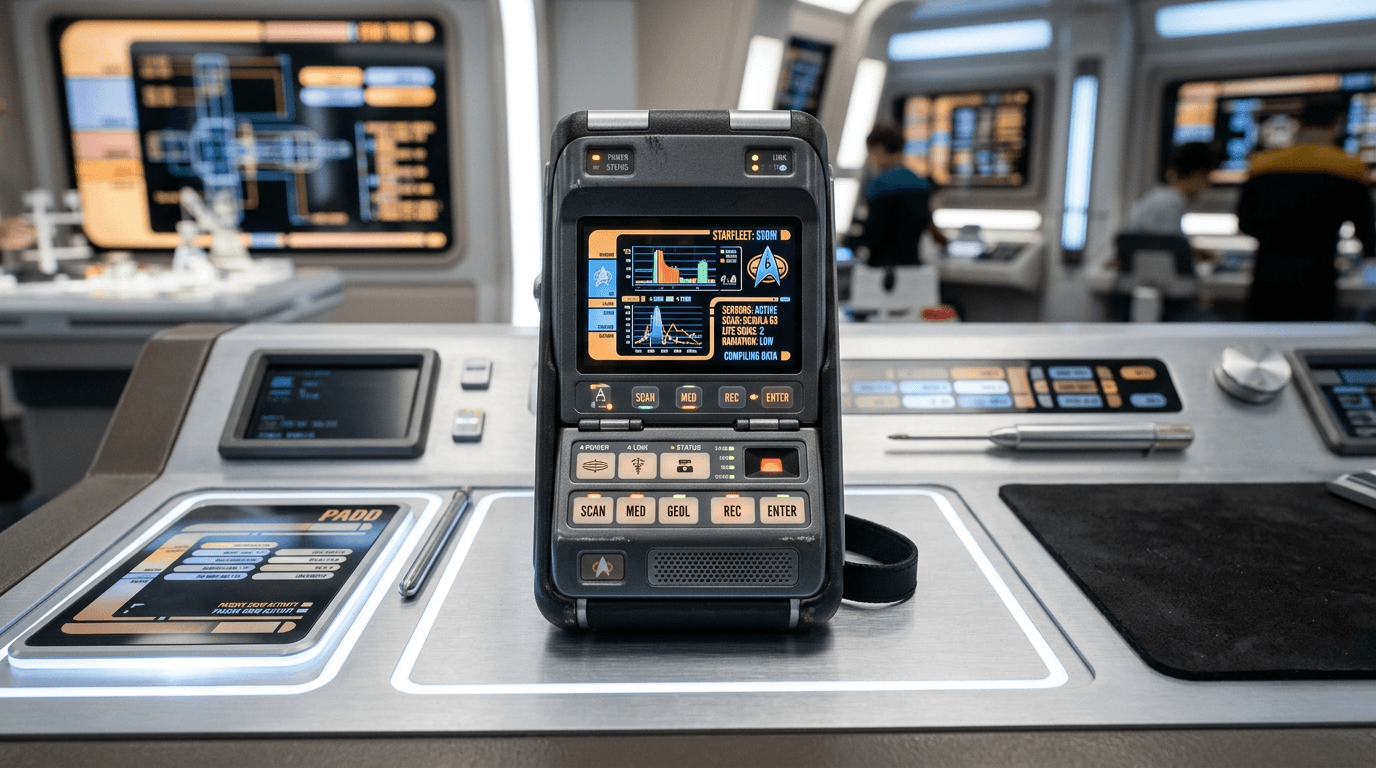
Tricorder
The tricorder represents one of science fiction's most influential conceptualizations of portable diagnostic technology—a handheld device capable of scanning, analyzing, and recording data across multiple scientific domains simultaneously. As depicted in Star Trek and similar narratives, the tricorder integrates environmental sensors, computational processing, data storage, and wireless communication into a compact form factor operable by a single user in field conditions. The device is imagined to employ advanced sensor arrays capable of detecting electromagnetic radiation, analyzing chemical compositions, measuring gravitational fields, and identifying biological signatures at a distance, all without direct physical contact with the subject. Specialized variants serve distinct functions: scientific tricorders focus on geological surveys, atmospheric analysis, and xenobiology, while medical tricorders emphasize physiological diagnostics, detecting vital signs, identifying pathogens, and even diagnosing complex medical conditions through non-invasive scanning. This conceptual versatility—combining the functions of spectrometers, medical imaging equipment, environmental monitors, and data recorders into one device—reflects an aspirational vision of technological convergence that has influenced real-world research directions.
The tricorder's narrative significance extends beyond its technical specifications to represent a broader philosophy about knowledge acquisition and scientific exploration. In storytelling contexts, it serves as an enabling device that allows characters to rapidly assess unfamiliar environments, make informed decisions under pressure, and gather intelligence without extensive laboratory infrastructure. This concept has proven particularly influential in shaping public expectations about medical diagnostics and field science, inspiring numerous research initiatives and innovation competitions aimed at developing real-world analogues. The Qualcomm Tricorder XPRIZE, for instance, explicitly challenged teams to create portable diagnostic devices capable of detecting multiple health conditions, demonstrating how fictional technologies can catalyze tangible research programs. In defense and emergency response scenarios, the tricorder concept informs requirements for next-generation portable sensing platforms that could enhance situational awareness for first responders, military personnel, and disaster assessment teams operating in challenging or hazardous environments.
Current technology offers partial realizations of tricorder functionality through increasingly sophisticated handheld devices. Smartphone-based sensors, portable spectrometers, handheld ultrasound units, and environmental monitoring devices collectively approach some imagined capabilities, though no single device integrates this breadth of sensing modalities. Fundamental constraints include the physics of miniaturization—many sensing technologies require specific geometries, sample preparation, or power consumption incompatible with truly compact form factors. Medical diagnostics particularly face challenges, as many conditions require laboratory analysis of biological samples rather than external scanning. The fictional tricorder often implies sensor technologies and computational capabilities beyond current scientific understanding, including the ability to identify unknown substances instantly or diagnose complex conditions through brief external scans. Nevertheless, advances in microelectromechanical systems, lab-on-a-chip technologies, machine learning for pattern recognition, and low-power computing suggest continued progress toward more capable portable diagnostic platforms. The tricorder's enduring appeal lies not in its literal realization but in its representation of accessible, democratized scientific capability—a vision that continues to guide research toward more integrated, portable, and user-friendly sensing technologies for both terrestrial and space exploration applications.
Research this in Signals
Signals turns a topic into a sourced research record you can inspect and rerun. Your first scan is free, and this one starts with Tricorder already loaded, so edit it or scan as is.