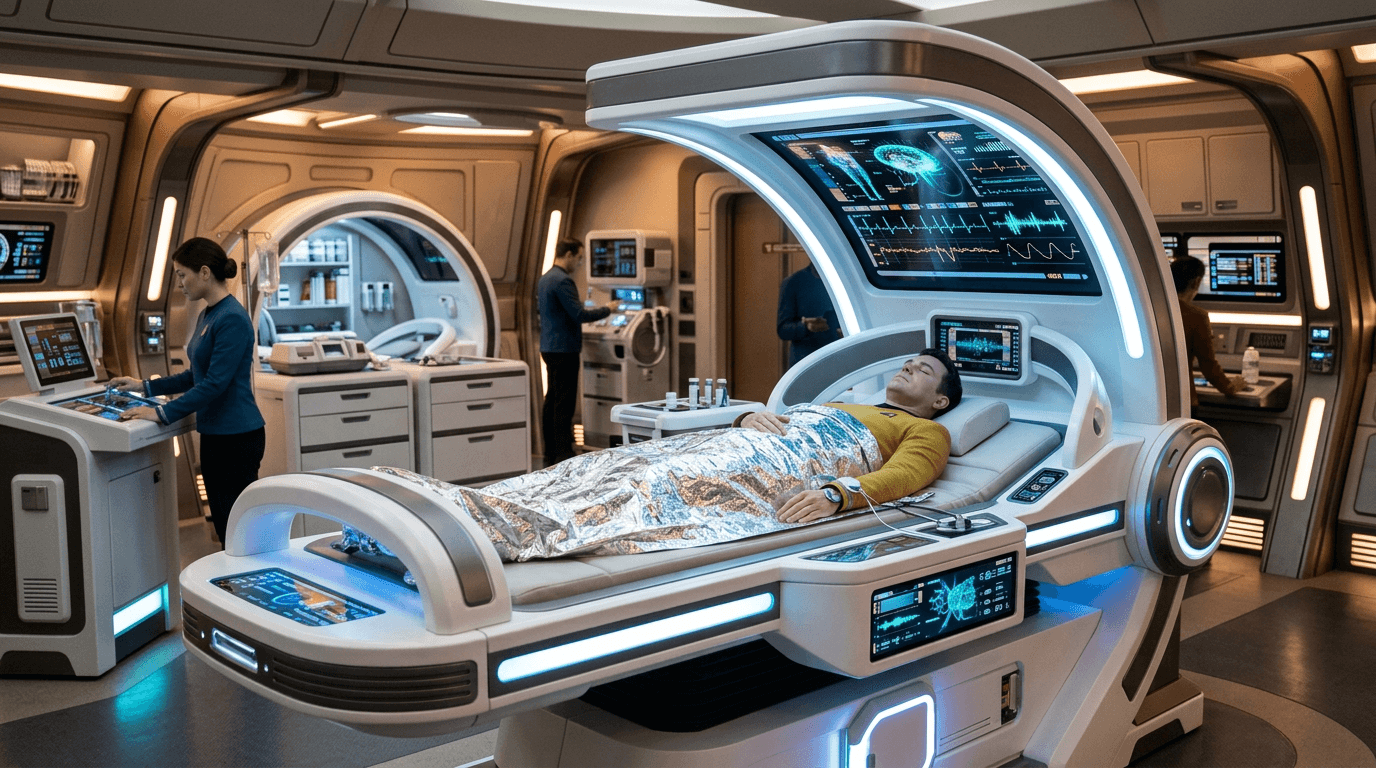
Biobed
The biobed represents a conceptual convergence of diagnostic imaging, life support, and therapeutic intervention into a single integrated medical platform. In speculative fiction, particularly Star Trek's vision of 24th-century medicine, this system is imagined to combine real-time biosensor arrays with automated treatment delivery mechanisms. The underlying concept draws from existing medical technologies—continuous patient monitoring systems, intensive care unit infrastructure, and emerging point-of-care diagnostics—but extrapolates them into a unified treatment station. Theoretically, such a system would employ non-invasive scanning technologies to assess patient physiology at molecular and cellular levels, while simultaneously maintaining critical life support functions and delivering targeted therapies. The biobed concept assumes breakthroughs in sensor miniaturisation, artificial intelligence-assisted diagnosis, and automated pharmaceutical delivery that remain largely aspirational in contemporary medicine.
Within science fiction narratives, the biobed serves as a narrative device that enables rapid medical intervention without the procedural complexity of modern healthcare. It reflects an optimistic vision of medicine where diagnostic uncertainty is minimised and treatment can be administered with precision and speed. This concept resonates with real-world research directions in telemedicine, wearable health monitoring, and closed-loop therapeutic systems that adjust treatment parameters based on continuous physiological feedback. Current medical research explores elements of this vision through smart hospital beds with integrated monitoring, robotic surgical assistance platforms, and intensive care systems that combine multiple functions. However, these remain discrete technologies rather than the seamlessly integrated treatment stations depicted in speculative scenarios.
The plausibility of biobed-like systems depends on advances across multiple domains that face substantial scientific and practical constraints. Non-invasive diagnostic technologies capable of detecting conditions at the molecular level would require sensor physics beyond current capabilities, while automated treatment systems must overcome the complexity of human physiology and the risks of algorithmic medical decision-making. Regulatory frameworks, ethical considerations around autonomous medical intervention, and the irreducible need for human clinical judgment present additional barriers. Nevertheless, incremental progress in areas such as continuous glucose monitoring, automated drug infusion systems, and AI-assisted radiology suggests a trajectory toward more integrated medical platforms. The biobed concept may be best understood not as a near-term development but as an aspirational framework that highlights the potential for medical technology to become more responsive, comprehensive, and patient-centred, even if the fully autonomous treatment station remains firmly in the realm of speculative fiction.
Research this in Signals
Signals turns a topic into a sourced research record you can inspect and rerun. Your first scan is free, and this one starts with Biobed already loaded, so edit it or scan as is.