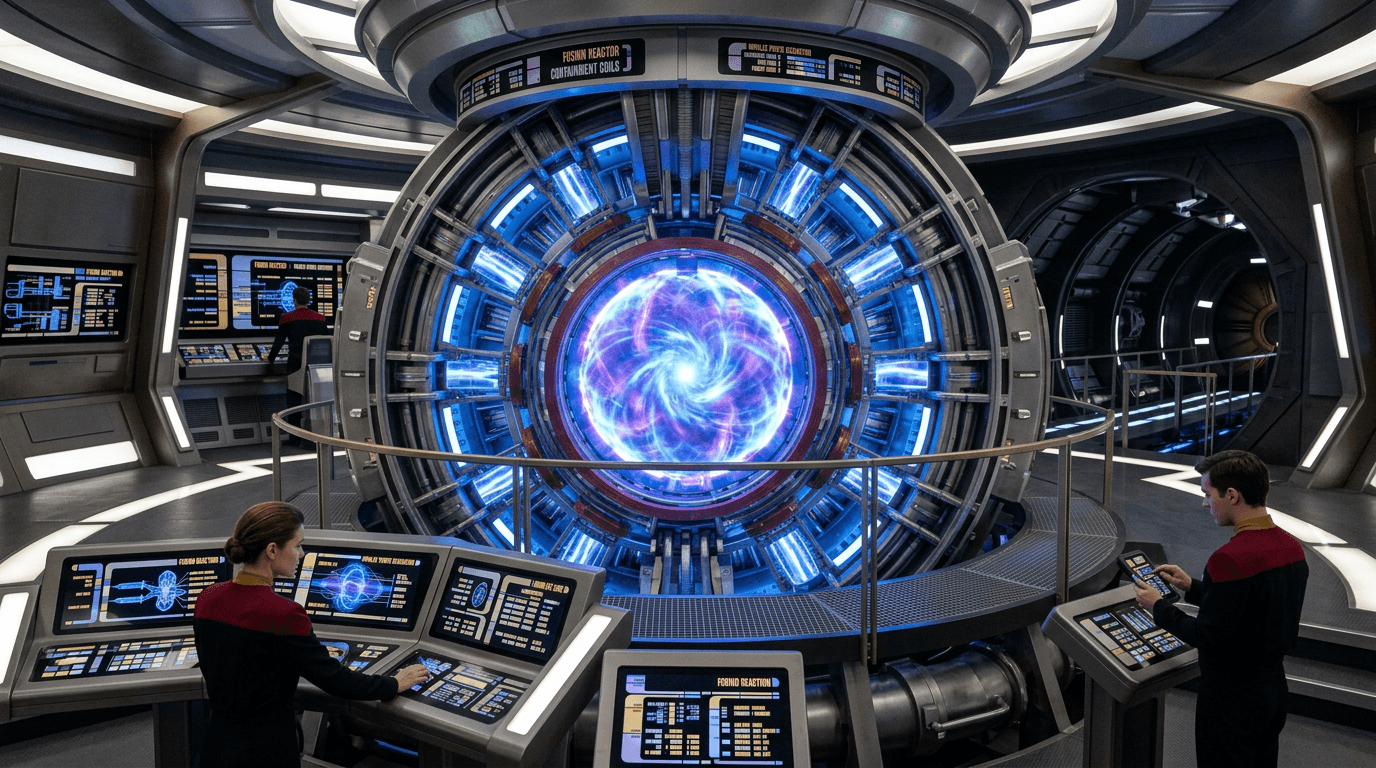
Fusion Reactor
Fusion reactors in speculative spacecraft design represent a mature evolution of controlled nuclear fusion—the process of combining lighter atomic nuclei, typically isotopes of hydrogen such as deuterium and tritium, to form heavier elements while releasing tremendous amounts of energy. Unlike contemporary experimental fusion approaches that struggle to achieve net energy gain, fictional starship reactors are imagined to have overcome the fundamental challenges of plasma confinement, sustained reaction temperatures exceeding 100 million degrees, and continuous operation. These systems theoretically employ advanced magnetic confinement or inertial confinement techniques far beyond current capabilities, maintaining stable fusion reactions that convert mass directly into usable electrical and thermal energy. The conceptual appeal lies in fusion's inherent advantages: abundant fuel sources, minimal radioactive waste compared to fission, and energy density sufficient to power systems requiring megawatts or gigawatts of continuous output.
In science fiction narratives, fusion reactors typically serve as the primary power source for sublight propulsion systems and secondary backup for more exotic faster-than-light drives. This dual-purpose role reflects strategic thinking about spacecraft energy architecture—the need for reliable, high-output power generation that can operate independently of more speculative technologies. The fictional portrayal of fusion as a solved engineering problem, with reactors running continuously for years without refueling, represents an aspirational endpoint for real-world fusion research programs that currently achieve fusion reactions lasting only seconds. Multiple redundant reactors in these narratives address failure-mode concerns familiar to aerospace engineering, ensuring that no single-point failure can disable critical ship systems. This design philosophy mirrors current practices in aviation and naval engineering, where redundancy is fundamental to safety.
The plausibility of such systems rests entirely on overcoming challenges that have eluded researchers for decades. Real-world fusion experiments like ITER and the National Ignition Facility have demonstrated fusion reactions and even brief net energy gain, but sustained, practical fusion power remains elusive. The fictional leap assumes breakthroughs in plasma physics, materials science capable of withstanding extreme neutron bombardment, and energy extraction methods far more efficient than current concepts. For fusion reactors to approach their science fiction portrayal, developments would need to include room-temperature superconductors for magnetic confinement, revolutionary heat management systems, and fuel cycles that minimize or eliminate radioactive byproducts. While the fundamental physics of fusion is well-understood, the engineering gap between laboratory demonstrations and compact, reliable starship power plants represents centuries of assumed technological progress.
Research this in Signals
Signals turns a topic into a sourced research record you can inspect and rerun. Your first scan is free, and this one starts with Fusion Reactor already loaded, so edit it or scan as is.