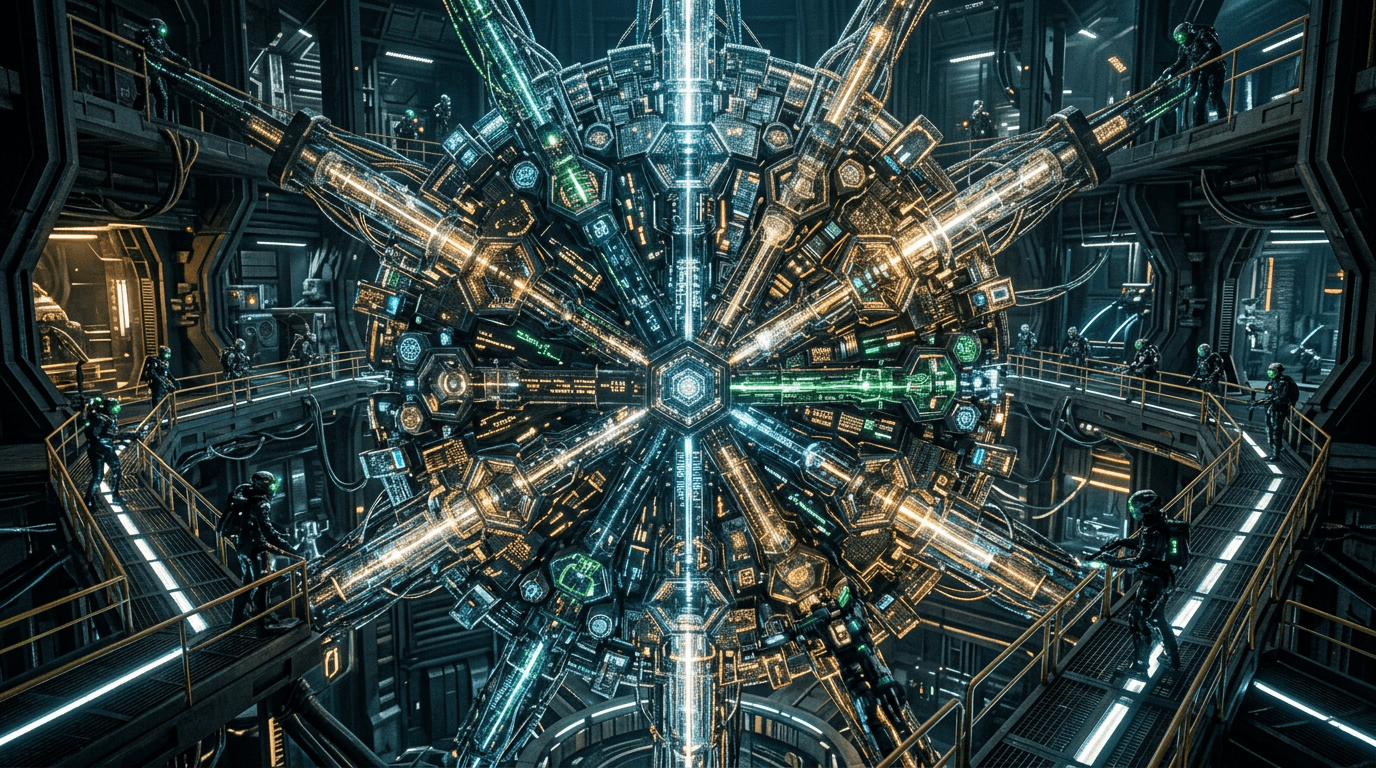
Collective Memory Core
The Collective Memory Core represents a speculative distributed intelligence architecture where individual processing nodes—in this case, cybernetic drones—maintain continuous access to a unified knowledge repository spanning an entire networked civilization. Unlike conventional databases that require queries and retrieval protocols, this concept imagines a system where information flows bidirectionally and instantaneously: every experience, technical specification, cultural artifact, and tactical observation gathered by any connected entity becomes immediately available to all others. The theoretical mechanism relies on a form of quantum entanglement or subspace communication that transcends lightspeed limitations, allowing real-time synchronization across potentially galactic distances. This architecture eliminates individual learning curves, redundant discovery, and information silos—each drone effectively inherits millennia of accumulated knowledge the moment it connects to the network.
Within science fiction narratives, the Collective Memory Core serves as both a technological marvel and a cautionary metaphor about the tension between efficiency and individuality. It appears in scenarios exploring post-scarcity information economies, hive-mind civilizations, and the potential endpoints of networked consciousness. The concept resonates with contemporary discussions about cloud computing, distributed ledger technologies, and neural interfaces, though it extrapolates far beyond current capabilities. In strategic foresight contexts, similar architectures appear in analyses of swarm robotics, where multiple autonomous units must coordinate without centralized command structures, and in speculative military doctrine examining networked warfare where individual soldiers might share tactical awareness instantaneously. The narrative power lies in examining what humanity might gain—perfect information sharing, elimination of knowledge loss—and what it might sacrifice in terms of privacy, cognitive autonomy, and the creative friction that emerges from diverse perspectives.
From a plausibility standpoint, the Collective Memory Core faces formidable constraints rooted in physics, information theory, and neuroscience. Current distributed systems struggle with consistency, latency, and bandwidth limitations even at terrestrial scales; extending such a network across interstellar distances would require communication methods that violate known physical laws or depend on speculative phenomena like traversable wormholes or quantum nonlocality at macroscopic scales. The storage requirements alone—containing detailed knowledge from thousands of civilizations—would demand data compression and indexing techniques far beyond present capabilities. Additionally, the cognitive architecture required for biological or synthetic minds to interface with such vast information stores without overwhelming processing capacity remains purely theoretical. Research in brain-computer interfaces, quantum computing, and mesh networking provides foundational concepts, but the gap between current prototypes and a galaxy-spanning shared consciousness remains vast. The concept's plausibility would increase substantially with breakthroughs in faster-than-light communication, practical quantum memory systems, and neural architectures capable of filtering relevant information from incomprehensibly large datasets without conscious effort.
Research this in Signals
Signals turns a topic into a sourced research record you can inspect and rerun. Your first scan is free, and this one starts with Collective Memory Core already loaded, so edit it or scan as is.