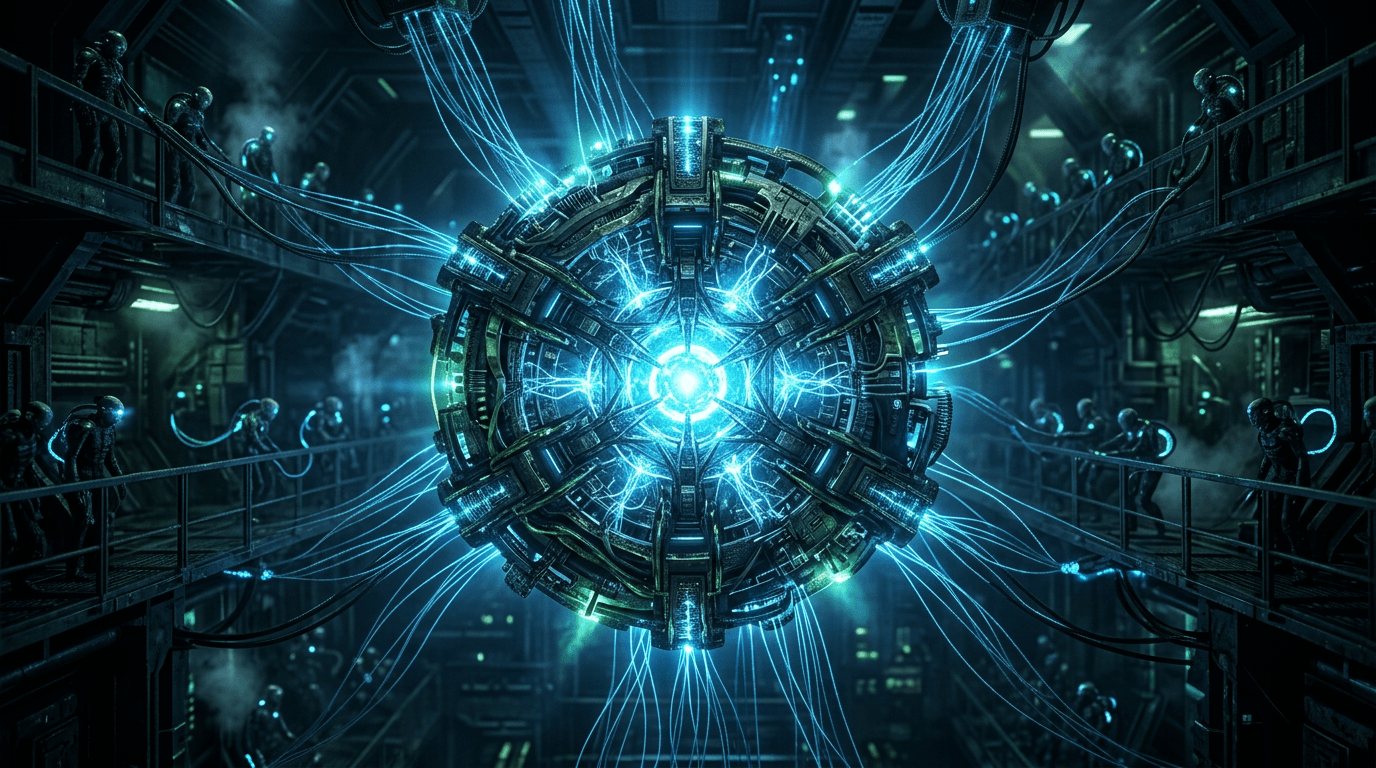
Vinculum
The Vinculum represents a conceptual architecture for distributed consciousness management within the fictional Borg Collective of Star Trek. Imagined as both software and specialized hardware, it functions as a central processing nexus that receives, harmonizes, and redistributes the neural patterns of thousands or millions of connected drones across a vessel or spatial region. The system operates through a continuous cycle of data aggregation and transmission, pulling individual thoughts, sensory inputs, and cognitive processes from each drone's cortical implants, then filtering these streams to suppress divergent thinking, emotional responses, and autonomous decision-making. What emerges is a unified operational consciousness where individual perspectives dissolve into collective awareness. The Vinculum essentially performs real-time neural pattern matching and synchronization, ensuring that all drones operate with identical priorities, shared tactical awareness, and coordinated responses to threats or objectives. This creates a hive intelligence where the whole becomes vastly more capable than any individual component, though at the complete cost of personal agency and identity.
Within science fiction narratives, the Vinculum serves as a powerful metaphor for the tension between collective efficiency and individual freedom, exploring questions about consciousness, identity, and the price of perfect coordination. Its role in Star Trek storylines often centers on moments when the system fails or is deliberately disrupted, revealing the fragility of enforced unity and the resilience of suppressed individuality. These narrative explorations connect to contemporary discussions in neuroscience, distributed computing, and organizational theory about how collective intelligence emerges, how individual contributions shape group outcomes, and whether consciousness can meaningfully exist as a distributed phenomenon. Research into brain-computer interfaces, neural synchronization, and swarm intelligence provides real-world parallels, though current technology remains orders of magnitude away from anything resembling forced neural harmonization across multiple individuals.
The plausibility of a Vinculum-like system depends entirely on breakthroughs that remain purely speculative: the ability to decode and transmit complete neural states in real-time, technology capable of overriding individual consciousness without destroying cognitive function, and computational architectures that can meaningfully integrate millions of distinct thought streams into coherent unified awareness. Current neuroscience suggests that consciousness emerges from extraordinarily complex electrochemical processes that we barely understand, let alone can replicate or forcibly synchronize. The ethical constraints alone would prevent any legitimate research toward such technology, though the concept raises important questions about the future of collective decision-making systems, the risks of neural augmentation technologies, and the philosophical boundaries of individual identity in an increasingly connected world. As brain-computer interfaces advance and distributed AI systems become more sophisticated, the Vinculum remains a cautionary fictional exploration of what might happen if we prioritize perfect coordination over the messy, inefficient, but fundamentally human quality of individual thought.
Research this in Signals
Signals turns a topic into a sourced research record you can inspect and rerun. Your first scan is free, and this one starts with Vinculum already loaded, so edit it or scan as is.