Subspace Relay Network
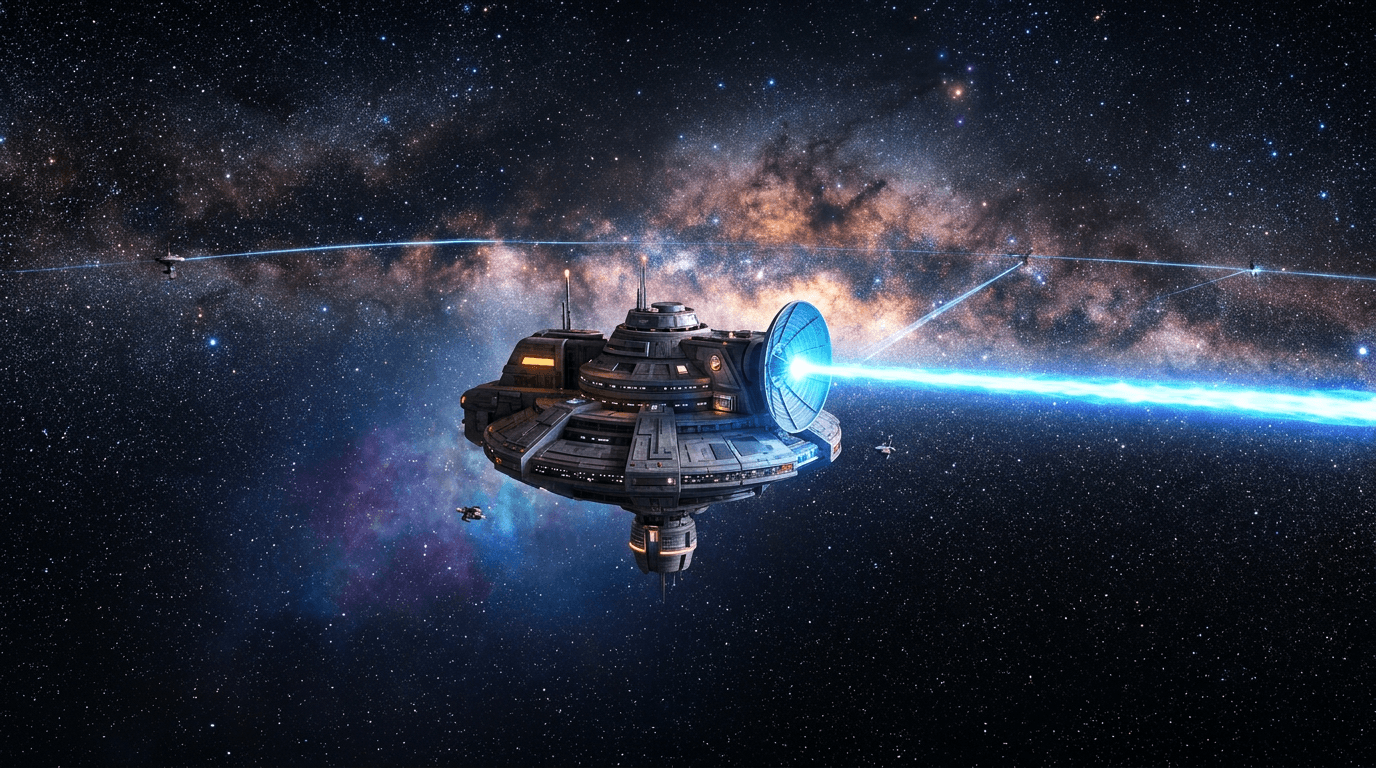
The subspace relay network represents one of the most ambitious infrastructure projects in speculative interstellar civilization-building: a galaxy-spanning communications backbone that enables faster-than-light information exchange across vast distances. In science fiction narratives, particularly those featuring spacefaring federations, these networks consist of thousands of automated stations positioned at strategic intervals throughout explored space. Each relay station functions as both a signal amplifier and an intelligent router, receiving subspace transmissions, boosting their strength, and retransmitting them toward their destination. The underlying premise assumes that subspace—a hypothetical domain beneath or parallel to normal spacetime—permits information to propagate faster than light, though with signal degradation over distance. Individual starships might achieve direct subspace communication across several light-years, but a relay network extends this capability across entire galactic arms, creating what amounts to an interstellar internet. The stations themselves are typically depicted as autonomous, self-maintaining platforms equipped with redundant power systems, adaptive antenna arrays, and sophisticated routing algorithms that can dynamically adjust transmission paths based on network conditions.
Within strategic and narrative contexts, subspace relay networks serve multiple critical functions beyond simple communication. They enable coordinated military operations across multiple star systems, facilitate real-time diplomatic exchanges between distant worlds, and support the economic integration necessary for interstellar commerce and governance. The networks also represent significant vulnerabilities—disrupting or capturing key relay nodes could fragment an empire's command structure or isolate entire sectors. This strategic importance appears frequently in military science fiction, where relay stations become contested assets during conflicts. From a worldbuilding perspective, the network's existence raises questions about maintenance logistics, territorial sovereignty in deep space, and the technical challenges of keeping thousands of unmanned stations operational across centuries. Real-world analogues include Earth's satellite communication networks and undersea fiber-optic cables, which similarly create redundant pathways and require constant maintenance, though obviously without faster-than-light capabilities.
The plausibility of subspace relay networks depends entirely on speculative physics that currently has no experimental support. Mainstream physics recognizes no "subspace" domain, and general relativity's cosmic speed limit remains unchallenged by observation. However, certain theoretical frameworks—including some interpretations of quantum entanglement, hypothetical wormhole networks, or exotic spacetime geometries—occasionally inspire speculation about faster-than-light information transfer, though none currently offer practical pathways to implementation. The engineering challenges would be formidable even if the physics worked: autonomous systems capable of self-repair across interstellar distances, power sources lasting decades without resupply, and routing protocols managing network topologies where signal transit times vary with subspace conditions rather than simple distance. For such networks to become remotely plausible would require not just breakthrough physics demonstrating faster-than-light communication, but also revolutionary advances in autonomous systems, power generation, and materials science. Until then, subspace relay networks remain valuable thought experiments for exploring the infrastructure requirements and strategic implications of hypothetical interstellar civilizations, while actual deep-space communication continues to face the fundamental constraint of light-speed delays.
Research this in Signals
Signals turns a topic into a sourced research record you can inspect and rerun. Your first scan is free, and this one starts with Subspace Relay Network already loaded, so edit it or scan as is.