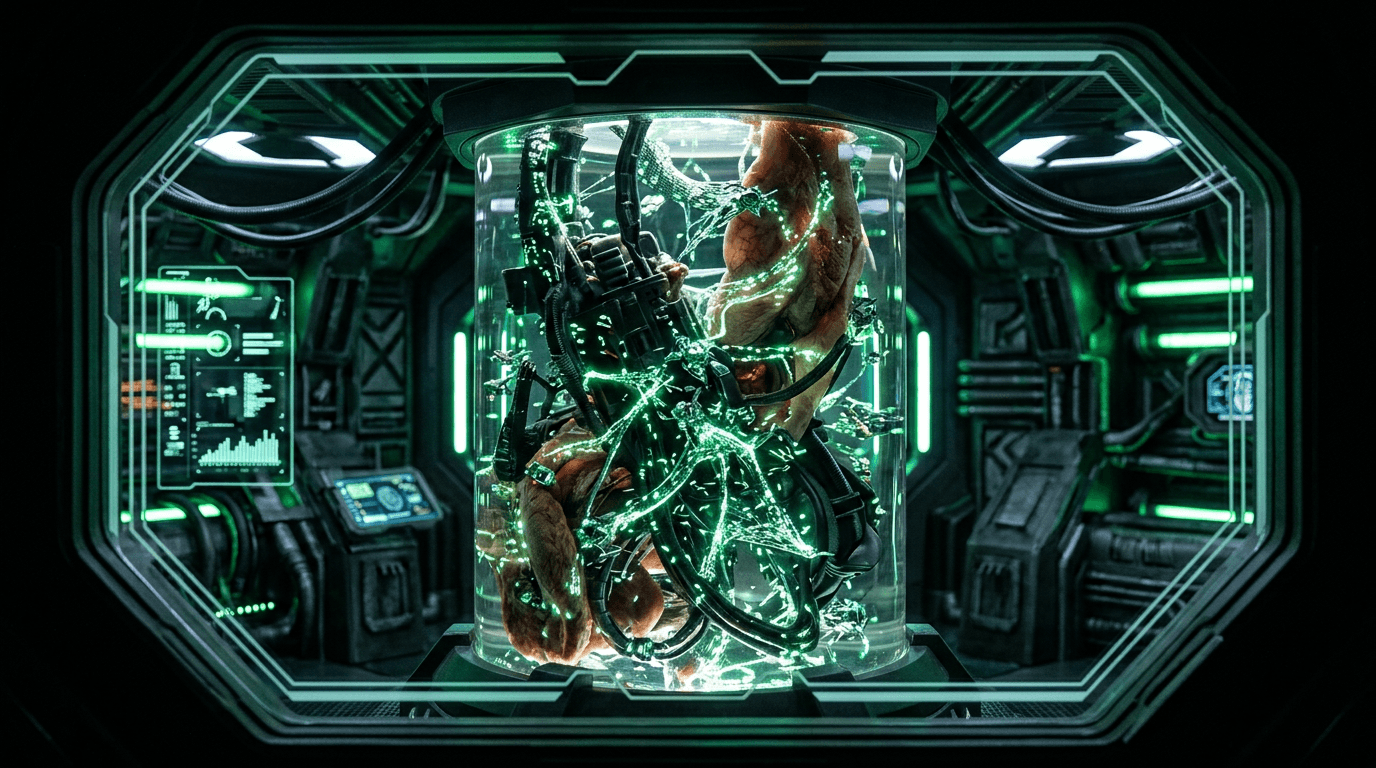
Borg Nanoprobes
Borg nanoprobes represent one of science fiction's most sophisticated explorations of nanotechnology at the intersection of biology and machine intelligence. As depicted in the Star Trek universe, these microscopic devices function as self-replicating agents capable of fundamentally altering biological systems at the cellular level. The conceptual mechanics involve nanoscale machines that can traverse the bloodstream, penetrate cellular membranes, and execute complex programming to rewrite DNA sequences, establish neural interfaces, and construct cybernetic components from available biological materials. Unlike passive medical nanoparticles being researched today, fictional nanoprobes possess autonomous decision-making capabilities, coordinated through a distributed network that connects them to a collective intelligence. This allows them to adapt their programming in real-time, responding to biological countermeasures and environmental challenges. The assimilation process they enable transforms individuals by creating a hybrid state where organic tissue and technological components become functionally indistinguishable, maintained through continuous nanoprobe activity that repairs damage and suppresses the host's immune response.
Within science fiction narratives, nanoprobes serve as a compelling metaphor for questions about identity, autonomy, and the boundaries between healing and violation. The Star Trek franchise uses them to explore scenarios where the same technology that could cure disease and repair catastrophic injuries becomes an instrument of forced transformation when deployed without consent. This duality reflects broader cultural anxieties about emerging biotechnologies and their potential for both therapeutic benefit and coercive control. In speculative defense and medical contexts, the concept resonates with ongoing research into targeted drug delivery systems, programmable matter, and brain-computer interfaces. Real-world nanoparticle research focuses on passive delivery mechanisms and simple chemical reactions, operating orders of magnitude below the complexity imagined for Borg technology. However, the narrative framework helps researchers and ethicists think through governance questions that might arise as capabilities advance, particularly regarding consent, reversibility, and the potential for dual-use applications.
The scientific plausibility of autonomous, self-replicating nanomachines faces substantial constraints that separate current research from fictional depictions. Manufacturing devices at this scale with the mechanical complexity to perform surgery, synthesize materials, and process information remains beyond present capabilities. The energy requirements for such operations within biological systems present formidable challenges, as does the problem of coordinating billions of independent agents without creating destructive interference or immune responses. Real nanoparticle therapies must navigate the body's sophisticated defense mechanisms, which would likely recognize and eliminate foreign machines long before they could establish the persistent presence depicted in fiction. Furthermore, the "grey goo" scenario of uncontrolled self-replication represents a fundamental safety concern that would require fail-safe mechanisms far more sophisticated than anything currently envisioned. While advances in DNA origami, molecular motors, and targeted therapeutics suggest that some limited nanoscale medical interventions may eventually become feasible, the autonomous, adaptive, and transformative capabilities of fictional nanoprobes would require breakthroughs in materials science, energy storage, artificial intelligence, and bioengineering that remain speculative. The concept nevertheless serves as a valuable thought experiment for considering the ethical frameworks and safety protocols that should accompany any future developments in programmable matter and invasive biotechnology.
Research this in Signals
Signals turns a topic into a sourced research record you can inspect and rerun. Your first scan is free, and this one starts with Borg Nanoprobes already loaded, so edit it or scan as is.