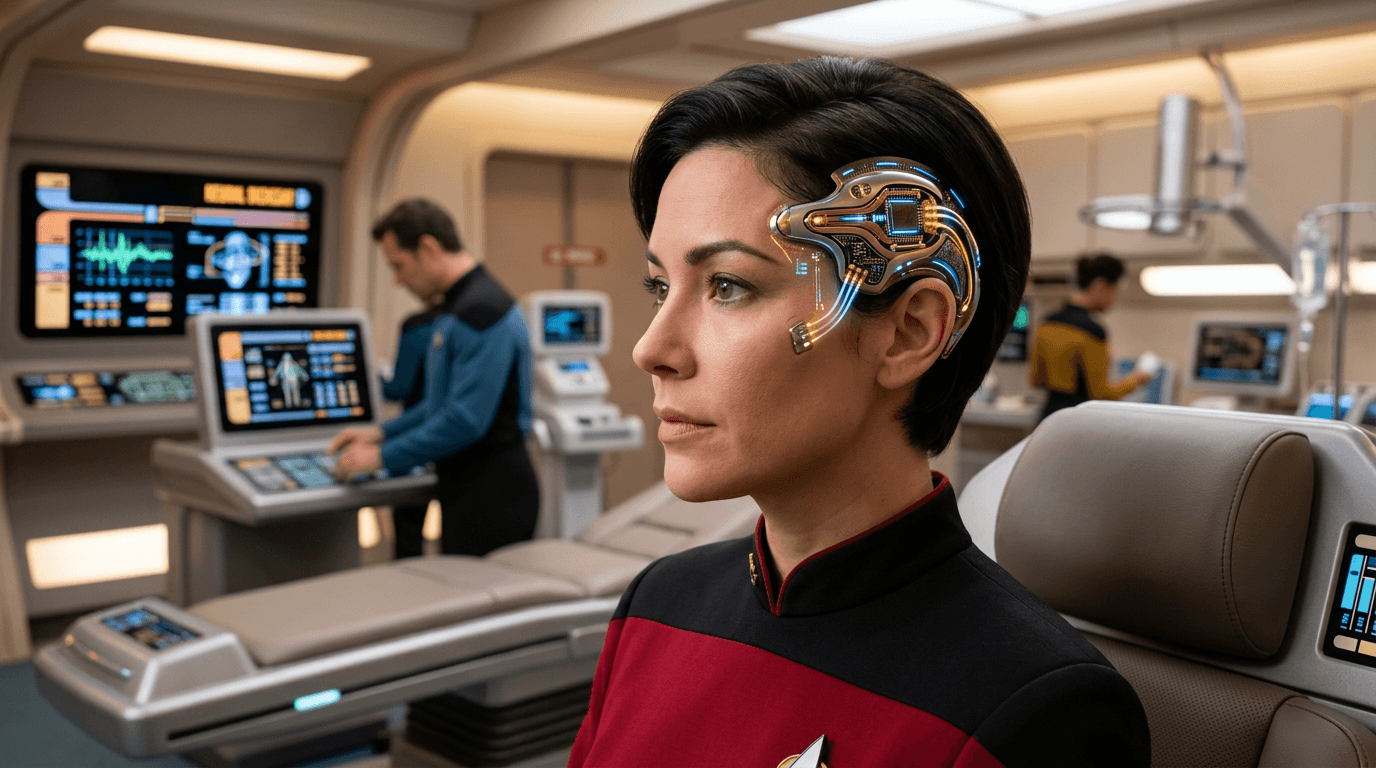
Neural Interface Implant
Neural interface implants represent one of the most profound intersections between biological and computational systems, establishing direct pathways between neural tissue and external devices. Unlike conventional brain-computer interfaces that rely on external sensors reading electrical activity through the skull, these implants create physical or electromagnetic connections with neural structures, enabling bidirectional data flow. The concept encompasses a spectrum of implementations, from electrode arrays that interface with specific brain regions to more speculative nanoscale networks that could theoretically integrate throughout neural tissue. In fictional contexts, particularly within Star Trek's narrative framework, these devices achieve seamless thought-to-machine communication, instantaneous data transfer, and even collective consciousness sharing among networked individuals. Real-world research in neuroprosthetics has demonstrated proof-of-concept for motor control and sensory feedback, though current implementations remain far more limited than their science fiction counterparts, typically requiring extensive training periods and producing relatively simple command sets rather than fluid thought translation.
The strategic and narrative significance of neural interface technology extends beyond mere convenience, touching fundamental questions about human agency, identity, and cognitive enhancement. In speculative scenarios, these implants serve as the ultimate tool for information access, potentially allowing users to query databases, perform calculations, or access memories with the speed of thought. The Borg Collective's use of neural interfaces in Star Trek exemplifies both the technology's potential and its dangers—demonstrating perfect coordination and knowledge sharing while simultaneously illustrating the loss of individual autonomy when consciousness becomes networked without consent. This duality makes neural interfaces a recurring element in discussions about human augmentation ethics, transhumanism, and the boundaries of acceptable medical intervention. Current research in brain-computer interfaces focuses primarily on therapeutic applications: restoring communication for locked-in patients, enabling prosthetic control for amputees, and treating conditions like Parkinson's disease through deep brain stimulation. These real-world applications, while transformative for patients, operate on fundamentally different principles than the seamless thought-transfer depicted in fiction, relying on pattern recognition algorithms to interpret neural signals rather than direct information encoding.
The plausibility of advanced neural interfaces depends on resolving numerous biological and technical constraints that remain largely theoretical. The human brain's complexity—with approximately 86 billion neurons forming trillions of synaptic connections—presents formidable challenges for any system attempting to interface at scale. Current electrode-based approaches face issues of biocompatibility, immune response, signal degradation over time, and the fundamental difficulty of decoding neural patterns that vary significantly between individuals. The concept of "downloading" information directly into memory, while narratively compelling, assumes a level of understanding about memory encoding, consolidation, and retrieval that neuroscience has not yet achieved. Research suggests memory formation involves complex biochemical processes across distributed neural networks rather than discrete data storage amenable to direct writing. For neural interfaces to approach their fictional capabilities, breakthroughs would be needed in materials science for long-term biocompatible implants, neuroscience for understanding neural coding schemes, and computational power for real-time processing of massive neural datasets. The timeline for such advances remains highly uncertain, with therapeutic applications likely preceding enhancement uses by decades, and collective consciousness scenarios remaining firmly in the realm of speculation rather than foreseeable technology development.
Research this in Signals
Signals turns a topic into a sourced research record you can inspect and rerun. Your first scan is free, and this one starts with Neural Interface Implant already loaded, so edit it or scan as is.