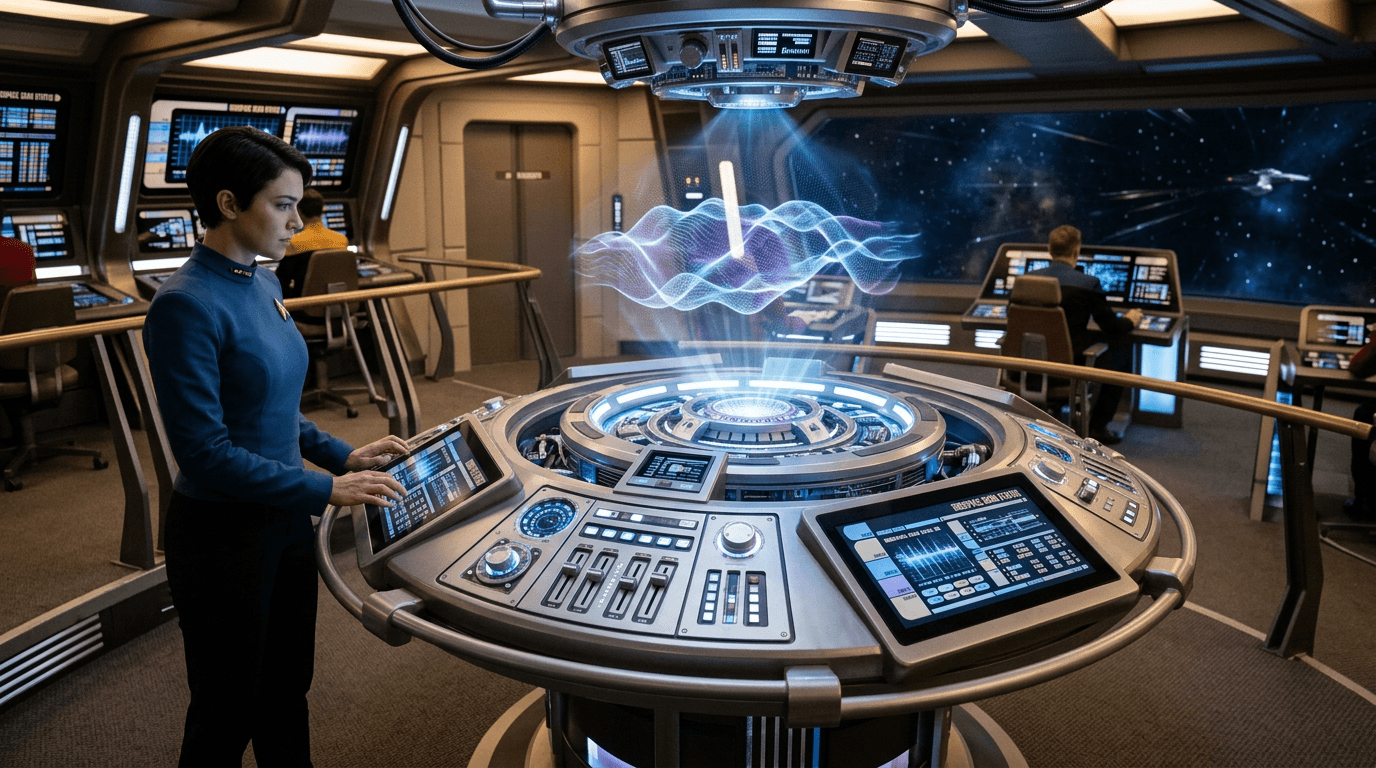
Subspace Anomaly Detector
Subspace anomaly detectors represent a speculative sensing technology conceived primarily within science fiction narratives, particularly those exploring faster-than-light travel and exotic spacetime phenomena. The concept imagines specialized instruments capable of monitoring theoretical subspace layers—hypothetical dimensional structures beneath or parallel to normal spacetime where conventional physics might operate differently. In fictional frameworks like Star Trek, these detectors identify distortions, rifts, wormholes, and other exotic phenomena that could threaten spacecraft navigating through or utilizing subspace for propulsion. The imagined mechanism typically involves measuring variations in subspace field strength, graviton fluctuations, and temporal distortions, providing early warning of dangerous spatial phenomena. While purely speculative, the concept draws loose inspiration from real gravitational wave detection and theoretical physics exploring extra dimensions, though no scientific evidence currently supports the existence of accessible subspace layers or the ability to detect phenomena within them.
Within science fiction narratives, subspace anomaly detectors serve crucial plot and worldbuilding functions, establishing the dangers and complexities of advanced space travel while creating dramatic tension through unpredictable cosmic hazards. The technology appears frequently in scenarios involving interstellar navigation, where detecting spatial anomalies becomes as essential as radar is to contemporary aviation. This narrative device allows stories to explore themes of cosmic uncertainty, the limits of technological mastery, and humanity's vulnerability when venturing beyond familiar physical laws. The concept also connects to legitimate scientific discussions about gravitational wave astronomy, where facilities like LIGO detect ripples in spacetime caused by massive cosmic events. While LIGO measures distortions in our observable spacetime rather than hypothetical subspace layers, it demonstrates that detecting subtle variations in the fabric of space is scientifically plausible, even if the specific phenomena described in fiction remain entirely theoretical.
The plausibility of subspace anomaly detection rests entirely on speculative physics that currently lacks experimental support. Modern physics recognizes four fundamental forces and has found no evidence of accessible subspace dimensions or exotic spatial phenomena like fictional subspace tears. Gravitational wave detection represents the closest real-world analogue, measuring spacetime distortions caused by colliding black holes or neutron stars, but these observations occur within conventional four-dimensional spacetime. Theoretical frameworks like string theory propose additional dimensions, but these remain mathematical constructs without observational confirmation, and even if they exist, they would likely be compactified at scales far too small for macroscopic detection. For subspace anomaly detectors to become plausible, physics would require revolutionary discoveries: confirmation of accessible extra dimensions, evidence of stable wormholes or spatial rifts, and development of sensors capable of measuring phenomena in these hypothetical realms. Until such breakthroughs occur, these detectors remain firmly in the realm of narrative speculation, useful for exploring fictional universes but disconnected from current scientific understanding of spacetime structure.
Research this in Signals
Signals turns a topic into a sourced research record you can inspect and rerun. Your first scan is free, and this one starts with Subspace Anomaly Detector already loaded, so edit it or scan as is.