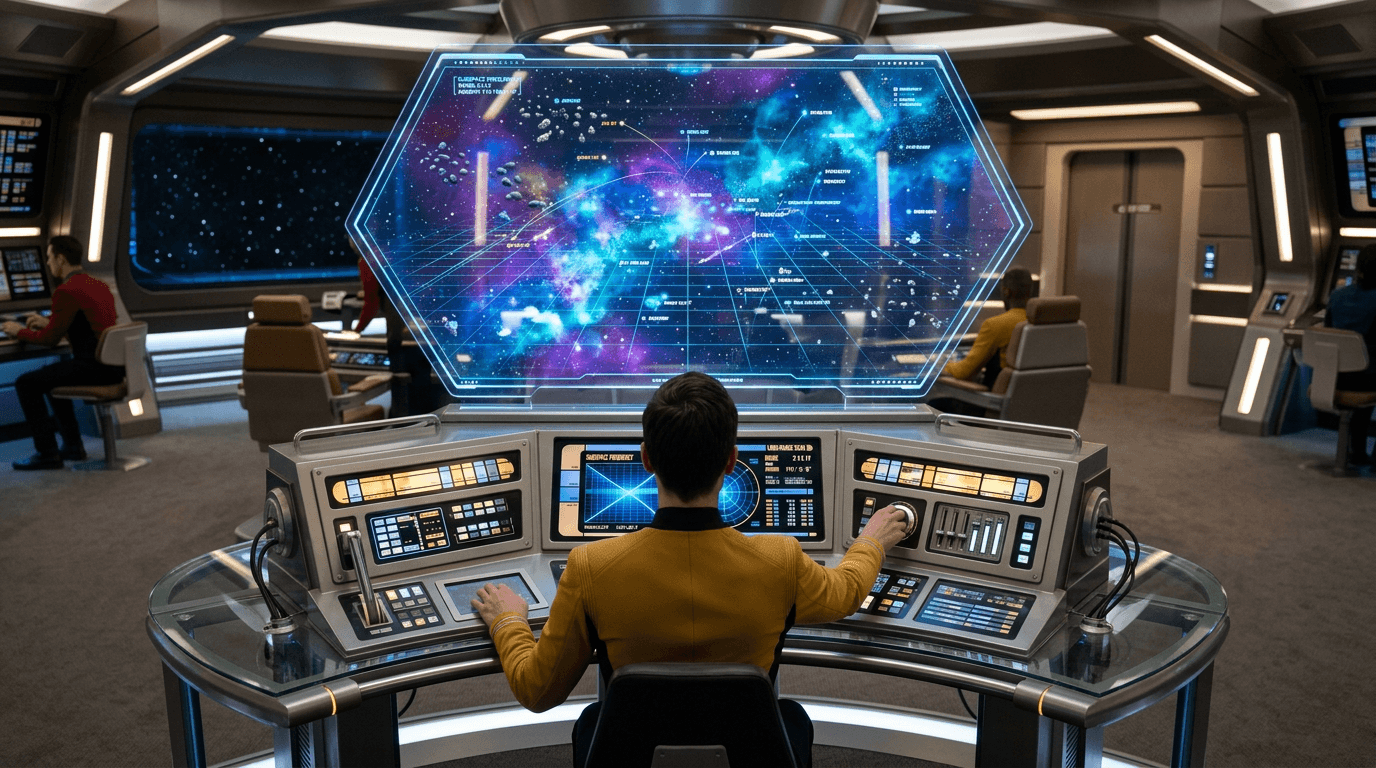
Long-Range Sensors
Long-range sensors represent one of the most persistent technological concepts in science fiction spacefaring narratives, imagined as sophisticated detection systems capable of perceiving objects, energy signatures, and spatial anomalies across distances measured in light-years. The conceptual mechanics typically involve arrays that transcend conventional electromagnetic detection—which would be limited by light-speed propagation delays—by incorporating speculative physics such as subspace scanning, gravimetric distortion analysis, or tachyon-based detection grids. In fictional frameworks, these systems are portrayed as synthesizing data from multiple sensing modalities simultaneously: passive electromagnetic receivers capturing radiation across the spectrum, active scanning beams that somehow propagate faster than light to probe distant regions, and exotic detectors sensitive to gravitational waves, quantum entanglement signatures, or dimensional fluctuations. The imagined result is a real-time or near-real-time awareness of the surrounding stellar environment, allowing vessels to navigate safely, identify potential threats, and catalogue astronomical phenomena without the years-long information delays that actual light-speed physics would impose.
Within science fiction narratives and strategic scenario planning, long-range sensors serve essential dramatic and tactical functions. They create the possibility of space combat doctrine, diplomatic encounters, and exploration missions by allowing characters to detect approaching vessels, identify unknown objects before close approach, and make informed decisions about course changes or defensive preparations. The technology appears prominently in military space scenarios as a force multiplier—the ability to detect adversaries at extreme range theoretically provides decisive tactical advantage, enabling pre-emptive manoeuvres or strategic withdrawal. In contemporary defense and space industry discussions, the concept influences thinking about space domain awareness, satellite tracking networks, and deep-space monitoring systems, even though these real-world systems operate under conventional physics constraints. Research into gravitational wave detection, neutrino astronomy, and advanced radio telescope arrays represents the nearest real-world analogues, though these systems detect cosmic-scale events rather than individual spacecraft and operate with significant time delays inherent to light-speed information transfer.
The fundamental constraint separating fictional long-range sensors from physical reality remains the light-speed limit and the inverse-square law governing signal strength. Detecting a spacecraft-sized object multiple light-years away would require either impossibly sensitive receivers or the object to emit extraordinarily powerful signals—and any detection would represent the target's position years in the past. Current astrophysics offers no mechanism for faster-than-light information transfer that would enable real-time detection at interstellar distances. Gravitational wave observatories like LIGO detect massive cosmic events but lack the sensitivity for artificial objects, while even the most advanced radio telescopes struggle to resolve exoplanet details at distances of mere dozens of light-years. For long-range sensors as depicted in fiction to approach plausibility, breakthrough discoveries in physics would be required: either practical faster-than-light communication methods, exotic detection mechanisms operating outside known spacetime constraints, or fundamentally new understanding of information propagation. Until such theoretical revolutions occur, the concept remains firmly in the realm of narrative convenience—a storytelling device that enables the dramatic pacing and tactical complexity that interstellar fiction requires, rather than a near-term technological development.
Research this in Signals
Signals turns a topic into a sourced research record you can inspect and rerun. Your first scan is free, and this one starts with Long-Range Sensors already loaded, so edit it or scan as is.