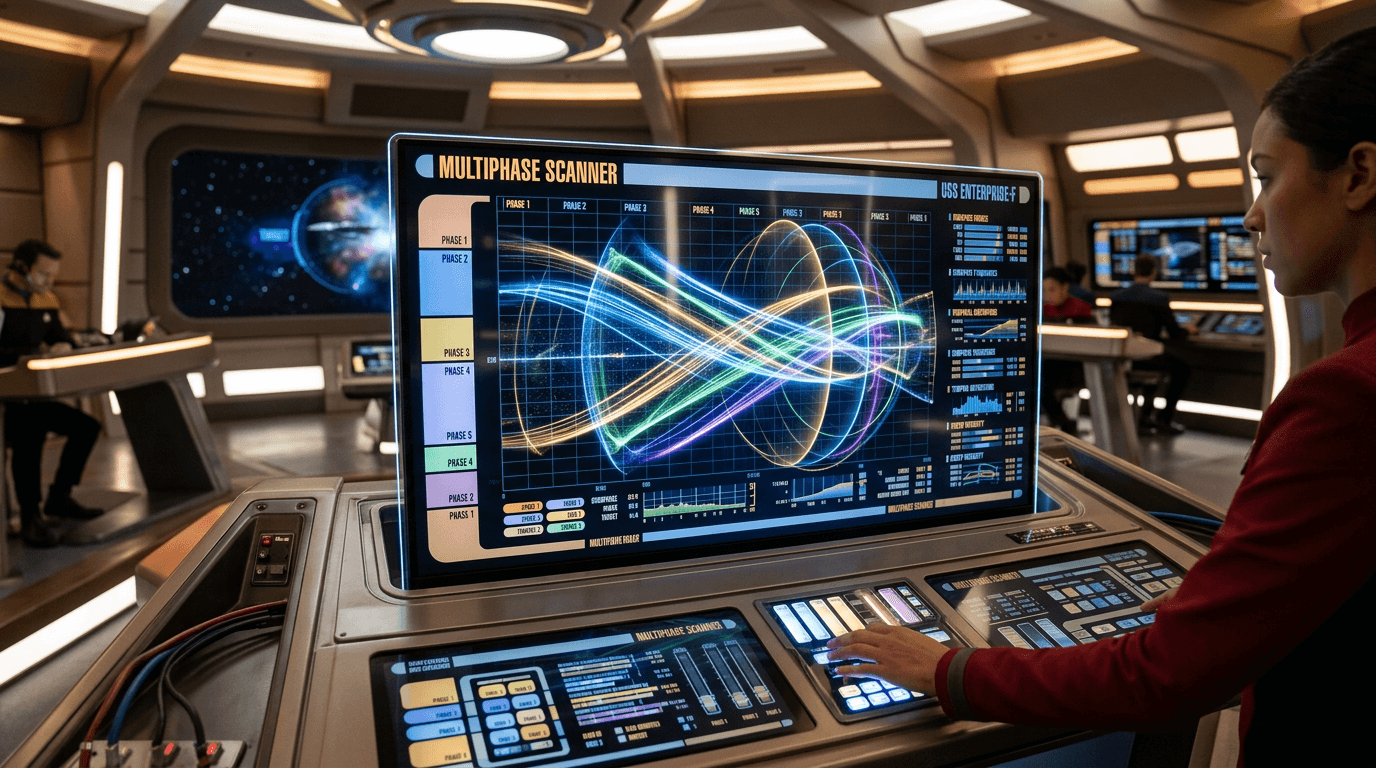
Multiphase Scanner
Multiphase scanning represents a speculative sensor architecture designed to overcome the limitations of conventional detection systems by simultaneously interrogating multiple layers of physical and subspace reality. The concept emerges from science fiction narratives where adversaries employ cloaking devices, phase-shift technologies, or subspace concealment to evade detection. In these scenarios, standard electromagnetic sensors prove insufficient because the target exists partially or wholly outside normal spacetime. A multiphase scanner addresses this by cycling through—or simultaneously sampling—different subspace frequency bands, phase states, and dimensional offsets while correlating these exotic returns with conventional sensor data from electromagnetic, gravimetric, and thermal arrays. The theoretical foundation assumes that subspace itself possesses stratified properties analogous to frequency bands in the electromagnetic spectrum, and that objects occupying these strata leave detectable signatures when probed with appropriately tuned emissions.
Within military and exploratory fiction, multiphase scanning serves as a critical countermeasure against stealth technologies and a tool for detecting anomalous phenomena. The narrative function parallels real-world interest in multispectral and hyperspectral sensing, where defense researchers combine infrared, radar, acoustic, and other modalities to defeat camouflage and low-observable designs. Current research into quantum radar, gravitational wave detection, and exotic matter searches provides loose analogues—technologies that attempt to sense phenomena invisible to conventional instruments. The strategic appeal lies in information dominance: the ability to detect what adversaries believe is hidden creates asymmetric advantage in reconnaissance, threat assessment, and tactical engagement. In speculative scenarios involving dimensional rifts or interphasic entities, multiphase scanners become essential diagnostic instruments, much as particle detectors reveal subatomic phenomena in contemporary physics.
The plausibility of multiphase scanning hinges entirely on whether subspace—as depicted in fiction—corresponds to any physical reality. Mainstream physics offers no evidence for stratified subspace domains accessible through frequency tuning, though theoretical frameworks like string theory and brane cosmology propose extra dimensions that might exhibit analogous properties under extreme conditions. The engineering challenges would be formidable even if the physics proved sound: generating coherent subspace emissions, maintaining phase coherence across multiple domains, and processing the resulting multidimensional data streams would require breakthroughs in energy generation, signal processing, and materials science. For now, multiphase scanning remains a narrative device that extrapolates from legitimate sensor fusion principles into domains where known physics provides no roadmap. Its evolution from fiction to reality would require not incremental progress but revolutionary discoveries about the fundamental structure of spacetime itself.
Research this in Signals
Signals turns a topic into a sourced research record you can inspect and rerun. Your first scan is free, and this one starts with Multiphase Scanner already loaded, so edit it or scan as is.