Urban Mining for Critical Minerals
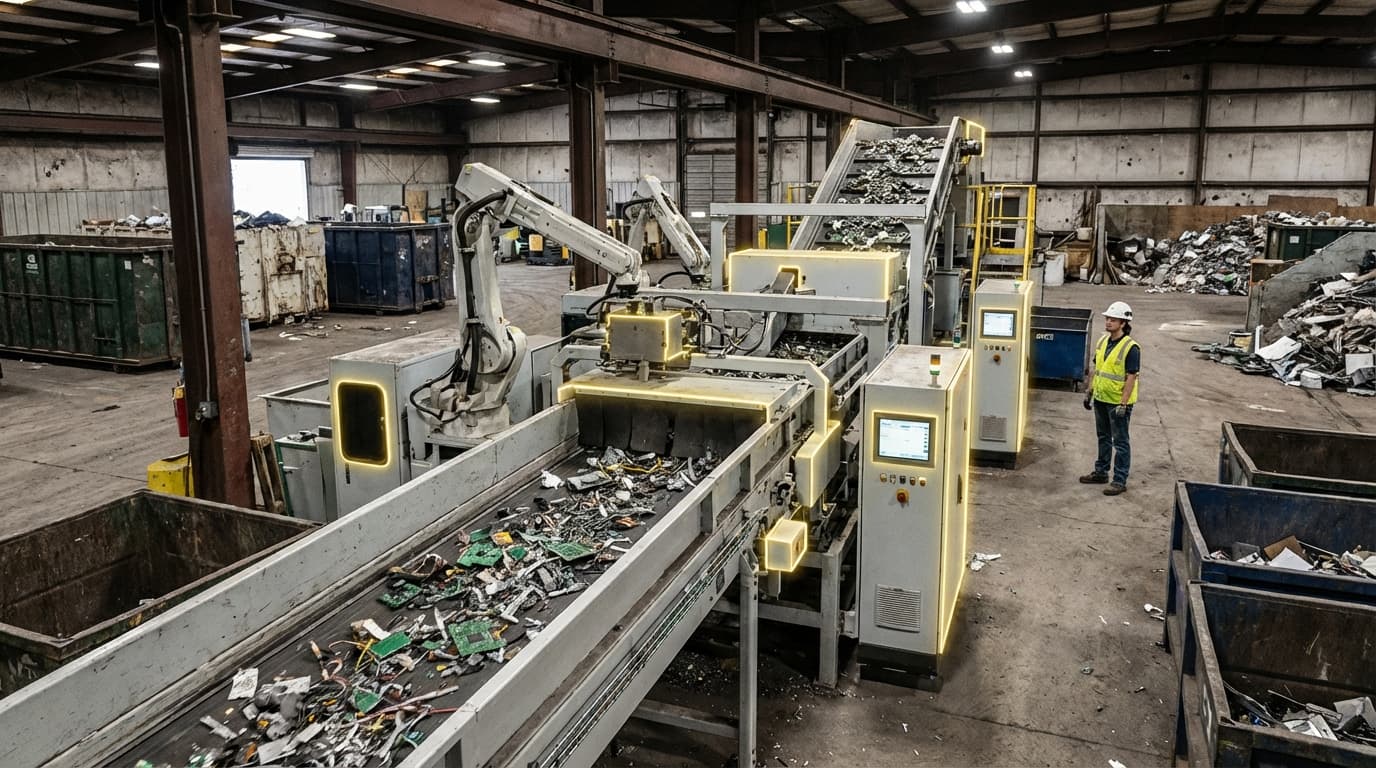
The accelerating demand for critical minerals—driven by electrification, renewable energy infrastructure, and digital technologies—has exposed significant vulnerabilities in global supply chains. Traditional mining operations face mounting environmental scrutiny, geopolitical constraints, and declining ore grades, while the accumulation of electronic waste and industrial scrap represents a largely untapped reservoir of valuable materials. Urban mining addresses this challenge by treating discarded products and waste streams as viable ore bodies, applying industrial-scale recovery processes to extract metals that would otherwise be lost to landfills or inefficient recycling. The approach fundamentally reframes waste management as resource recovery, positioning cities and industrial zones as distributed mining sites where materials can be reclaimed at concentrations often exceeding those found in natural deposits.
The technical foundation of urban mining combines mechanical processing with advanced separation and extraction methods tailored to complex waste matrices. Sophisticated shredding and liberation techniques break down end-of-life electronics, batteries, and industrial equipment into constituent materials, while sensor-based sorting systems—using X-ray fluorescence, infrared spectroscopy, and machine vision—identify and segregate metal-bearing fractions with increasing precision. Hydrometallurgical processes employ chemical leaching to dissolve target metals from crushed materials, enabling selective recovery of copper, cobalt, nickel, and precious metals through subsequent purification steps. Bioleaching leverages microorganisms to extract metals under milder conditions, offering lower energy consumption and reduced chemical inputs for certain waste streams. These integrated systems can process heterogeneous feedstocks that conventional smelting struggles to handle economically, unlocking value from materials previously considered too dilute or contaminated for recovery.
Commercial urban mining facilities are now operating across Europe, Asia, and North America, processing millions of tonnes of electronic waste and industrial scrap annually. Battery recycling plants recover lithium, cobalt, and nickel from spent electric vehicle batteries, feeding these materials back into manufacturing supply chains and reducing dependence on primary mining in politically sensitive regions. Rare earth recovery from hard drives, motors, and fluorescent lamps addresses supply constraints for elements critical to wind turbines and electric motors. As regulatory frameworks increasingly mandate extended producer responsibility and circular economy targets, urban mining is transitioning from niche recovery operations to strategic infrastructure that enhances resource security, mitigates environmental impacts of primary extraction, and captures economic value from the growing volumes of technological waste generated by modern economies.
Related Organizations
Uses Spoke & Hub technologies to recover critical materials from lithium-ion batteries with high efficiency.

Creates a closed-loop supply chain for lithium-ion batteries by recycling end-of-life batteries into critical materials.
Uses 'Hydro-to-Cathode' technology to synthesize new cathode active materials directly from spent Li-ion batteries.
Specializes in the recovery of rare earth elements from end-of-life magnets and electric vehicle motors.

South Korea's leading battery recycler, recovering cobalt, nickel, lithium, and copper from spent batteries.
Global materials technology group with extensive operations in battery recycling and refining.

Comprehensive battery management and materials company, formerly Retriev Technologies and Battery Solutions.

Uses electro-extraction technology to recover critical minerals from waste streams and low-grade ores.

Major commodity trader investing heavily in circularity partnerships (e.g., with Li-Cycle and circular supply chains).

Develops bio-refining technology using microbes to recover precious metals from electronic waste.
Supporting Evidence
Research this in Signals
Signals turns a topic into a sourced research record you can inspect and rerun. Your first scan is free, and this one starts with Urban Mining for Critical Minerals already loaded, so edit it or scan as is.