Industrial Digital Twins
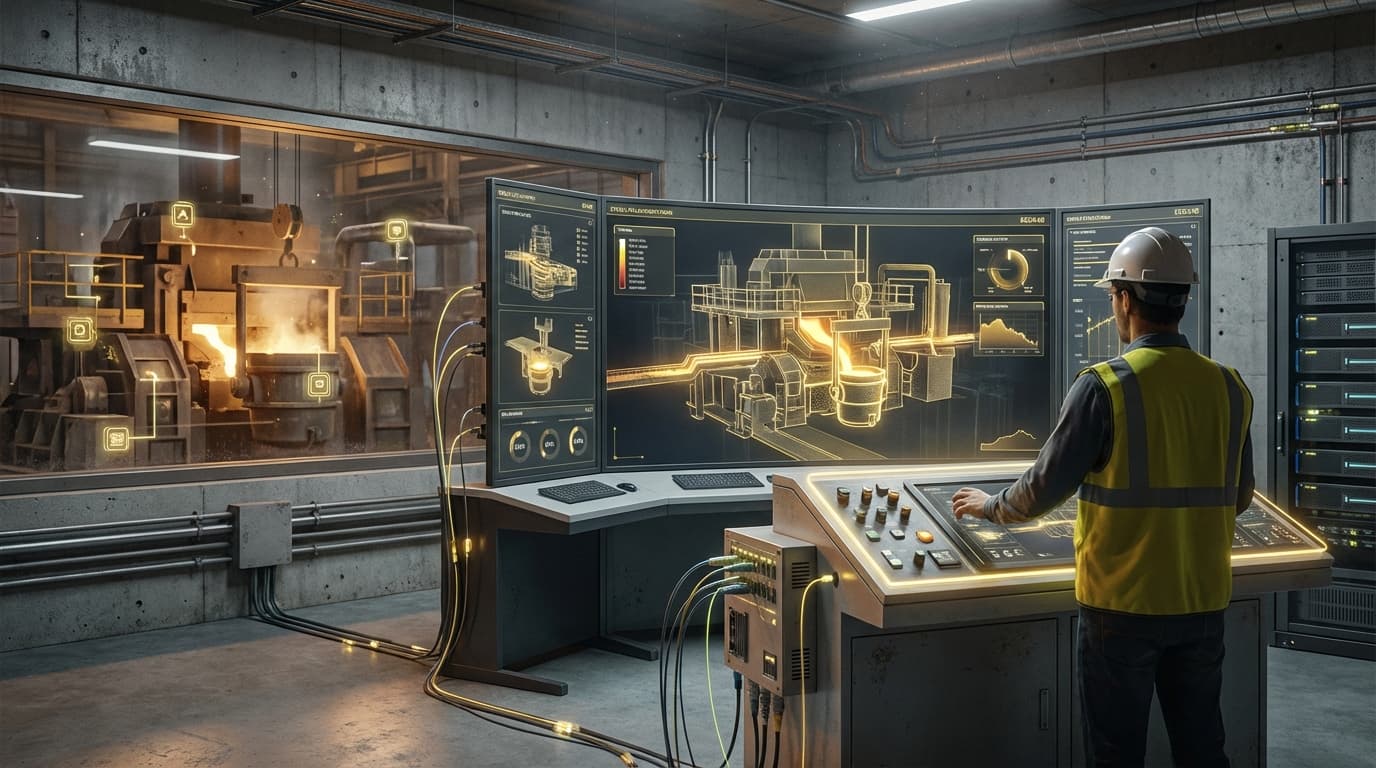
Industrial digital twins represent a fundamental shift in how heavy industry manages complex physical assets by creating precise, continuously updated virtual replicas of equipment, processes, and entire facilities. These sophisticated models combine real-time data streams from sensors, operational systems, and historical performance records with advanced physics-based simulations and machine learning algorithms. In mining and heavy industry contexts, digital twins can represent everything from individual pieces of equipment like crushers and conveyor systems to entire processing plants or mine sites. The technology works by establishing a bidirectional data flow between the physical asset and its virtual counterpart, where sensors continuously feed operational parameters such as temperature, vibration, pressure, and throughput into the digital model, while the model provides predictive insights and optimization recommendations back to operators.
The extractives and heavy industry sectors face unique challenges that make digital twins particularly valuable. Mining operations involve expensive, mission-critical equipment operating in harsh environments where unplanned downtime can cost millions of dollars per day. Traditional maintenance approaches rely on fixed schedules or reactive responses to failures, both of which are inefficient and costly. Digital twins address these challenges by enabling predictive maintenance strategies that identify potential failures before they occur, allowing maintenance to be scheduled during planned downtime. Beyond maintenance, these virtual models allow operators to test process modifications, experiment with different operational parameters, and evaluate the impact of equipment upgrades in a risk-free virtual environment. This capability is especially valuable in materials processing, where even minor adjustments to crushing circuits, flotation cells, or smelting operations can significantly impact throughput, energy consumption, and product quality.
Early implementations in mining and heavy industry have demonstrated substantial operational improvements, with some facilities reporting reductions in unplanned downtime of thirty to fifty percent and energy efficiency gains of ten to twenty percent. Major mining operations are deploying digital twins for haul truck fleet optimization, mill circuit performance enhancement, and mine planning scenario analysis. In petrochemical facilities, digital twins monitor complex reaction processes and predict optimal operating conditions across interconnected systems. The technology is evolving beyond individual asset monitoring toward integrated facility-level twins that can optimize entire value chains, from extraction through processing to logistics. As computational power increases and sensor technology becomes more sophisticated and affordable, digital twins are becoming standard practice in heavy industry, representing a critical component of the broader digital transformation that is reshaping these traditionally analog-intensive sectors. The convergence of digital twins with artificial intelligence and edge computing promises even greater capabilities, enabling autonomous optimization and real-time decision-making that could fundamentally transform how extractive and processing industries operate.
Related Organizations
Industrial giant offering the 'Senseye Predictive Maintenance' suite and MindSphere IoT platform.

Delivers 'Vessel Insight' and digital twin technologies that capture sensor data from ships to monitor fuel consumption and emissions.


The energy portfolio of GE (formerly GE Digital), offering Asset Performance Management (APM) software powered by AI.

Software corporation specializing in 3D design and digital mock-ups.
Provides physics-based digital twins for critical infrastructure.

No-code application composition platform for industrial digital twins.

One of the world's largest providers of products and services to the energy industry.
Supporting Evidence
Research this in Signals
Signals turns a topic into a sourced research record you can inspect and rerun. Your first scan is free, and this one starts with Industrial Digital Twins already loaded, so edit it or scan as is.