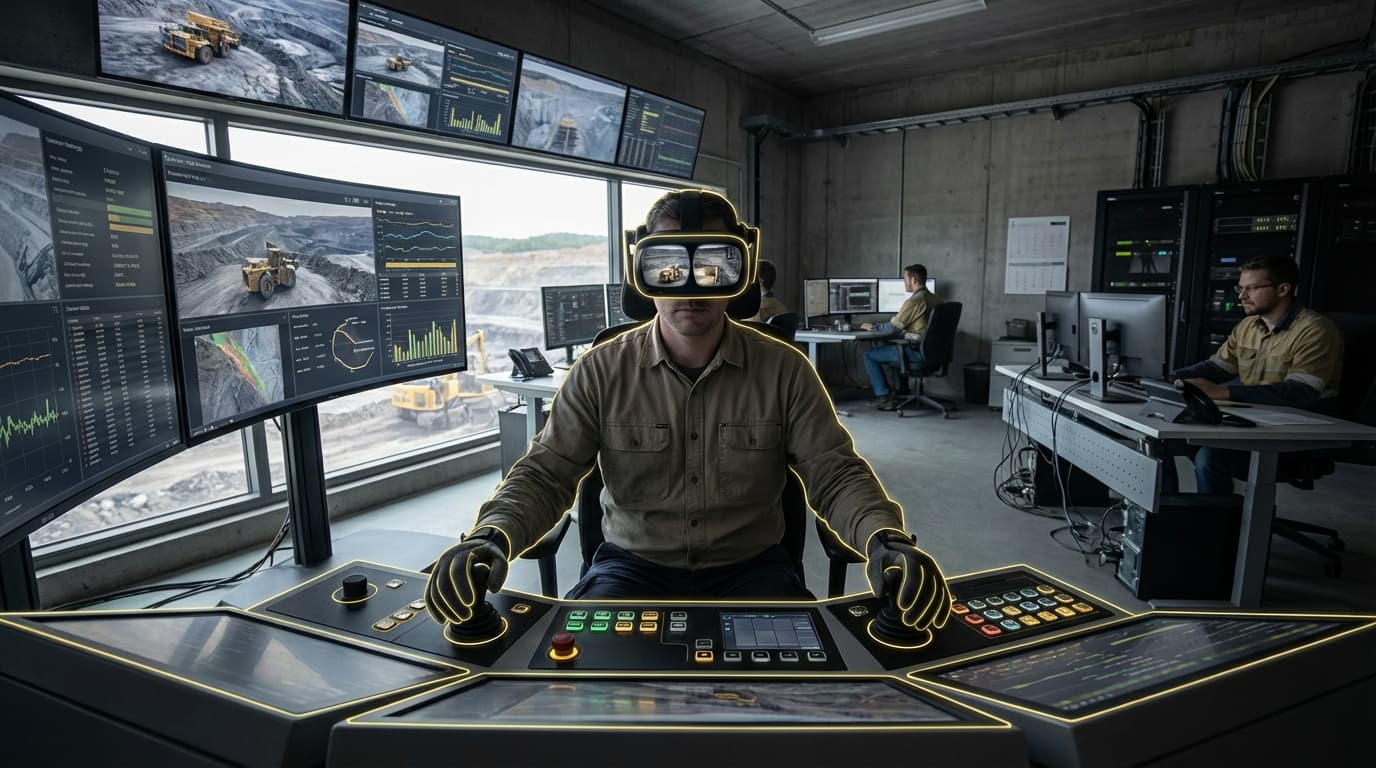
Immersive Remote Operation Centers
The mining industry has long grappled with the challenge of operating equipment in hazardous, remote environments while maintaining operator safety and precision. Traditional remote operation centers rely on flat-screen displays and camera feeds, which limit depth perception and situational awareness, making it difficult for operators to judge distances, navigate complex terrain, or respond quickly to unexpected conditions. Immersive Remote Operation Centers address these limitations by leveraging virtual reality headsets, augmented reality overlays, and haptic feedback systems to create a three-dimensional, sensory-rich interface between human operators and distant mining machinery. These systems integrate real-time data from multiple cameras, LiDAR sensors, and machine telemetry to construct a comprehensive digital twin of the operational environment. Operators wearing VR headsets can look around naturally, perceive depth and spatial relationships accurately, and receive tactile feedback through haptic gloves or vests that simulate the resistance of rock, the vibration of drilling, or the tension in hydraulic systems.
This technological approach solves critical problems that have constrained the mining industry's ability to operate safely and efficiently in challenging locations. By enabling operators to work from centralized facilities in urban areas rather than on-site in extreme heat, cold, or altitude, companies can improve worker safety, reduce fatigue-related errors, and access a broader talent pool unconstrained by geographic isolation. The enhanced situational awareness provided by immersive interfaces allows for more precise equipment control, reducing damage to machinery, minimizing ore dilution, and improving extraction efficiency. Early deployments indicate that operators using immersive systems can achieve productivity levels comparable to or exceeding those of on-site operation, while significantly reducing the risk of accidents in underground or open-pit environments. Furthermore, this approach enables mining companies to maintain operations during extreme weather events, health emergencies, or other conditions that would traditionally halt production, improving operational continuity and return on capital-intensive equipment investments.
Research suggests that several major mining operations have begun piloting immersive remote operation centers for autonomous haul trucks, drilling rigs, and excavators, with operators stationed hundreds or even thousands of kilometers from active mine sites. These systems are particularly valuable for deep underground operations, where communication latency and environmental hazards have historically made remote operation impractical. As 5G and dedicated industrial networks reduce latency to near-imperceptible levels, the technology is becoming viable for increasingly complex and time-sensitive tasks. Industry analysts note that this convergence of immersive technologies with mining automation represents a fundamental shift toward what some describe as the "Industrial Metaverse"—persistent digital environments where physical and virtual operations merge seamlessly. The trajectory points toward hybrid operational models where human expertise and machine precision combine through immersive interfaces, potentially transforming not only how mining is conducted but also where mining professionals can live and work, decoupling operational excellence from physical presence in remote, often inhospitable locations.
Related Organizations

Hard-Line
Canada · Company
Specializes in remote control and tele-operation systems for heavy mining machinery (acquired by Hexagon).

World's leading manufacturer of construction and mining equipment.

Spun out of Atlas Copco, Epiroc specializes in mining equipment and provides extensive automation solutions for underground loaders and trucks.


Major mining company actively deploying remote operation centers for autonomous trucks and drills.

Global leader in mining equipment simulators, now expanding into digital twin and operational support.
Develops CYBERMINE simulators and workforce optimization technologies.

XR (Extended Reality) company providing VR/AR solutions for industrial design and remote collaboration.

Non-profit research institute with a long history in AI, currently working on hybrid neuro-symbolic systems for DARPA and commercial use.
Supporting Evidence
Research this in Signals
Signals turns a topic into a sourced research record you can inspect and rerun. Your first scan is free, and this one starts with Immersive Remote Operation Centers already loaded, so edit it or scan as is.