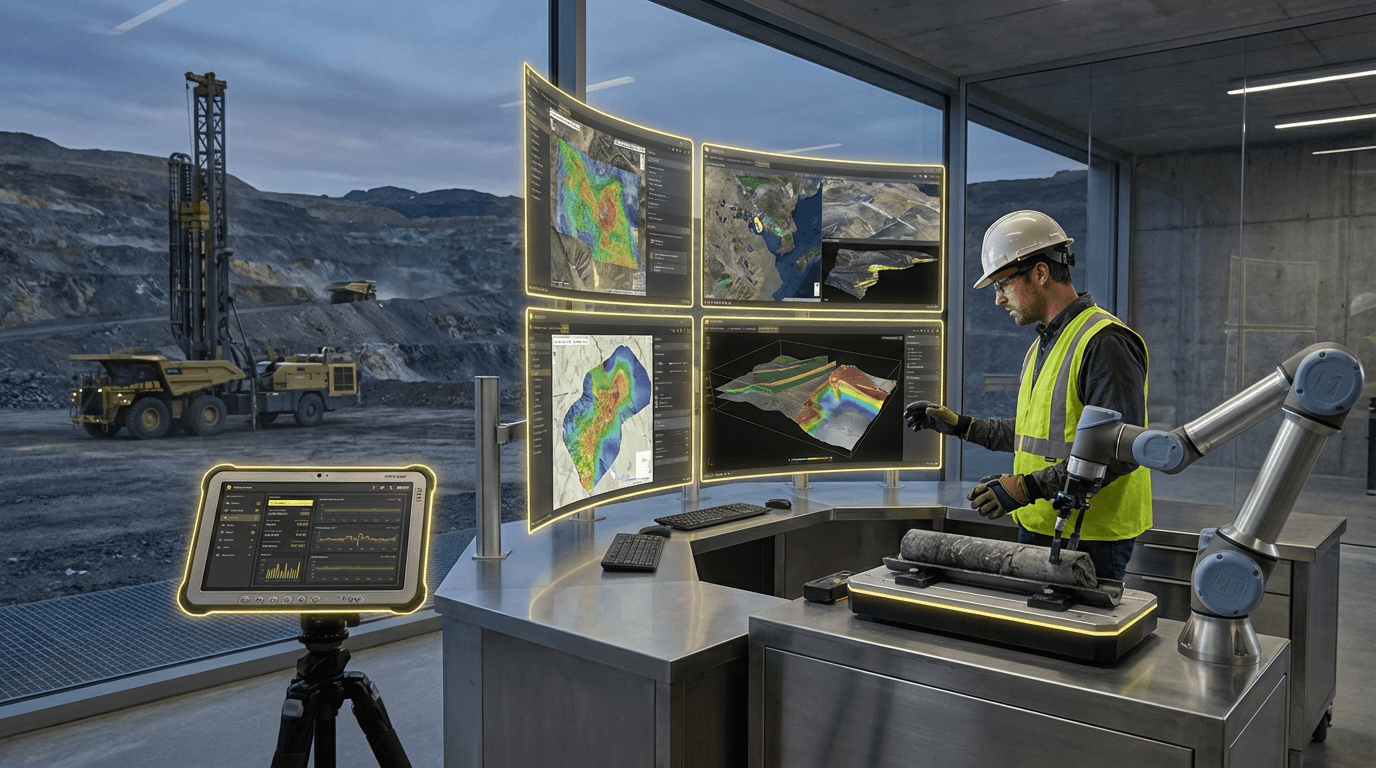
AI-Driven Exploration Targeting
Mineral exploration has historically been a capital-intensive endeavor characterized by high failure rates, with traditional methods relying heavily on expert interpretation of disparate geological datasets and costly drilling campaigns that often yield disappointing results. The challenge intensifies as shallow, easily discoverable deposits become exhausted, forcing the industry to search for deeper, concealed mineralization beneath layers of barren rock or sediment cover. AI-driven exploration targeting addresses this fundamental problem by applying machine learning algorithms to integrate and analyze vast quantities of multi-scale geoscience data—including regional geological maps, airborne and ground geophysical surveys, geochemical assays, satellite imagery, and historical drilling records—to identify subtle spatial patterns and correlations that human analysts might overlook. These systems employ techniques such as neural networks, random forests, and support vector machines to learn the complex signatures associated with known mineral deposits, then extrapolate those patterns across unexplored terrain to generate probabilistic targeting maps that rank areas by their likelihood of hosting economically viable mineralization.
The mining industry faces mounting pressure to discover new deposits of critical minerals essential for energy transition technologies while simultaneously reducing exploration costs and environmental footprint. AI-driven targeting platforms help companies overcome these challenges by dramatically improving the efficiency of exploration programs, concentrating drilling efforts in the most prospective zones and avoiding wasteful expenditure in barren areas. This capability proves particularly valuable in the search for battery metals, rare earth elements, and other strategic resources where demand is surging but new discoveries remain elusive. By processing terabytes of geoscientific data in hours rather than months, these systems enable exploration teams to evaluate larger land packages more thoroughly, test multiple geological hypotheses simultaneously, and make more informed decisions about where to commit scarce capital. The technology also democratizes access to sophisticated analysis, allowing junior exploration companies with limited budgets to compete more effectively against major mining houses.
Several mining companies and exploration technology firms have deployed AI targeting systems in recent years, with early results indicating significant improvements in discovery rates and reductions in exploration cycle times. Research suggests that machine learning models can identify prospective zones that traditional methods miss entirely, particularly in regions with complex geology or extensive cover sequences. Industry analysts note growing adoption across commodity sectors, from gold and copper to lithium and cobalt, with systems increasingly incorporating real-time data feeds from ongoing drilling programs to continuously refine their predictions. The technology aligns with broader trends toward digital transformation in mining, where integrated data platforms and predictive analytics are becoming standard tools for resource companies seeking competitive advantage. As geological datasets continue to expand and algorithms grow more sophisticated, AI-driven exploration targeting is positioned to become an essential component of the mineral discovery process, helping the industry meet rising demand for raw materials while navigating an era of increasingly challenging exploration conditions.
Related Organizations

Uses AI to explore for critical materials like cobalt, copper, and lithium to diversify supply chains.

Research affiliate program focusing on AI/Data Science for critical mineral discovery.

Earth AI
United States · Startup
Vertically integrated explorer using AI to predict deposit locations and proprietary drilling hardware to verify them.

Technology company deploying a Discriminant Predictive Targeting (DPT) workflow for mineral discovery.

Consultancy and technology group using AI to optimize exploration targeting (formerly GoldSpot Discoveries).

Global resources company with a dedicated closure and legacy asset management function.

Provides AI-driven geological data analysis to generate exploration targets.
Uses ambient noise tomography (ANT) and satellite connectivity with AI processing to map subsurface structures.

Uses muon tomography combined with AI inversion to map subsurface density for exploration.
Minerva Intelligence
Canada · Company
Knowledge engineering and AI company focused on reasoning with geological data.

Specializes in geophysical data processing and inversion using advanced algorithms.
Supporting Evidence
Research this in Signals
Signals turns a topic into a sourced research record you can inspect and rerun. Your first scan is free, and this one starts with AI-Driven Exploration Targeting already loaded, so edit it or scan as is.