Generative Mine Design Software
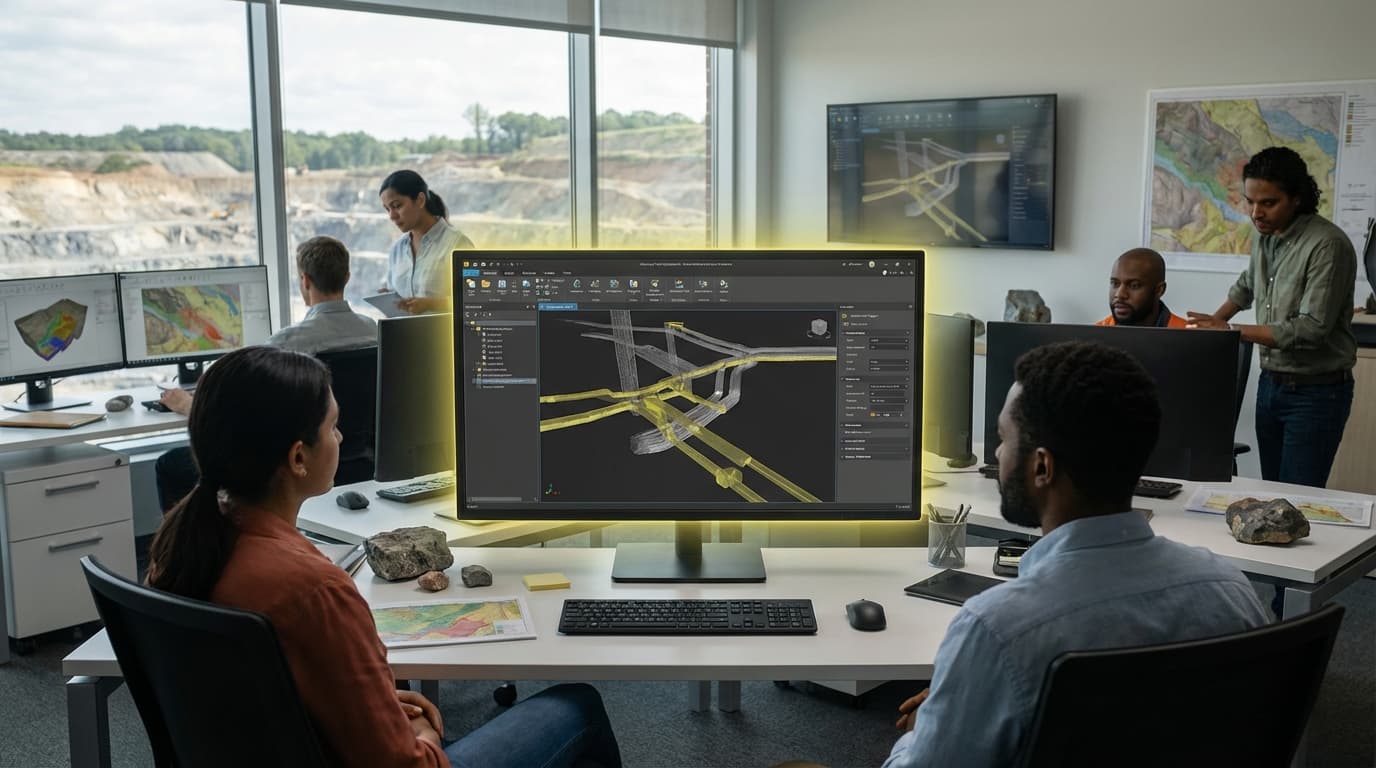
Mining operations face an increasingly complex optimization challenge: balancing economic returns against safety requirements, environmental constraints, and geological uncertainties while working with deposits that are deeper, lower-grade, and more geometrically irregular than ever before. Traditional mine design relies heavily on human expertise and iterative manual adjustments, a process that can take weeks or months and typically explores only a limited subset of possible configurations. Generative mine design software addresses this limitation by employing evolutionary algorithms and machine learning techniques to autonomously explore vast design spaces. These systems work by encoding mine design parameters—including pit shell geometries, haul road networks, ventilation systems, and underground stope sequences—into computational models that can be rapidly evaluated and modified. The algorithms then generate thousands or even millions of design variations, testing each against multiple objectives such as net present value, ore recovery rates, geotechnical stability, worker safety metrics, and environmental impact measures including carbon emissions and water usage. Through successive generations of designs, the software identifies and refines configurations that represent optimal trade-offs across these competing priorities, often revealing non-intuitive solutions that leverage subtle geological features or unconventional extraction sequences.
The mining industry's economic pressures have intensified as easily accessible, high-grade deposits become scarce, forcing operators to extract value from increasingly marginal resources. Generative design software directly addresses this challenge by maximizing resource recovery while minimizing operational costs and capital expenditure. Where a human design team might evaluate a dozen pit configurations over several weeks, these systems can assess thousands of alternatives in hours, accounting for variables such as commodity price fluctuations, equipment availability, and regulatory constraints simultaneously. This capability proves particularly valuable when dealing with complex orebody geometries or when designing hybrid operations that combine open-pit and underground methods. The technology also enables rapid scenario planning, allowing mining companies to quickly assess how design choices perform under different economic conditions or regulatory frameworks. By identifying designs that remain viable across a range of futures, the software helps de-risk major capital investments that can exceed billions of dollars and span decades of operation.
Early commercial deployments of generative mine design software have emerged primarily in large-scale operations where even marginal improvements in efficiency translate to substantial financial returns. Mining companies are integrating these tools into feasibility studies and life-of-mine planning processes, using them to challenge conventional design assumptions and identify value-creation opportunities. The technology has proven especially useful in brownfield expansions, where existing infrastructure constrains design options and the optimization problem becomes particularly complex. Beyond pure economic optimization, these systems are increasingly being applied to sustainability challenges, helping operators design mines that minimize surface disturbance, reduce energy consumption, and facilitate eventual site rehabilitation. As the mining sector faces mounting pressure to reduce its environmental footprint while maintaining productivity, generative design software represents a critical capability for achieving these dual objectives. The technology aligns with broader industry trends toward digitalization and autonomous operations, providing a foundation for mines that can adapt their extraction strategies in real-time as geological understanding improves or market conditions shift.
Related Organizations

Stochastic Mine Planning Laboratory focusing on risk-resilient mine design and production scheduling.

Develops SimSched, a direct block scheduler that uses global optimization to generate mine plans without traditional pit limits.

Polymathian
Australia · Company
Industrial mathematics company (acquired by Deswik) using advanced solvers for value chain optimization.
Hosts the Center for Space Resources, a leading academic hub for ISRU research and education.

Developer of Maptek Evolution, which uses genetic algorithms for strategic mine scheduling and design.

Acquired Alastri to enhance their mine planning suite with automated scheduling capabilities.

Develops XPAC Solutions, a scheduling platform that uses heuristics and solvers to generate mine plans.

Uses machine learning to predict defects and optimize production in metals, expanding into mining optimization.

Developing a swarm of AI-powered industrial robots for mining on Earth, with the explicit goal of expanding to the Moon and Mars.
Supporting Evidence
Research this in Signals
Signals turns a topic into a sourced research record you can inspect and rerun. Your first scan is free, and this one starts with Generative Mine Design Software already loaded, so edit it or scan as is.