








Regenerative Agriculture
Regenerative Agriculture at Scale
Farming systems that restore soil health and sequester carbon while maintaining yields
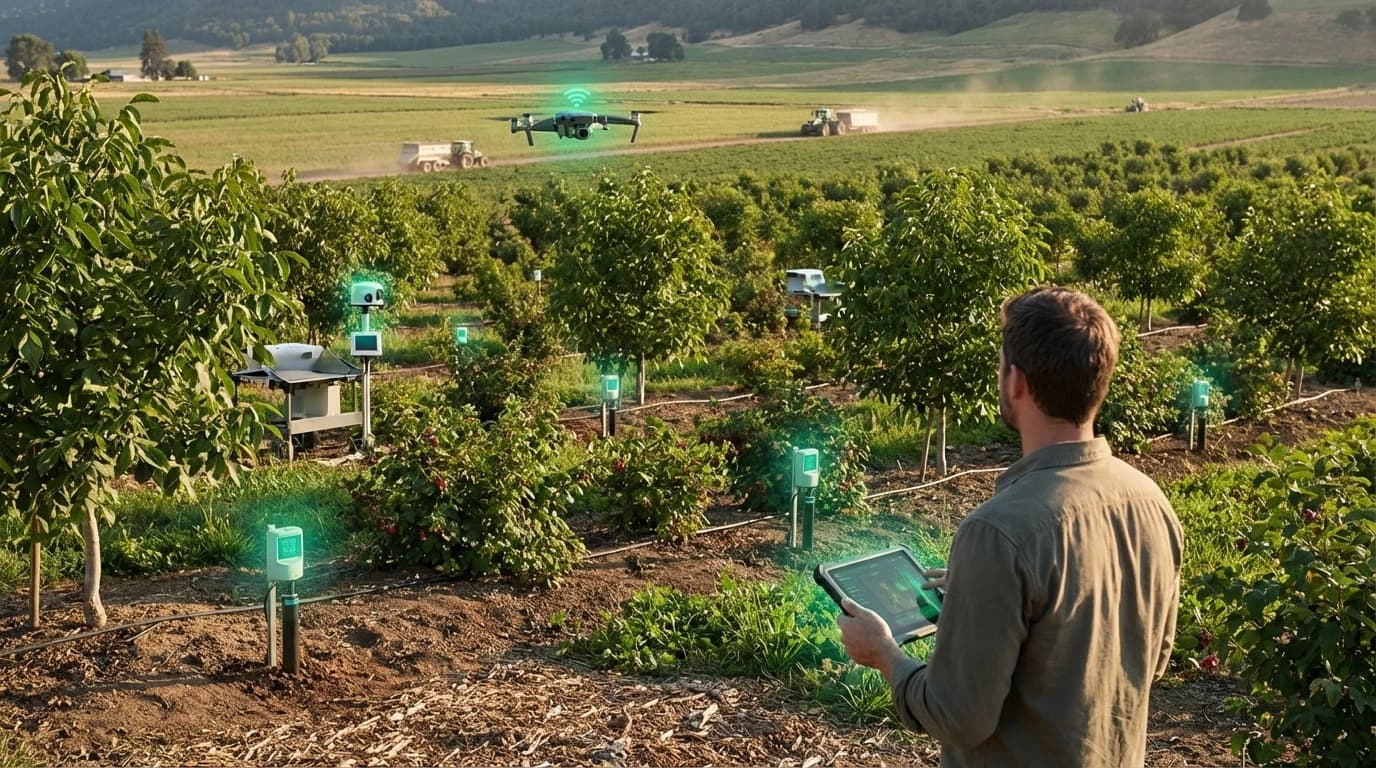
Regenerative agriculture at scale represents a fundamental shift from extractive farming practices toward systems that actively restore soil health, sequester carbon, and enhance biodiversity while maintaining or improving yields. Unlike conventional agriculture, which often depletes soil organic matter and relies heavily on synthetic inputs, regenerative approaches integrate perennial crop systems, cover cropping, rotational grazing, and minimal tillage to rebuild living soil ecosystems. The technical foundation rests on understanding soil as a dynamic biological system rather than an inert growing medium. Practices such as maintaining continuous living roots, increasing plant diversity, and integrating livestock create conditions where soil microbiomes flourish, organic carbon accumulates, and water infiltration improves. What distinguishes the current wave of regenerative agriculture is the integration of digital measurement, reporting, and verification (MRV) platforms that use satellite imagery, soil sensors, and predictive analytics to quantify outcomes with unprecedented precision. These systems track soil organic carbon levels, water retention capacity, and biodiversity indicators, transforming what were once qualitative farming philosophies into data-driven methodologies with verifiable environmental outcomes.
The agricultural industry faces mounting pressure from climate commitments, consumer demand for sustainable products, and the economic reality that degraded soils produce diminishing returns. Conventional farming's reliance on tillage, monocultures, and synthetic fertilizers has contributed to soil erosion, greenhouse gas emissions, and declining farm profitability in many regions. Regenerative agriculture addresses these interconnected challenges by creating systems that reduce input costs while generating new revenue streams through carbon markets and sustainability-linked financing. The ability to verify carbon sequestration and other ecosystem services through digital platforms enables farmers to participate in emerging environmental markets, where corporations and governments pay for measurable climate benefits. This financial architecture de-risks the transition period when farmers adopt new practices, providing income stability while soil health improves. Food multinationals and grain merchandisers increasingly fund regional regenerative hubs that offer agronomy services, equipment sharing, and outcome guarantees, allowing thousands of farms to transition simultaneously rather than in isolation. This aggregated approach creates economies of scale in both practice adoption and market access, making regenerative methods financially viable for operations of varying sizes.
Early implementations demonstrate the model's potential, with initiatives like General Mills' regenerative wheat programs and Indigo Agriculture's Terraton Initiative showing how aggregated data combined with financial incentives can accelerate adoption. These programs typically provide farmers with upfront payments for practice changes, technical support during transition, and premium prices for regeneratively grown commodities. Current deployments focus primarily on annual crops and grazing systems, but the next phase envisions integration of perennial grain varieties, agroforestry configurations, and adaptive grazing systems optimized through artificial intelligence. Research into perennial crops promises to reduce tillage needs further while extending root systems that sequester more carbon, though commercial varieties remain limited. Significant challenges persist, particularly in measuring below-ground carbon stocks accurately and cost-effectively at field scale, aligning economic incentives between landowners and tenant farmers, and establishing trusted marketplaces where regenerative premiums reflect true environmental value. Industry analysts note that standardized contracts, blended finance models combining public and private capital, and improved remote sensing technologies are gradually addressing these barriers. As climate policy increasingly values agricultural carbon sequestration and soil health becomes recognized as critical infrastructure, regenerative agriculture at scale represents not merely an alternative farming method but a necessary evolution in how food systems interact with planetary boundaries.
TRL
8/9Deployed
Impact
5/5
Investment
4/5
Category
Applications
Related Organizations
Improves grower profitability and environmental sustainability using microbiology and digital technologies.
Deployer
Develops MRV (Measurement, Reporting, and Verification) software for agriculture, modeling soil carbon sequestration and GHG emissions at the field level.
Developer
A nonprofit research institution that pioneered the concept of regenerative organic agriculture.
Researcher
Europe's leading soil carbon platform, issuing certificates to farmers for regenerative transitions.
Deployer
Develops microbial seed coatings that increase soil carbon sequestration in cropping systems.
Developer
Develops handheld hardware and software for in-situ soil carbon measurement to lower the cost of verification.
Developer
Creator of BeCrop technology, which analyzes soil biology to assess health and functionality.
Developer
Uses satellites and AI to measure soil carbon globally, enabling carbon credits for developing nations.
Developer
Digital platform helping farmers transition to regenerative agriculture and connecting them with food companies.
Deployer
Major food corporation with a commitment to advance regenerative agriculture on 1 million acres by 2030.
Investor
What was expected
Published forecasts about this technology, graded against what happened in Hindsight.
Regenerative Farming Goes Mainstream
Supporting Evidence
Evidence data is not available for this technology yet.
Research this in Signals
Scan Regenerative Agriculture at Scale for yourself.
Signals turns a topic into a sourced research record you can inspect and rerun. Your first scan is free, and this one starts with Regenerative Agriculture at Scale already loaded, so edit it or scan as is.