Autonomous Agroecological Farms
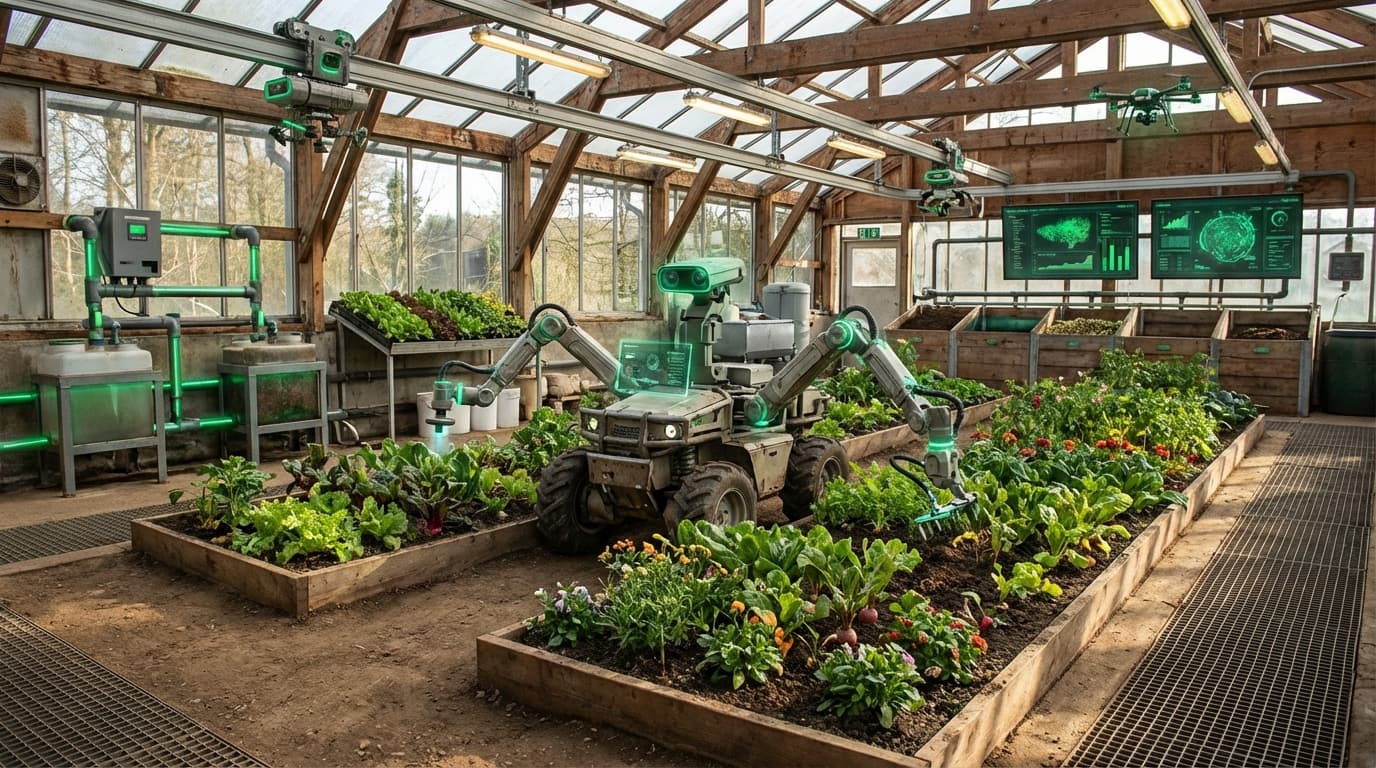
Autonomous agroecological farms represent a convergence of robotics, ecological design principles, and closed-loop resource management to create highly productive agricultural systems that work with natural processes rather than against them. Unlike conventional automated farms that rely on monocultures and simplified environments, these systems deploy coordinated fleets of specialized robots to manage the complexity inherent in polyculture growing—where multiple crop species are cultivated together to mimic natural ecosystems. Small autonomous units navigate between diverse plantings, performing tasks such as precision seeding, mechanical weeding that distinguishes between dozens of plant species, targeted application of organic amendments, and distribution of beneficial microorganisms that enhance soil health. Sensor networks embedded throughout the farm continuously monitor soil microbial activity, moisture gradients, nutrient availability, and microclimate conditions within the crop canopy, feeding data to AI systems that orchestrate planting schedules, irrigation cycles, and nutrient distribution. Water management follows closed-loop principles, capturing and treating condensate, recycling greywater, and integrating rainwater harvesting, while composting systems and anaerobic digesters convert organic waste into nutrients that are precisely matched to crop uptake patterns, eliminating external fertilizer inputs.
The agricultural sector faces mounting pressure to reduce its environmental footprint while feeding growing urban populations, yet conventional industrial farming relies heavily on chemical inputs, depletes soil health, and contributes significantly to greenhouse gas emissions. Autonomous agroecological farms address these challenges by demonstrating that automation need not lead to ecological simplification. Research initiatives and early commercial deployments suggest these systems can maintain or even enhance biodiversity while achieving yields comparable to conventional methods, all with dramatically reduced labor requirements—a critical consideration as agricultural labor becomes increasingly scarce and expensive. By locating these farms near urban centers, the model also tackles food miles and supply chain fragility, enabling cities to develop more resilient local food systems. The technology enables a fundamental shift in agricultural economics: rather than competing on commodity prices through scale and simplification, these farms can command premium pricing for diverse, ultra-fresh produce grown using verifiably regenerative methods that sequester carbon rather than emit it.
Current deployments remain largely experimental, with climate-focused venture funds, university research programs, and urban agriculture collectives testing various configurations and business models. Early projects indicate that the primary technical challenge lies not in individual robot capabilities but in coordinating heterogeneous fleets—seeding robots, weeding units, harvest assistants, and monitoring drones—within complex, constantly changing polyculture environments. Ensuring that automation genuinely supports rather than undermines biodiversity requires sophisticated sensing and decision-making systems that can recognize and respond to ecological indicators beyond simple yield metrics. The capital intensity of these systems presents another hurdle, though emerging solutions include modular hardware platforms that allow farms to scale incrementally, open-source farm operating systems that reduce software costs and enable knowledge sharing across sites, and cooperative ownership models that distribute investment across multiple stakeholders. As these technical and economic challenges are addressed, the vision extends beyond individual demonstration farms toward regional networks of autonomous agroecological sites that could fundamentally reshape peri-urban food production, offering a pathway to agriculture that is simultaneously more automated and more ecologically integrated.
Related Organizations

Open-source CNC farming machine for small-scale polyculture.

A top-tier university for agricultural research, specifically in greenhouse and vertical farming innovation.

Solar-powered autonomous robotics platform for soil regeneration.

Specialist university for the agri-food sector.

Develops and markets autonomous electric robots for weeding and hoeing in vegetable farming.

Produces the Autonomous LaserWeeder, which uses AI and lasers to eliminate weeds without chemicals.

Produces ultra-high precision sprayers (ARA) that use AI to target individual weeds.

Alphabet company applying AI and robotics to sustainable agriculture.

Supporting Evidence
Research this in Signals
Signals turns a topic into a sourced research record you can inspect and rerun. Your first scan is free, and this one starts with Autonomous Agroecological Farms already loaded, so edit it or scan as is.