







Air & soil sensors
This page is a narrower case of it.
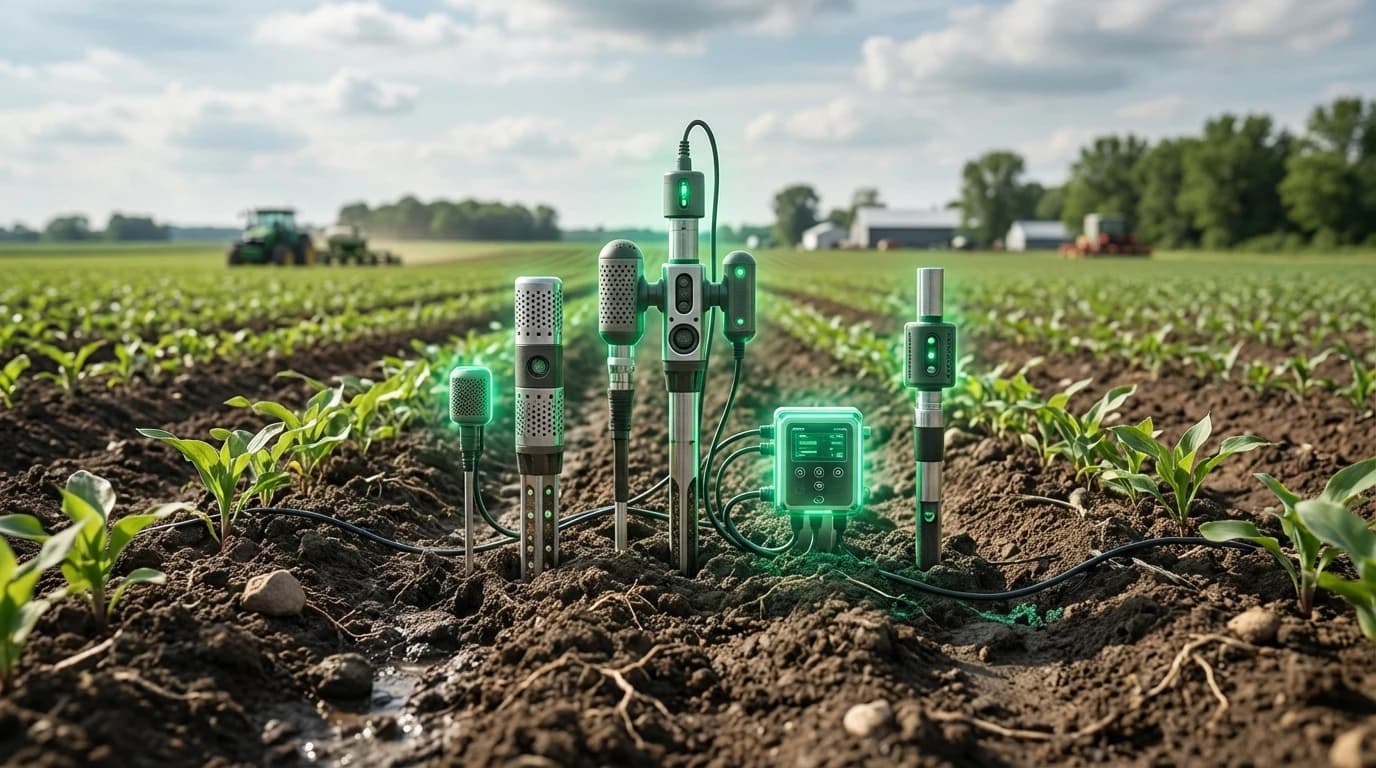
Soil health sensors and microbiome monitors deploy in-situ electrochemical probes, microfluidic cartridges, and lab-on-chip DNA sequencers directly in the root zone to capture real-time data on microbial diversity, nitrogen mineralization, carbon flux, moisture, and salinity. Wireless gateways push readings into agronomic dashboards that pair with decision-support AI, so growers can trigger cover crop seeding, variable-rate nutrient delivery, or grazing rotations based on live soil biology rather than seasonal lab tests.
Regenerative agriculture projects, carbon-market verifiers, and ag insurers use these datasets to quantify soil organic carbon gains, verify conservation compliance, and de-risk lending. Companies such as Yard Stick, Biome Makers, and ChrysaLabs demonstrate that high-frequency microbial and nutrient data improves yield stability while validating sequestration claims needed for premium carbon credits.
Next-generation sensors will integrate with autonomous implements, allowing robots to sample micro-sites and close feedback loops between soil condition and field operations. Persistent challenges include calibrating sensors across diverse soil textures, powering devices in remote paddocks, and establishing open data standards so agronomists can trust cross-platform readings. As standards mature, soil health telemetry will become a foundational layer for climate-smart agriculture finance.
Produces wireless soil probes that measure NPK, pH, and moisture at multiple depths in real-time.
Creator of BeCrop technology, which analyzes soil biology to assess health and functionality.
Developed the FarmLab, a handheld sensor for real-time soil analysis without lab wait times.
Provides comprehensive soil microbiome analysis using DNA sequencing to identify pathogens and beneficial microbes.
Offers a portable soil probe that uses spectroscopy to measure nutrients and carbon in real-time.
Develops handheld hardware and software for in-situ soil carbon measurement to lower the cost of verification.
Combines ground-penetrating radar and electromagnetic induction to map soil compaction and carbon.
Provides a farm management system integrated with proprietary soil sensors for moisture, temperature, and EC.
One of the oldest agricultural research institutions, heavily focused on soil microbiome and health metrics.
Published forecasts about this technology, graded against what happened in Hindsight.
Air & soil sensors
This page is a narrower case of it.
Signals turns a topic into a sourced research record you can inspect and rerun. Your first scan is free, and this one starts with Soil Health Sensors & Microbiome Monitors already loaded, so edit it or scan as is.