








Regenerative Agriculture
Regenerative Agriculture Systems
Farming practices that restore soil health, sequester carbon, and rebuild ecosystem function
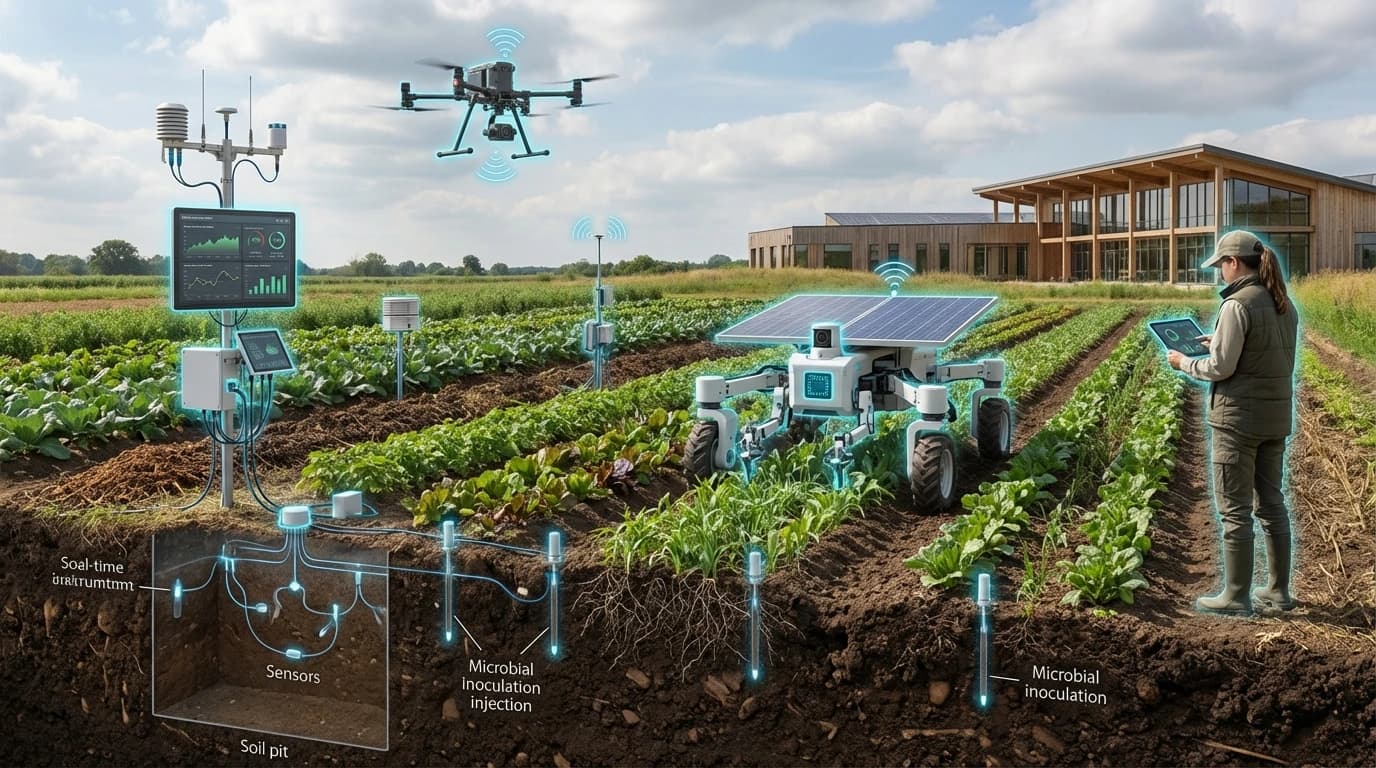
Regenerative agriculture systems represent a fundamental shift from extractive farming methods toward practices that actively restore and enhance the natural systems upon which food production depends. Unlike conventional agriculture, which often depletes soil organic matter, disrupts microbial communities, and requires increasing inputs of synthetic fertilizers and pesticides, regenerative approaches work with ecological processes to build soil health, sequester carbon, and enhance biodiversity. The core mechanisms include minimising soil disturbance through no-till or reduced-till cultivation, maintaining living root systems year-round through cover cropping and diverse crop rotations, integrating livestock through adaptive multi-paddock grazing, and incorporating perennial crops and trees through agroforestry systems. These practices foster complex soil food webs, increase water infiltration and retention, and create habitats for beneficial insects and wildlife. By keeping soil covered and biologically active, regenerative systems can accumulate organic carbon at rates that transform farmland from a net source of greenhouse gas emissions into a significant carbon sink, with research suggesting potential sequestration of multiple tons of carbon dioxide equivalent per hectare annually.
The agricultural sector faces mounting pressures from climate change, soil degradation, water scarcity, and the need to feed a growing global population while reducing environmental impacts. Conventional industrial agriculture has contributed significantly to these challenges, with tillage-intensive monocultures responsible for massive soil carbon losses, erosion rates that exceed soil formation by orders of magnitude, and dependence on fossil fuel-derived inputs. Regenerative agriculture systems address these interconnected problems by rebuilding the natural capital that underpins productive farmland. Farmers adopting these methods report improved drought resilience, reduced input costs as soil fertility increases, and often enhanced profitability despite potential yield variations during transition periods. The approach also creates new economic opportunities through carbon credit markets, premium pricing for regeneratively produced foods, and ecosystem service payments. By drawing on traditional knowledge systems developed over millennia by indigenous communities and smallholder farmers in the Global South, regenerative agriculture offers pathways that are culturally appropriate and locally adaptable rather than dependent on proprietary technologies or external inputs.
Adoption of regenerative practices is accelerating across diverse agricultural contexts, from large-scale grain operations in North America and Australia to smallholder farms in Africa and Asia. Major food companies and retailers have begun establishing regenerative sourcing programmes, while governments in several countries now provide technical assistance and financial incentives for farmers transitioning away from conventional methods. Pilot projects demonstrate that regenerative grazing can restore degraded rangelands while maintaining livestock productivity, and that integrating trees into cropland through agroforestry increases both carbon sequestration and farm income through diversified products. The movement extends beyond individual farm practices to encompass landscape-scale coordination, where neighbouring farms collaborate to create wildlife corridors, manage watersheds, and achieve greater ecological benefits. As climate commitments intensify and the limitations of purely technological solutions become apparent, regenerative agriculture is increasingly recognised as essential infrastructure for long-term food security and climate stability. The challenge ahead lies in scaling these practices rapidly enough to reverse decades of degradation while ensuring that the transition supports farmer livelihoods and maintains food production during the critical decades of this century.
TRL
6/9Demonstrated
Impact
5/5
Investment
4/5
Category
Applications
Related Organizations
A nonprofit research institution that pioneered the concept of regenerative organic agriculture.
Researcher
Promotes holistic management of grasslands to regenerate land and sequester carbon.
Standards Body
Developing perennial grain crops (like Kernza) to replace annual monocultures.
Researcher
Develops MRV (Measurement, Reporting, and Verification) software for agriculture, modeling soil carbon sequestration and GHG emissions at the field level.
Developer
Improves grower profitability and environmental sustainability using microbiology and digital technologies.
Developer
Operates a certified carbon payment program for farmers, using a proprietary calculator to assess operational shifts.
Developer
Uses advanced modeling and simulation to predict how farming practices impact soil carbon and yield.
Developer
An agricultural tech company producing microbial nitrogen fertilizers.
Developer
Software and financing platform specifically for agroforestry implementation.
Developer
Europe's leading food innovation initiative, heavily funding regenerative agriculture pilots and startups.
Investor
What was expected
Published forecasts about this technology, graded against what happened in Hindsight.
Regenerative Farming Goes Mainstream
Supporting Evidence
Evidence data is not available for this technology yet.
Research this in Signals
Scan Regenerative Agriculture Systems for yourself.
Signals turns a topic into a sourced research record you can inspect and rerun. Your first scan is free, and this one starts with Regenerative Agriculture Systems already loaded, so edit it or scan as is.