Attention Restoration Environments
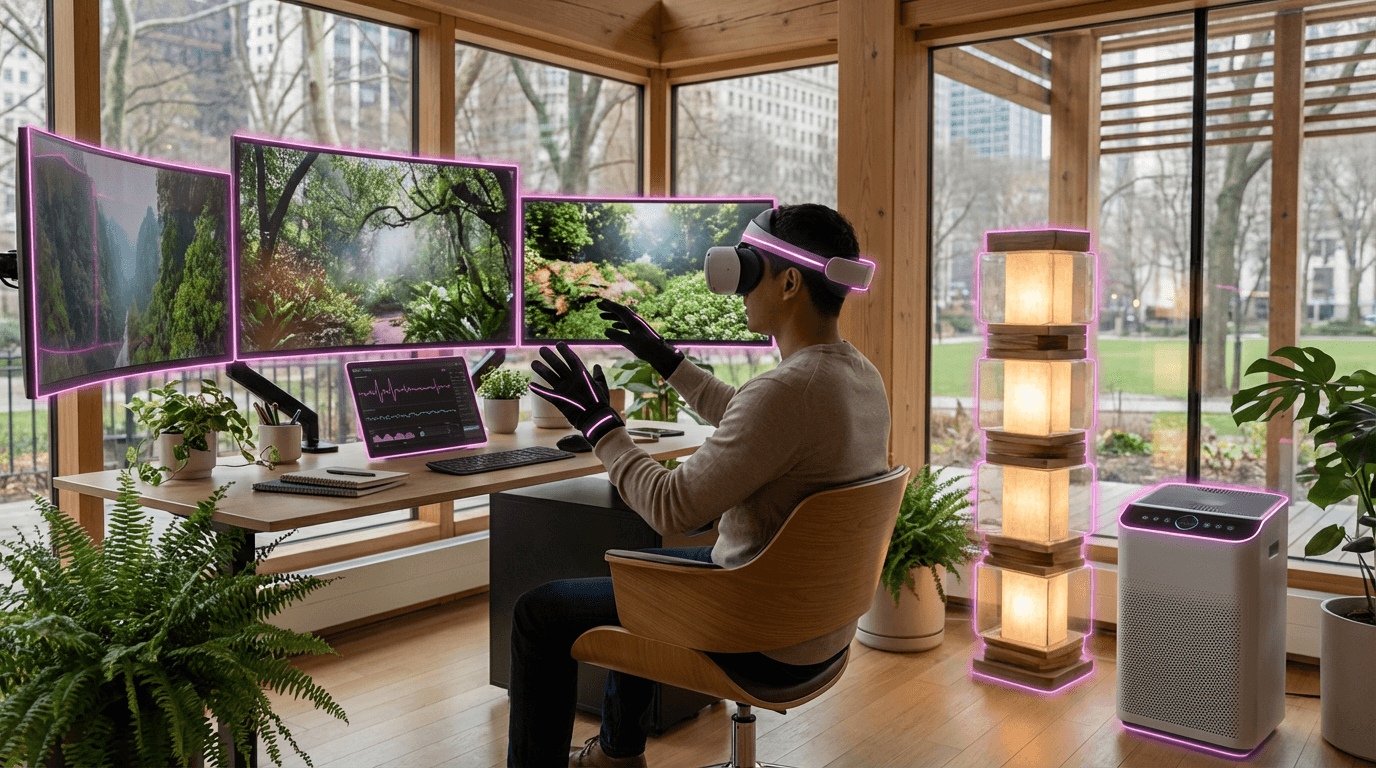
Modern life, particularly in urban environments, subjects individuals to constant cognitive demands that can lead to mental fatigue, reduced focus, and diminished well-being. The phenomenon of "directed attention fatigue"—where the brain's capacity to voluntarily focus becomes depleted—has intensified with the proliferation of digital devices, open-plan workspaces, and information-saturated environments. Attention Restoration Environments address this challenge by applying principles from Attention Restoration Theory, which posits that exposure to certain types of environments can replenish cognitive resources. These systems leverage extended reality (XR) technologies, including virtual reality headsets and augmented reality displays, alongside ambient environmental controls to create immersive or semi-immersive experiences. The technical foundation involves carefully calibrated natural soundscapes—such as flowing water, rustling leaves, or birdsong—combined with biophilic visual elements that mimic natural settings like forests, coastlines, or meadows. These environments are deliberately designed with low-stimulation visuals that avoid the harsh contrasts, rapid movements, and attention-demanding elements typical of urban or digital spaces, instead offering soft fascination that allows the mind to wander without effort.
The workplace wellness sector has emerged as a primary application area for these technologies, as organisations grapple with declining employee productivity and rising burnout rates. Research suggests that even brief exposure to nature-based virtual environments can measurably reduce stress markers and improve subsequent task performance. Healthcare settings have also begun exploring these systems as non-pharmaceutical interventions for anxiety management and post-operative recovery, where access to actual nature may be limited. Educational institutions are investigating their potential to provide students with cognitive breaks between intensive study sessions. The technology addresses a fundamental limitation of urban living: the scarcity of accessible natural environments that traditionally served this restorative function. By digitally replicating the psychological benefits of nature exposure, these systems offer a scalable solution that doesn't require physical proximity to parks or wilderness areas.
Early commercial deployments have appeared in corporate wellness programs, meditation apps, and specialised recovery pods in airports and office buildings. Some implementations use simple ambient displays that project nature scenes onto walls, while more sophisticated versions employ full VR immersion with spatial audio and even haptic feedback to simulate natural textures. The technology is evolving beyond purely visual and auditory experiences to incorporate olfactory elements and temperature variations that enhance the sense of presence. As remote work continues to blur the boundaries between professional and personal spaces, and as concerns about screen time and digital wellness intensify, Attention Restoration Environments represent a growing category within the broader mental health technology landscape. The approach aligns with emerging workplace design philosophies that prioritise psychological safety and cognitive sustainability, suggesting that these systems may become standard features in future offices, healthcare facilities, and even residential spaces as society seeks technological solutions to technology-induced problems.
Related Organizations

Indie developers behind 'Nature Treks VR', a benchmark application for virtual nature exploration.

Provides virtual reality and augmented reality stories that change visually based on the user's heart rate (via Apple Watch) or brainwaves (via Muse).

A VR wellness platform that integrates with flow-state sensors and wearables to customize the visual journey based on user physiology.

A platform for short VR experiences designed to consciously alter mood and energy states.

Creates personalized soundscapes using AI that adapt in real-time to inputs like heart rate, weather, and circadian rhythm to help users focus, relax, or sleep.


Creators of RelieVRx, an FDA-authorized VR therapeutic for chronic lower back pain.

Operates physical immersive art entertainment venues that use projection mapping and sound to create surreal, restorative environments.

A gaming and social platform that functions across VR headsets, mobile devices, and web browsers, maintaining a unified 3D space.

Supporting Evidence
Research this in Signals
Signals turns a topic into a sourced research record you can inspect and rerun. Your first scan is free, and this one starts with Attention Restoration Environments already loaded, so edit it or scan as is.