Immersive Workspaces and Classrooms
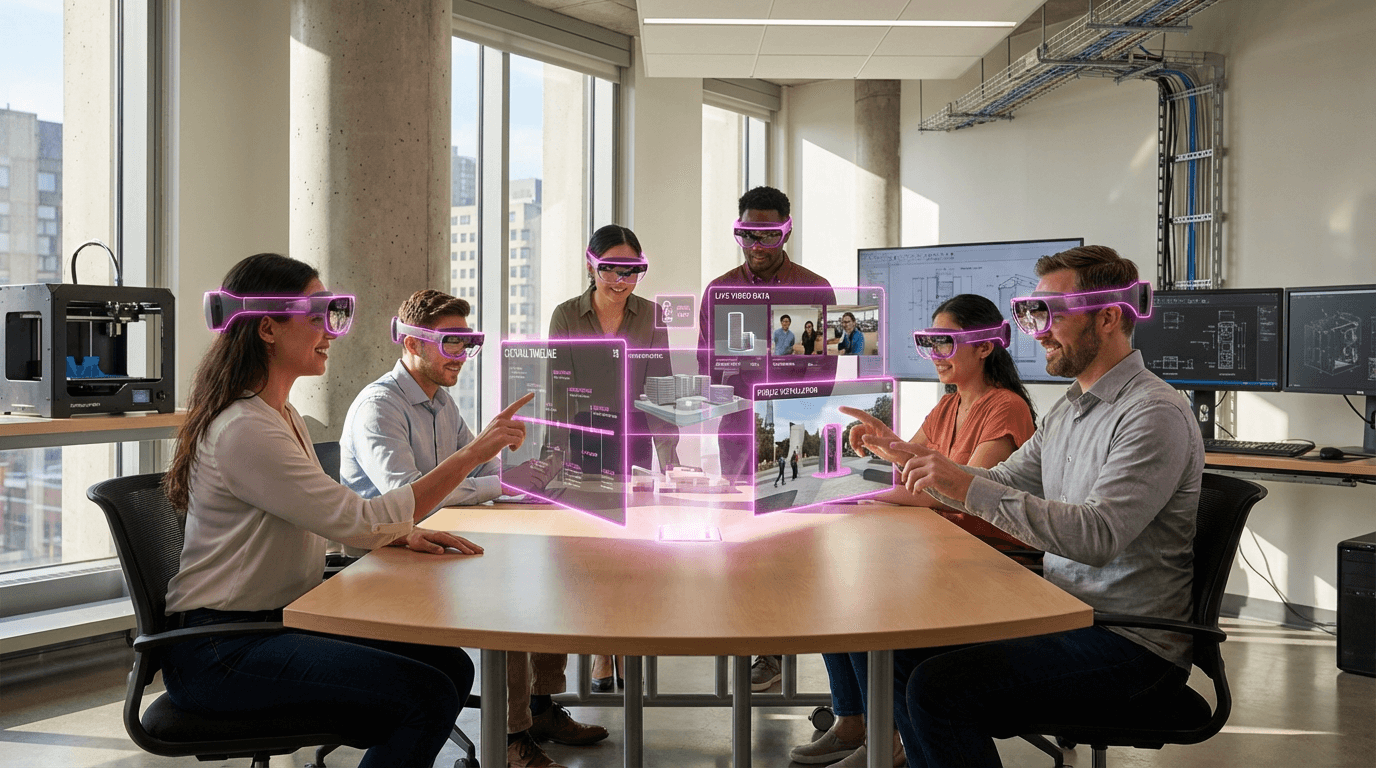
Immersive workspaces and classrooms represent a fundamental shift in how we conceptualize shared environments for collaboration and learning. These systems combine extended reality (XR) technologies—including virtual reality, augmented reality, and mixed reality—with spatial computing to create persistent digital layers that coexist with physical spaces. Unlike traditional video conferencing or screen-based collaboration tools, these environments leverage three-dimensional spatial awareness, allowing participants to interact with digital content and each other as if occupying the same physical room. The technology relies on headsets, spatial sensors, and cloud-based rendering to maintain consistent virtual environments that persist across sessions, preserving the spatial arrangement of objects, notes, and collaborative artifacts. Advanced implementations incorporate biometric sensors and computer vision to detect participant emotions, attention patterns, and engagement levels, enabling what researchers call "affect-aware facilitation"—systems that can adapt the environment or suggest interventions based on the collective emotional state of the group.
The fundamental challenge these platforms address is the loss of embodied presence and spatial context that occurs in remote collaboration. Traditional remote work and distance learning flatten three-dimensional human interaction into two-dimensional screens, eliminating crucial non-verbal cues, spatial memory anchors, and the sense of shared presence that facilitates deep collaboration and learning. In educational contexts, students struggle to maintain engagement and build meaningful peer relationships through conventional video platforms. In professional settings, creative teams lose the spontaneous ideation and spatial thinking that occurs when physically gathered around whiteboards or prototypes. Immersive workspaces restore these dimensions by allowing participants to gesture naturally, arrange virtual objects in space, and build shared spatial memories—the ability to remember "where" a conversation or idea occurred within the virtual environment, mirroring how physical spaces support human memory and collaboration.
Early deployments in corporate training programs and higher education institutions indicate promising adoption patterns, particularly in fields requiring spatial reasoning such as architecture, engineering, and medical education. Design studios are experimenting with hybrid configurations where team members can seamlessly transition between physical desk work and immersive collaborative sessions, maintaining continuity of their spatial workspace across both modes. Educational institutions are piloting virtual campuses that preserve social spaces—lounges, study areas, informal gathering spots—recognizing that learning extends beyond formal instruction. Industry analysts note growing interest from multinational organizations seeking to reduce travel costs while maintaining the collaborative intensity of in-person workshops and design sprints. As the technology matures and hardware becomes more accessible, these platforms are positioned to fundamentally reshape assumptions about presence, proximity, and the nature of shared experience in both professional and educational contexts, potentially enabling new forms of global collaboration that transcend geographic and cultural boundaries while preserving the richness of embodied human interaction.
Related Organizations

Through Copilot and the 'Recall' feature in Windows, Microsoft is integrating persistent memory and agentic capabilities directly into the operating system.

A gaming and social platform that functions across VR headsets, mobile devices, and web browsers, maintaining a unified 3D space.

Academic lab led by Jeremy Bailenson, famous for the 'Becoming Homeless' and 'Coral Reef' empathy studies.

VR education company building 'metaversities' and virtual field trips for schools.

Provides a metaverse platform for education, training, and events.

A VR learning platform for math and science that allows students to experience real-world problems physically.

Builds immersive 3D virtual worlds for work, learning, and events.
A virtual office space provider for enterprise collaboration in VR.

VR productivity software company developing the 'Visor' hardware.

Holographic collaboration system for professional 3D workflows.

Provides virtual laboratory simulations for science education and training.
Supporting Evidence
Research this in Signals
Signals turns a topic into a sourced research record you can inspect and rerun. Your first scan is free, and this one starts with Immersive Workspaces and Classrooms already loaded, so edit it or scan as is.