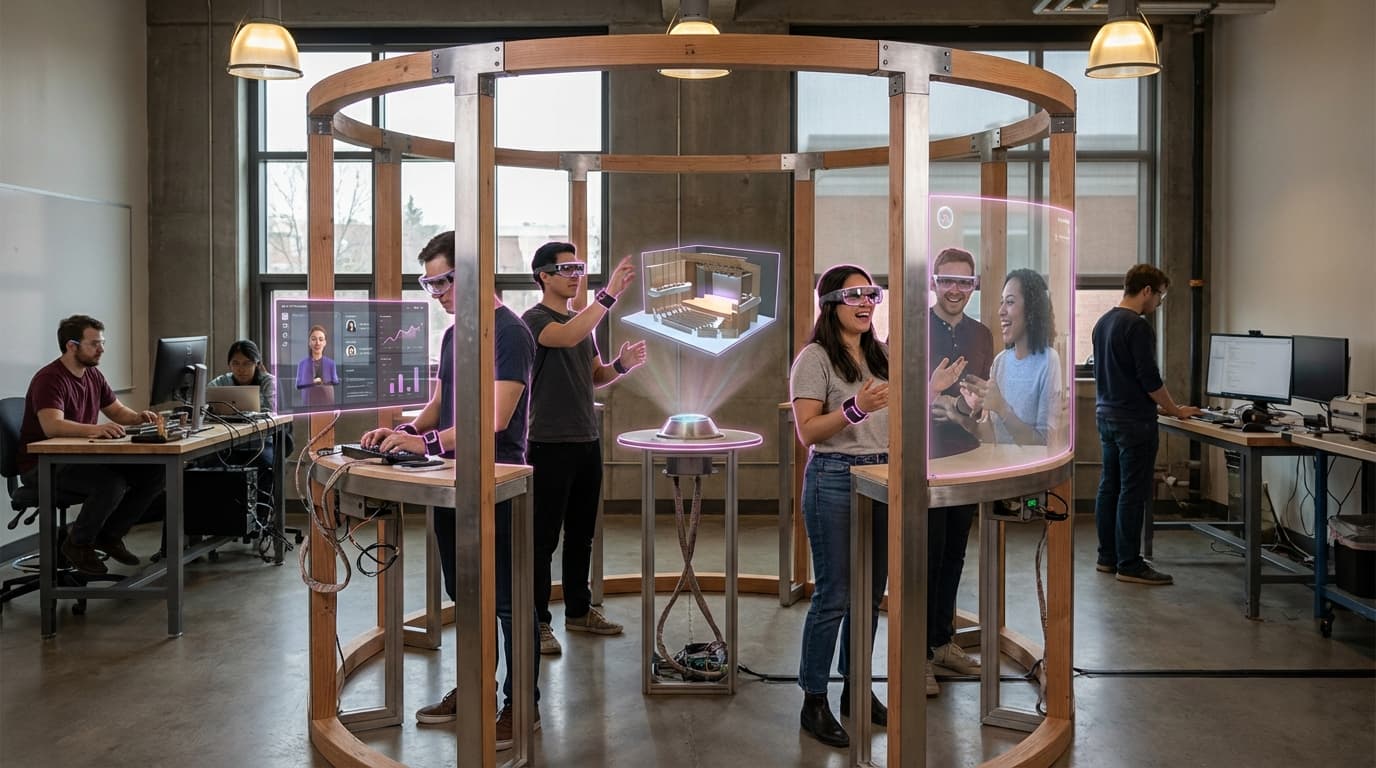
Persistent Social XR Venues
Persistent Social XR Venues represent a fundamental shift in how digital spaces support human connection and community formation. Unlike traditional virtual environments that exist only during scheduled sessions or events, these are always-on social worlds that maintain continuity across time, preserving the spatial memory, social dynamics, and cultural artifacts that accumulate through ongoing use. The technology combines extended reality platforms—spanning virtual reality, augmented reality, and mixed reality interfaces—with persistent state management systems that track and preserve changes to the environment, user-generated content, and social relationships. These venues employ spatial computing to create three-dimensional environments where users can gather, perform, and participate in shared rituals, while generative systems and human curation work in tandem to evolve the space organically. The infrastructure maintains user identities, reputation systems, and social graphs across sessions, enabling the formation of genuine communities with shared histories rather than ephemeral encounters.
The emergence of these persistent venues addresses a growing crisis in social infrastructure, particularly the erosion of "third places"—those informal public gathering spaces beyond home and work where communities traditionally formed. As physical third places like cafes, community centers, and public squares face economic pressures and changing urban patterns, many people experience increasing social isolation and fragmentation. Persistent Social XR Venues offer a digital alternative that preserves the essential qualities of third places: regular gathering, informal interaction, and the development of community norms and culture. They solve critical challenges in existing social platforms, which often struggle to maintain engagement beyond novelty or fail to support the depth of interaction necessary for meaningful community building. By enabling asynchronous participation—where users can leave traces, messages, and modifications that persist for others to discover—these venues create a sense of place and continuity that ephemeral chat rooms and video calls cannot provide. They also unlock new possibilities for distributed communities to maintain cultural practices, host performances, and conduct rituals that would be impossible to coordinate across geographic distances in physical space.
Early implementations of persistent social XR venues have emerged in platforms designed for virtual concerts, community gatherings, and creative collaboration, though widespread adoption remains in nascent stages. These spaces are being explored for applications ranging from support groups and educational communities to artistic performances and cultural celebrations that transcend geographic boundaries. Some venues incorporate procedural generation to expand and evolve their environments based on community activity, while others emphasize handcrafted spaces that reflect the aesthetic sensibilities of their communities. The technology aligns with broader trends toward the spatial internet and embodied social computing, where presence and spatial relationships become primary modes of digital interaction. As XR hardware becomes more accessible and social isolation continues to challenge urban populations, persistent social venues may evolve into essential infrastructure for maintaining community bonds, preserving cultural practices, and creating new forms of shared experience that blend the spontaneity of physical gathering with the flexibility and reach of digital connection.
Related Organizations

Social VR platform with an advanced Inverse Kinematics (IK) system supporting full-body tracking.

A social VR/gaming platform heavily focused on user-generated content.

Massive gaming platform with a persistent avatar identity system across millions of user-created experiences.

A gaming and social platform that functions across VR headsets, mobile devices, and web browsers, maintaining a unified 3D space.

Japan's largest metaverse platform, allowing users to gather in virtual spaces from smartphones, PCs, and VR headsets.

Provides a metaverse platform for education, training, and events.

A creative social VR platform (spiritual successor to NeosVR) emphasizing limitless creativity and collaborative building.

Builds immersive 3D virtual worlds for work, learning, and events.

Software company turned hardware manufacturer with the Bigscreen Beyond headset.

An open VR world that natively supports external NFT assets and avatars.
Supporting Evidence
Research this in Signals
Signals turns a topic into a sourced research record you can inspect and rerun. Your first scan is free, and this one starts with Persistent Social XR Venues already loaded, so edit it or scan as is.