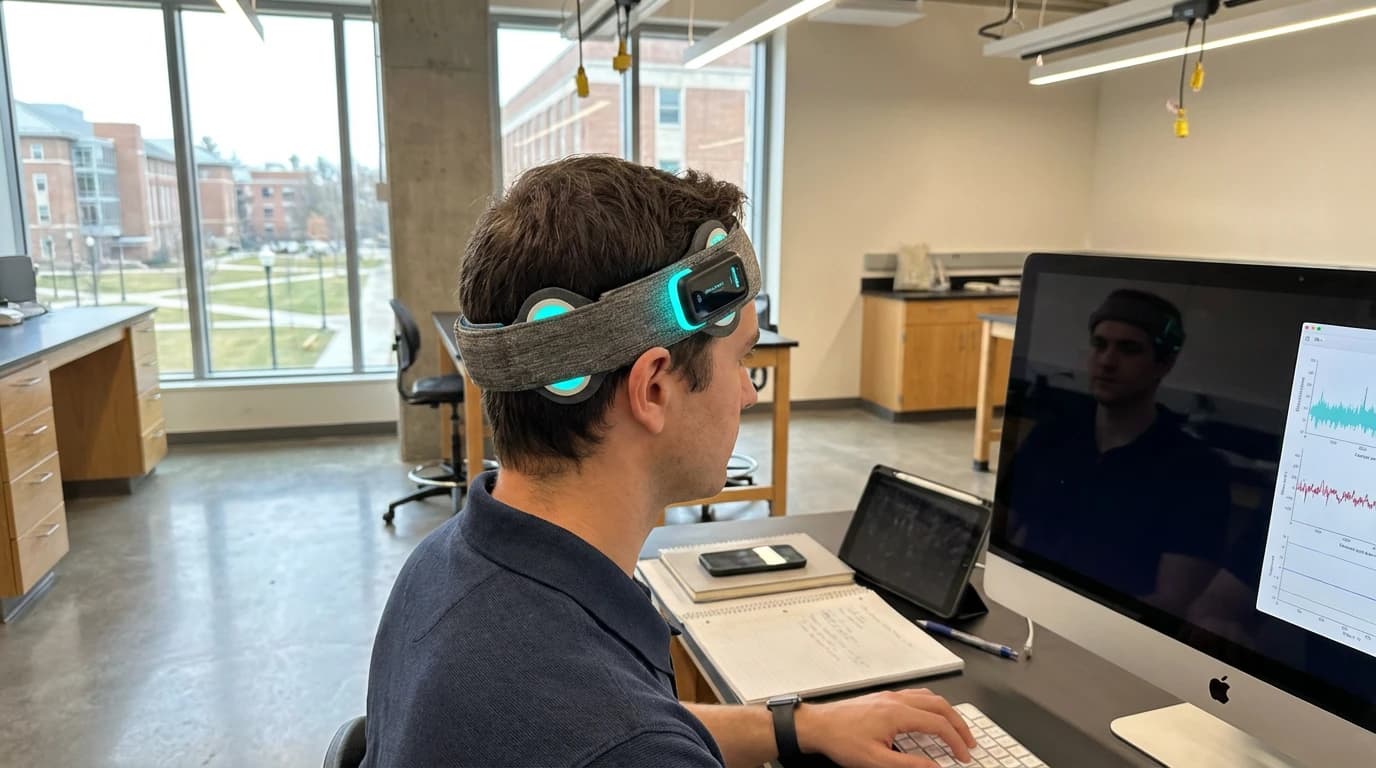
Closed-Loop Neurofeedback Headbands
Closed-loop neurofeedback headbands represent a convergence of consumer-grade electroencephalography (EEG) sensors, real-time signal processing, and adaptive feedback mechanisms designed to help individuals develop greater awareness and control over their cognitive states. Unlike traditional clinical neurofeedback systems that require specialized equipment and trained operators, these wearable devices employ dry-electrode sensors positioned along the forehead or around the scalp to detect electrical activity associated with different brainwave frequencies—particularly alpha waves linked to relaxation, beta waves associated with focused attention, and theta waves connected to meditative states. The "closed-loop" aspect refers to the system's ability to continuously monitor brain activity, process this data through proprietary algorithms, and deliver immediate sensory feedback through auditory tones, visual cues on companion apps, or subtle haptic vibrations. This creates a responsive training environment where users receive moment-to-moment information about their neural patterns, enabling them to experiment with mental strategies and observe their physiological effects in real time.
The wellness and productivity challenges these devices address are rooted in the growing recognition that many individuals struggle with attention regulation, stress management, and mental fatigue in increasingly demanding environments. Traditional approaches to developing these capacities—such as meditation instruction or cognitive behavioral techniques—often lack objective measures of progress and can feel abstract to practitioners. Closed-loop neurofeedback headbands bridge this gap by making invisible cognitive processes tangible and trainable. In workplace settings, early adopters report using these devices to establish pre-work focus routines or to signal when mental fatigue requires a break. Educational applications include attention training for students with focus difficulties, offering an alternative or complement to pharmaceutical interventions. Clinical contexts have explored these tools for anxiety management and sleep preparation, where users learn to shift their brainwave patterns toward states associated with calm and relaxation. By democratizing access to neurofeedback principles previously confined to specialized clinics, these headbands enable a form of cognitive skill-building that was historically inaccessible to most people.
Current implementations range from consumer wellness products available through direct purchase to specialized programs integrated into corporate wellness initiatives and therapeutic settings. Several manufacturers have developed companion mobile applications that gamify the training experience, presenting users with tasks that become easier or more difficult based on their real-time brain state—such as a virtual ball that rises when focus increases or ambient soundscapes that become more harmonious as relaxation deepens. Research in human-computer interaction and neuroscience continues to refine the accuracy of consumer-grade sensors and the effectiveness of different feedback modalities, with ongoing investigations into which training protocols produce lasting changes in self-regulation capacity. As these devices become more sophisticated and validation studies accumulate, they represent part of a broader movement toward quantified mental wellness—tools that make psychological states measurable and improvable through deliberate practice. The trajectory suggests these headbands may evolve from standalone training devices into integrated components of comprehensive digital wellness ecosystems, potentially connecting with other biometric sensors and adaptive environments to support sustained cognitive health throughout daily life.
Related Organizations

Develops the Muse EEG headband and software platform that adapts audio soundscapes in real-time based on the user's brain state (meditation/focus).
Creates open-source brain-computer interface tools and the Galea headset (integrating with VR) for researching physiological responses.

Produces a comprehensive 5-in-1 brain training headset combining neurofeedback and photobiomodulation.

Develops BMI technology including the FocusCalm headband and prosthetic hands.

Produces EEG headsets and the BCI-OS platform, allowing developers to build applications that respond to cognitive stress and facial expressions.

Develops BCI-enabled headphones that detect focus and intent to control digital experiences.

Provides a remote neurofeedback platform using consumer wearables (like Muse) to treat ADHD and anxiety.

Develops semi-dry and dry EEG wearable devices for human behavior research and neurotechnology applications.

Consumer fNIRS headband for brain training and blood flow monitoring.

Manufacturer of biosensor chips (ThinkGear) and the MindWave headset, enabling low-cost consumer EEG.
Supporting Evidence
Research this in Signals
Signals turns a topic into a sourced research record you can inspect and rerun. Your first scan is free, and this one starts with Closed-Loop Neurofeedback Headbands already loaded, so edit it or scan as is.