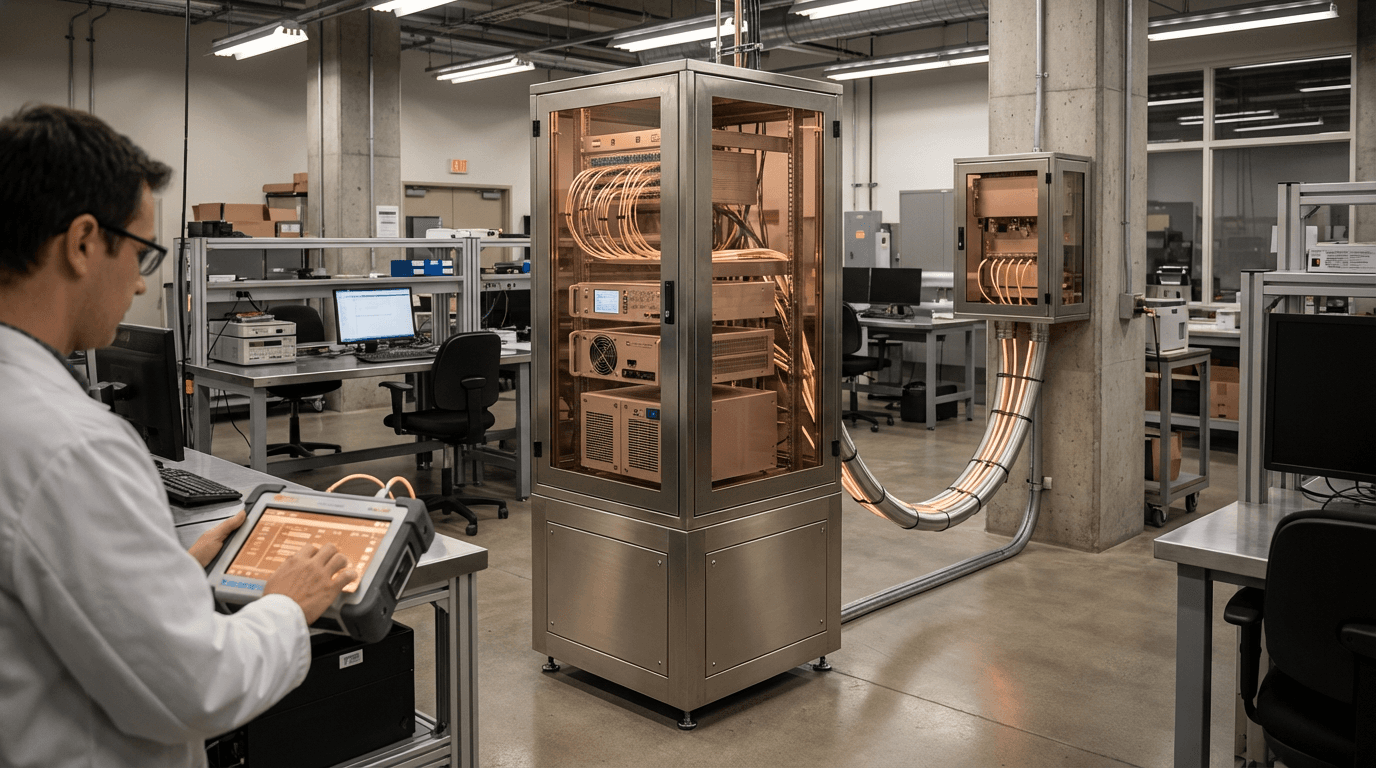
Quantum Key Distribution Networks
Quantum Key Distribution (QKD) represents a fundamental shift in secure communications, moving beyond mathematical complexity to leverage the immutable laws of physics for cryptographic protection. At its core, QKD exploits quantum mechanical properties—primarily the behavior of individual photons—to establish encryption keys between parties. When photons are transmitted through fiber optic cables or free-space optical links, they carry information encoded in quantum states such as polarization or phase. The revolutionary aspect lies in the quantum no-cloning theorem and Heisenberg's uncertainty principle: any attempt to intercept or measure these quantum states inevitably disturbs them, leaving detectable traces of eavesdropping. This creates a communication channel where the mere act of observation by an unauthorized party alerts legitimate users to the breach. The distributed network architecture extends this capability beyond point-to-point links, creating mesh topologies where multiple nodes can establish secure keys across entire metropolitan areas or even between cities, with trusted relay stations extending range beyond the typical limitations of quantum signal degradation.
The emergence of QKD networks addresses a critical vulnerability facing governments, financial institutions, and critical infrastructure operators: the looming threat of quantum computers capable of breaking current public-key cryptography. Research suggests that sufficiently powerful quantum computers could decrypt communications secured with RSA or elliptic curve cryptography, potentially exposing decades of archived sensitive data. This "harvest now, decrypt later" threat has accelerated interest in quantum-safe communications. QKD networks solve this by providing information-theoretic security—protection that doesn't depend on computational difficulty but on fundamental physical laws. Early deployments indicate particular value for securing inter-bank transactions, government communications, and power grid control systems, where the consequences of compromised encryption could be catastrophic. The technology also enables new trust architectures, allowing organizations to verify the integrity of transmitted data without relying on potentially vulnerable certificate authorities or key management hierarchies.
Several countries have already established operational QKD networks, with China operating a 2,000-kilometer backbone connecting Beijing and Shanghai, while European initiatives have demonstrated metropolitan-scale deployments. Financial institutions in Asia and Europe have begun pilot programs for securing high-value transactions, and defense agencies worldwide are evaluating QKD for classified communications. Current implementations face practical challenges including limited transmission distances before signal degradation, the need for specialized hardware at each node, and integration with existing network infrastructure. However, advances in quantum repeater technology and satellite-based QKD promise to extend coverage globally. As the quantum computing threat transitions from theoretical to practical, QKD networks are evolving from experimental curiosities to essential components of critical communication infrastructure. The technology represents a convergence of quantum physics and network engineering, offering a pathway toward communications security that remains robust even against adversaries with unlimited computational power—a crucial capability as we enter an era where traditional cryptographic assumptions may no longer hold.
Related Organizations

A global leader in quantum cybersecurity solutions, specifically known for their Quantis QRNG chips and appliances.

Commercializes quantum communication hardware and builds the ground station infrastructure connecting to satellites.

A major researcher and developer of QKD technology, holding numerous patents and deploying commercial QKD networks.

Provider of quantum-safe cryptography and operator of Phio TX, a commercial QKD network in the US.

Australian quantum cybersecurity company offering high-throughput QRNG appliances.

Develops QKD hardware specifically designed for critical infrastructure protection, such as the electric grid.

Develops chip-based QKD hardware to miniaturize quantum security for telecommunications.

South Korea's largest wireless telecommunications operator.

British multinational telecommunications holding company conducting extensive QKD trials and commercial pilots.

Spin-off from ICFO developing Continuous Variable QKD (CV-QKD) systems for metropolitan networks.
Supporting Evidence
Research this in Signals
Signals turns a topic into a sourced research record you can inspect and rerun. Your first scan is free, and this one starts with Quantum Key Distribution Networks already loaded, so edit it or scan as is.