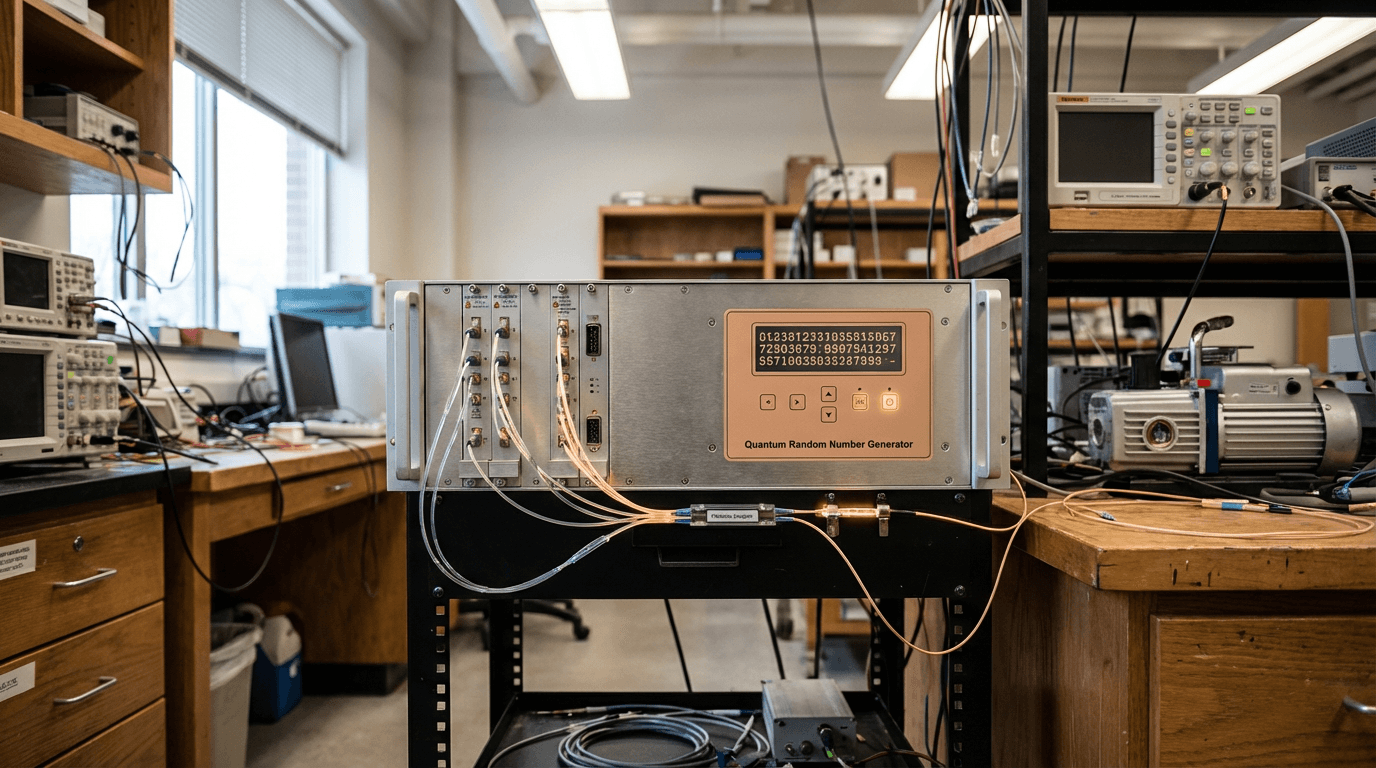
Quantum Random Number Generators
Quantum Random Number Generators represent a fundamental shift in how we approach randomness in digital systems, addressing a critical vulnerability in modern cryptographic infrastructure. Traditional pseudo-random number generators, which rely on deterministic algorithms seeded with initial values, can theoretically be predicted if the algorithm and seed are known—a weakness that poses significant risks for encryption systems, authentication protocols, and secure communications. QRNGs solve this problem by harnessing quantum mechanical phenomena such as photon polarization, beam splitter outcomes, or radioactive decay timing—events that are fundamentally probabilistic according to the laws of quantum physics. These devices typically employ specialized hardware configurations, such as single-photon detectors measuring the arrival time of photons passing through a beam splitter, or systems that measure quantum vacuum fluctuations. The resulting randomness is not merely computationally difficult to predict but is theoretically impossible to determine in advance, providing what cryptographers call "true entropy" rather than algorithmic approximations.
The implications for trust and verification systems are profound, particularly as cyber threats grow more sophisticated and quantum computing threatens to break many existing encryption schemes. Current cryptographic protocols depend heavily on the quality of random number generation for creating encryption keys, digital signatures, and authentication tokens. Weak randomness has been the root cause of numerous security breaches, where attackers successfully predicted supposedly random values and compromised systems. QRNGs eliminate this vulnerability by providing certifiable randomness that can be verified through quantum mechanical principles. This capability is especially critical for high-security applications in financial services, government communications, defense systems, and critical infrastructure protection. Furthermore, as organizations prepare for the post-quantum cryptography era, QRNGs provide a foundation for quantum key distribution networks and other quantum-safe security architectures, enabling verification systems that remain secure even against adversaries with quantum computational capabilities.
Several commercial QRNG systems have already entered the market, with implementations ranging from rack-mounted enterprise devices to compact modules integrated into network security appliances. Research institutions and telecommunications companies have deployed QRNGs in pilot quantum communication networks, demonstrating their practical viability for securing high-value transactions and sensitive data transmission. The technology has also found applications in scientific research requiring high-quality randomness, including Monte Carlo simulations and statistical sampling. Industry analysts note growing interest from sectors handling sensitive identity verification, such as blockchain networks seeking to enhance the security of digital wallets and smart contracts. As manufacturing techniques improve and costs decrease, integration of QRNG chips into consumer devices and IoT systems appears increasingly feasible, potentially bringing quantum-grade security to everyday authentication scenarios. The convergence of QRNG technology with emerging quantum networks and post-quantum cryptographic standards positions these devices as essential infrastructure for next-generation trust systems, where the ability to verify the true randomness of cryptographic operations becomes as important as the encryption algorithms themselves.
Related Organizations

A global leader in quantum cybersecurity solutions, specifically known for their Quantis QRNG chips and appliances.

Australian quantum cybersecurity company offering high-throughput QRNG appliances.

Manufactures photonic QRNG chips and PCIe cards for high-performance computing and cryptographic applications.

Develops source-device-independent (SDI) QRNGs that self-certify the randomness of the output in real-time.

Integrated quantum computing company formed by Honeywell and CQC.

Develops chip-based QKD hardware to miniaturize quantum security for telecommunications.


Offers a 'Quantum Entropy' service that streams high-quality random numbers from their lab-based QRNGs to clients via the cloud.

South Korea's largest wireless telecommunications operator.
Swiss quantum technology company offering 'Quantum as a Service'.

Leading research university in physics and quantum mechanics.

A major semiconductor manufacturer developing secure chips with hardware support for PQC algorithms.
Supporting Evidence
Research this in Signals
Signals turns a topic into a sourced research record you can inspect and rerun. Your first scan is free, and this one starts with Quantum Random Number Generators already loaded, so edit it or scan as is.