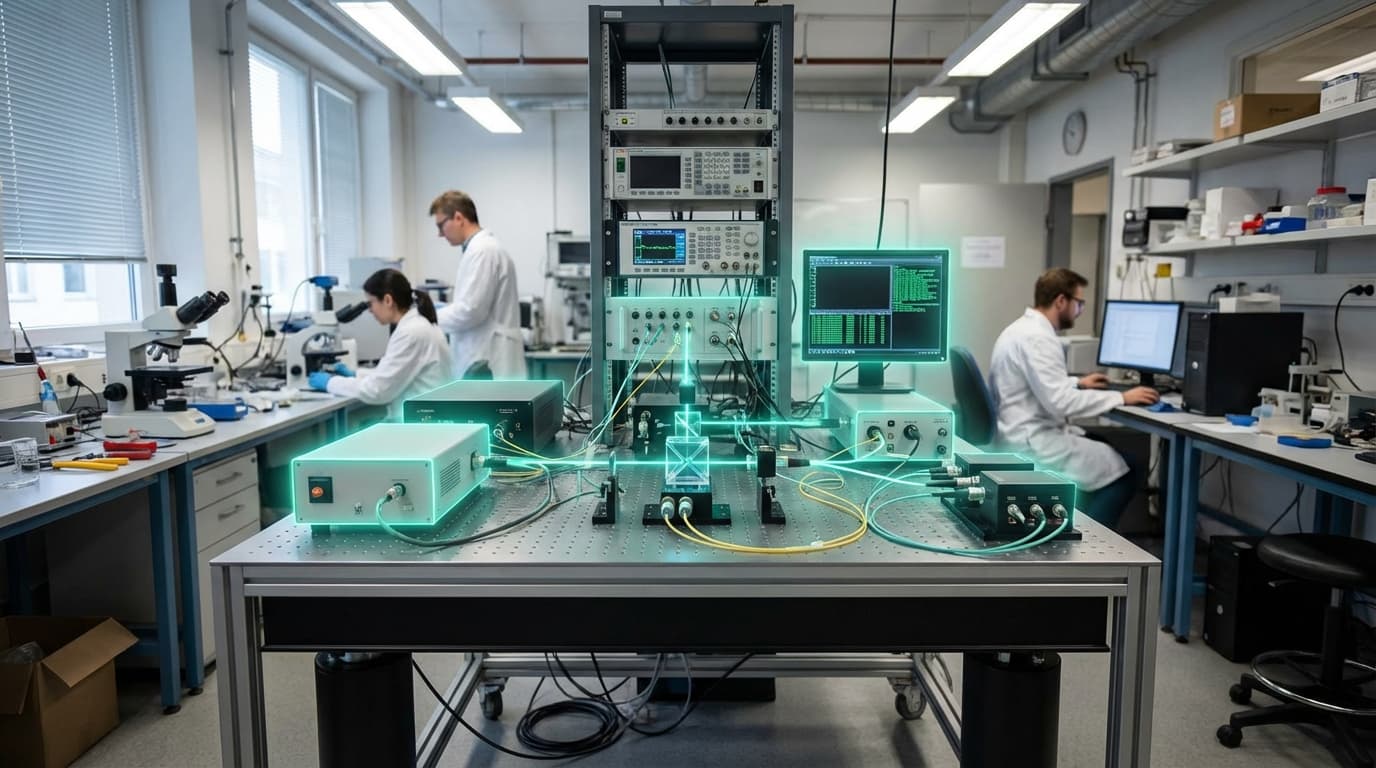
Quantum Key Distribution (QKD)
Quantum Key Distribution represents a fundamental shift in secure communications, leveraging the principles of quantum mechanics to create encryption keys that are theoretically impossible to intercept without detection. Unlike classical encryption methods that rely on mathematical complexity, QKD exploits the quantum properties of photons—typically their polarisation states or phase information—to transmit cryptographic keys between parties. The technology operates on the principle that any attempt to observe or measure a quantum state inevitably disturbs it, a phenomenon rooted in Heisenberg's uncertainty principle. When photons carrying key information are transmitted through optical fibres or free-space channels, any eavesdropping attempt leaves detectable traces in the quantum states, alerting legitimate users to the security breach. This intrinsic detection capability distinguishes QKD from conventional encryption, where interception can occur silently and undetected.
The emergence of quantum computing poses an existential threat to current encryption standards, as sufficiently powerful quantum computers could theoretically break widely-used public-key cryptography systems like RSA and elliptic curve cryptography. This vulnerability creates particular urgency for governments, military organisations, and critical infrastructure operators who must protect sensitive information not only today but decades into the future. QKD addresses this challenge by providing "future-proof" security that remains unbreakable regardless of computational advances. The technology enables secure key exchange for diplomatic communications, military command networks, financial transactions between central banks, and protection of classified intelligence. Beyond immediate security concerns, QKD supports the development of quantum-safe communication networks that can coexist with and eventually replace vulnerable classical systems, ensuring continuity of secure operations during the transition to post-quantum cryptography standards.
Several nations have already deployed QKD networks for government and defence applications, with China operating satellite-based systems for intercontinental secure communications and European countries establishing metropolitan quantum networks connecting government facilities and research institutions. Commercial QKD systems are available from specialised vendors, though adoption remains concentrated in high-security applications due to current limitations in transmission distance and key generation rates. Ongoing research focuses on extending QKD range through quantum repeaters, integrating the technology with existing fibre-optic infrastructure, and developing satellite constellations for global quantum-secure communications. As geopolitical tensions intensify and the timeline for practical quantum computing advances, QKD is transitioning from experimental technology to critical infrastructure component. The establishment of quantum communication networks represents a strategic priority for maintaining information sovereignty and ensuring that sensitive state communications remain protected against both current and future cryptographic threats, positioning QKD as an essential element of national security architecture in an increasingly contested digital domain.
Related Organizations

A global leader in quantum cybersecurity solutions, specifically known for their Quantis QRNG chips and appliances.

Commercializes quantum communication hardware and builds the ground station infrastructure connecting to satellites.

Develops QKD hardware specifically designed for critical infrastructure protection, such as the electric grid.

Australian quantum cybersecurity company offering high-throughput QRNG appliances.

Develops space-based QKD systems to enable global quantum-secure communication networks.

A major researcher and developer of QKD technology, holding numerous patents and deploying commercial QKD networks.

Provides QuantumCloud, a platform that uses a symmetric key agreement protocol originally designed for satellite delivery.

Develops chip-based QKD hardware to miniaturize quantum security for telecommunications.

Provider of quantum-safe cryptography and operator of Phio TX, a commercial QKD network in the US.

South Korea's largest wireless telecommunications operator.
Supporting Evidence
Research this in Signals
Signals turns a topic into a sourced research record you can inspect and rerun. Your first scan is free, and this one starts with Quantum Key Distribution (QKD) already loaded, so edit it or scan as is.