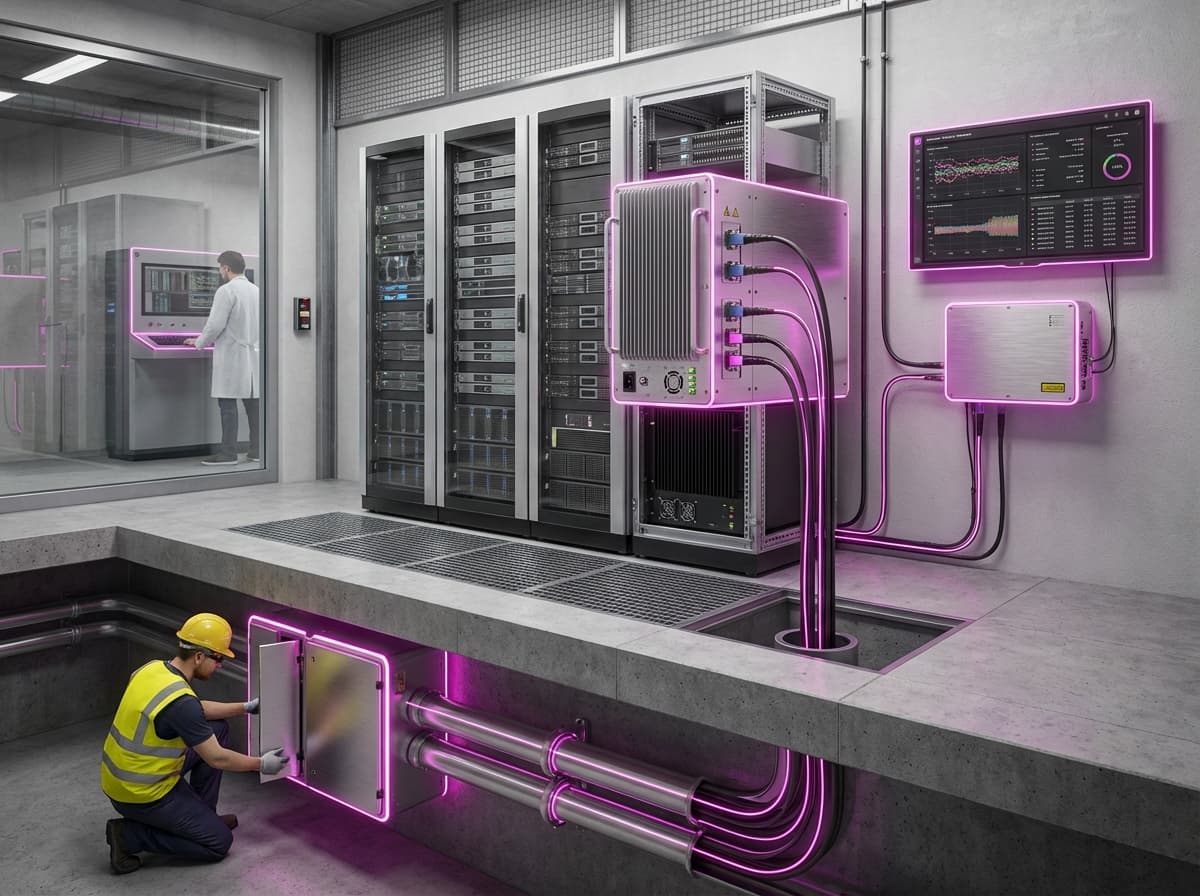
Quantum-Secure Communication Backbones
Modern communication networks face an escalating threat from quantum computing, which promises to render current encryption methods obsolete. Traditional public-key cryptography, which secures everything from banking transactions to power grid control signals, relies on mathematical problems that quantum computers could solve exponentially faster than classical machines. This looming vulnerability has created an urgent need for communication infrastructure that can withstand attacks from both current and future quantum-capable adversaries. Quantum-secure communication backbones address this challenge by integrating quantum key distribution (QKD) directly into the physical infrastructure of backhaul networks—the high-capacity links that connect major network nodes and carry aggregated traffic across cities, regions, and continents. Unlike conventional encryption that depends on computational complexity, QKD leverages the fundamental laws of quantum mechanics to detect any interception attempt. The technology encodes cryptographic keys in the quantum states of individual photons transmitted through fiber-optic cables or free-space optical links. Any attempt to measure or copy these quantum states inevitably disturbs them, alerting legitimate users to the presence of an eavesdropper and allowing them to discard compromised keys before they're used.
The integration of QKD into backbone infrastructure solves a critical vulnerability in sectors where communication security is paramount. Energy utilities require absolute confidence that commands sent to substations and generation facilities haven't been tampered with, as compromised grid control signals could trigger cascading failures across entire regions. Financial institutions similarly depend on the integrity of high-value transaction data flowing between data centers and clearing houses. Traditional encryption methods, while currently robust, operate under the assumption that certain mathematical problems remain computationally hard—an assumption that quantum computing threatens to invalidate within the coming decades. By deploying QKD at the backbone level, network operators can future-proof their most critical communication pathways against this quantum threat while maintaining compatibility with existing network architectures. The technology also addresses compliance requirements in regulated industries, where demonstrable security measures are increasingly mandatory for handling sensitive data.
Early deployments of quantum-secure backbones have emerged in financial districts and government networks, with several metropolitan areas establishing QKD-protected links between key facilities. Research initiatives in Europe and Asia have demonstrated citywide quantum networks spanning dozens of kilometers, while satellite-based QKD systems are extending secure communication capabilities across continental distances where fiber deployment is impractical. The technology currently faces practical constraints including distance limitations in fiber-based systems and the need for specialized hardware at network endpoints, but ongoing advances in quantum repeaters and integrated photonics are progressively addressing these challenges. As quantum computing capabilities mature and the timeline for breaking conventional encryption becomes clearer, the deployment of quantum-secure communication infrastructure is transitioning from experimental installations to strategic infrastructure investments, positioning these systems as essential components of resilient, future-proof network architecture for critical services.
Related Organizations

A global leader in quantum cybersecurity solutions, specifically known for their Quantis QRNG chips and appliances.

Commercializes quantum communication hardware and builds the ground station infrastructure connecting to satellites.

A major researcher and developer of QKD technology, holding numerous patents and deploying commercial QKD networks.
British multinational telecommunications holding company conducting extensive QKD trials and commercial pilots.

Develops QKD hardware specifically designed for critical infrastructure protection, such as the electric grid.

Australian quantum cybersecurity company offering high-throughput QRNG appliances.

South Korea's largest wireless telecommunications operator.

Provides QuantumCloud, a platform that uses a symmetric key agreement protocol originally designed for satellite delivery.

Develops chip-based QKD hardware to miniaturize quantum security for telecommunications.

Multinational telecommunications, information technology, and consumer electronics company.
Supporting Evidence
Research this in Signals
Signals turns a topic into a sourced research record you can inspect and rerun. Your first scan is free, and this one starts with Quantum-Secure Communication Backbones already loaded, so edit it or scan as is.