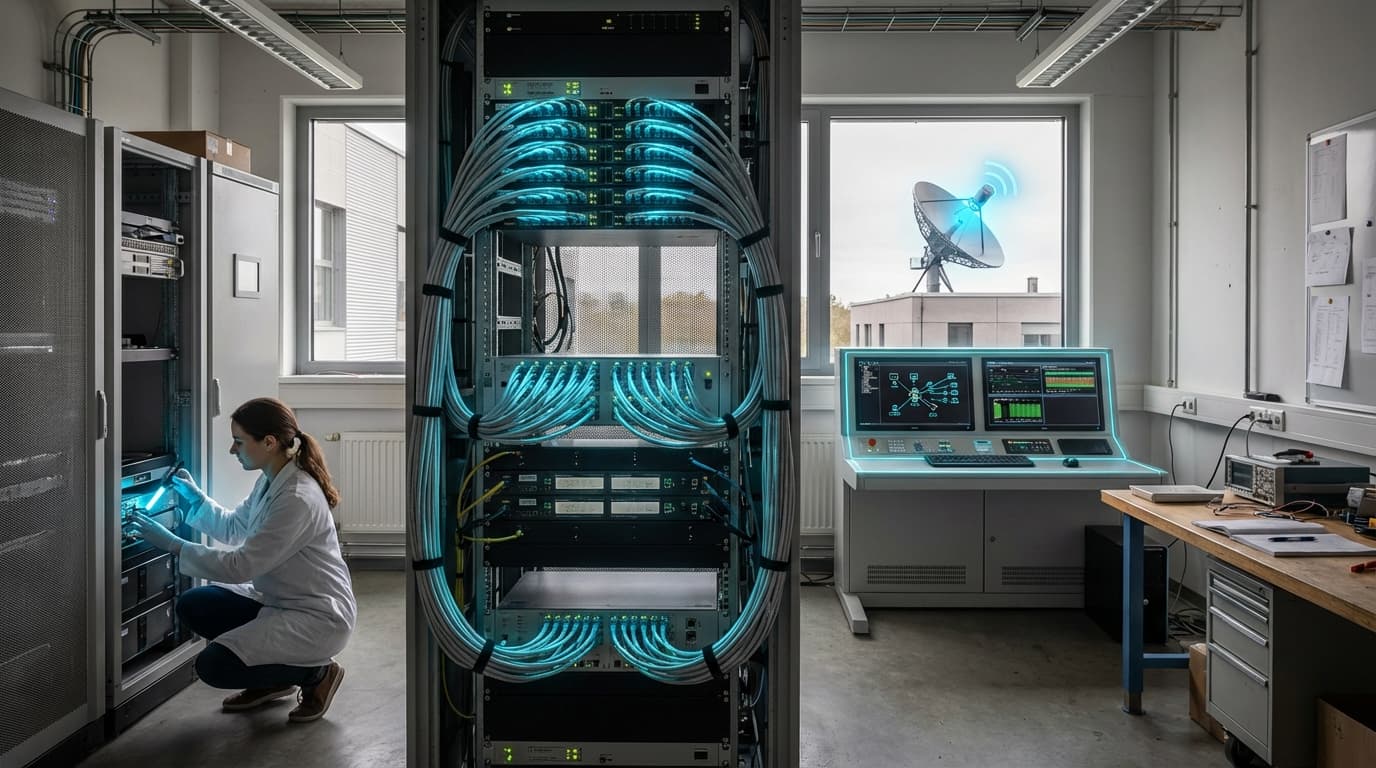
Quantum Communication Backbones
Quantum communication backbones represent a fundamental shift in how secure information can be transmitted across vast distances, addressing the growing vulnerability of classical encryption methods to both current cyberattacks and future quantum computing threats. Unlike traditional fiber-optic networks that rely on mathematical complexity for security, quantum communication leverages the fundamental laws of quantum mechanics—specifically, the principle that observing a quantum state inevitably disturbs it. These networks employ quantum key distribution (QKD) protocols to generate and share encryption keys between distant parties, where any attempt at eavesdropping would introduce detectable anomalies in the quantum states being transmitted. The infrastructure requires specialized components including single-photon sources, ultra-sensitive detectors capable of registering individual photons, and quantum repeaters that can extend transmission distances beyond the typical 100-kilometer limit of direct fiber transmission. Satellite-based quantum links complement terrestrial fiber networks by enabling intercontinental key distribution, using free-space optical channels to beam entangled photons between ground stations and orbiting platforms.
The imperative for quantum-secure communication infrastructure stems from the looming threat of "harvest now, decrypt later" attacks, where adversaries collect encrypted data today with the intention of breaking it once sufficiently powerful quantum computers become available. Financial institutions, government agencies, and critical infrastructure operators face particular urgency in transitioning to quantum-safe communications, as sensitive data transmitted today may remain valuable for decades. Traditional public-key cryptography, which underpins everything from online banking to secure messaging, could be rendered obsolete by quantum algorithms capable of efficiently solving the mathematical problems that currently guarantee security. Quantum communication backbones address this challenge by providing information-theoretic security—protection guaranteed by the laws of physics rather than computational difficulty. This technology also enables new capabilities beyond secure key distribution, including quantum-enhanced sensing networks and distributed quantum computing architectures that could transform how telecom infrastructure supports emerging applications.
Several nations and research consortia have deployed early quantum communication networks, with China's intercontinental QKD network spanning thousands of kilometers and European initiatives connecting multiple cities through fiber-based quantum links. Commercial deployment remains in nascent stages, with pilot programs focusing on securing government communications, financial transactions, and data center interconnections. The technology faces practical challenges including the need for trusted nodes at regular intervals, integration with existing classical network infrastructure, and the development of cost-effective quantum repeaters that can extend range without compromising security guarantees. Industry analysts note that hybrid approaches—combining quantum key distribution with post-quantum cryptographic algorithms—may provide the most practical path forward for large-scale deployment. As quantum computing capabilities advance and the timeline for breaking current encryption methods becomes clearer, investment in quantum communication backbones is accelerating, positioning this technology as a critical component of future telecommunications infrastructure designed to remain secure in a post-quantum world.
Related Organizations

A global leader in quantum cybersecurity solutions, specifically known for their Quantis QRNG chips and appliances.
Develops quantum memory and networking devices that interface with existing fiber infrastructure.

Collaboration between TU Delft and TNO, a world leader in Majorana fermion research.

South Korea's largest wireless telecommunications operator.

Provider of quantum-safe cryptography and operator of Phio TX, a commercial QKD network in the US.

Australian quantum cybersecurity company offering high-throughput QRNG appliances.

Develops space-based QKD systems to enable global quantum-secure communication networks.

A major researcher and developer of QKD technology, holding numerous patents and deploying commercial QKD networks.

Provides QuantumCloud, a platform that uses a symmetric key agreement protocol originally designed for satellite delivery.

Develops chip-based QKD hardware to miniaturize quantum security for telecommunications.
Supporting Evidence
Research this in Signals
Signals turns a topic into a sourced research record you can inspect and rerun. Your first scan is free, and this one starts with Quantum Communication Backbones already loaded, so edit it or scan as is.