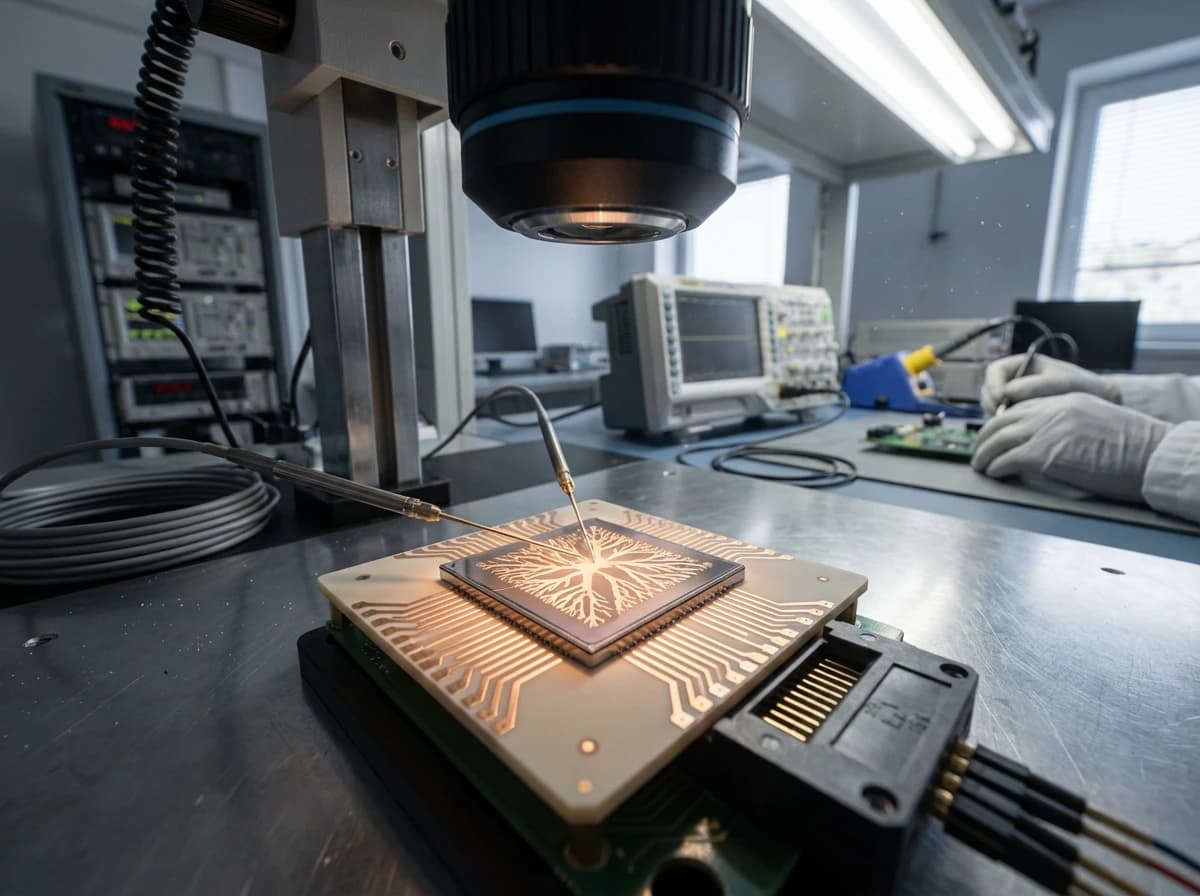
Physically Unclonable Functions
Physically Unclonable Functions represent a fundamental shift in how cryptographic security is implemented at the hardware level. Unlike traditional security approaches that rely on storing secret keys in memory—where they remain vulnerable to extraction through various attack vectors—PUFs exploit the inherent randomness that occurs during semiconductor fabrication. At the nanoscale, manufacturing processes introduce minute variations in transistor threshold voltages, wire delays, and other physical properties that are impossible to control precisely. These variations, while typically considered manufacturing imperfections, create a unique physical signature for each chip that can be measured and converted into cryptographic material. When a challenge is presented to a PUF circuit, it produces a response based on these physical characteristics, generating keys on-demand rather than storing them. This challenge-response mechanism means the secret never exists in a form that can be directly read from memory, fundamentally changing the security paradigm from "hiding secrets" to "deriving secrets from physics."
The technology addresses critical vulnerabilities in supply chains and device authentication that have plagued the semiconductor industry for decades. Counterfeit electronics represent a multi-billion dollar problem, with fake components infiltrating everything from consumer devices to critical infrastructure and military systems. Traditional authentication methods that rely on stored credentials can be cloned or extracted, but the physical randomness underlying PUFs cannot be duplicated even by the original manufacturer. This makes PUFs particularly valuable for establishing hardware roots of trust—the foundational layer upon which all other security measures depend. In Internet of Things deployments, where billions of resource-constrained devices require authentication, PUFs offer a lightweight alternative to traditional cryptographic key storage that doesn't require dedicated secure memory or battery-backed storage. The technology also enables new business models around secure licensing and feature activation, allowing manufacturers to differentiate products through cryptographically-enforced capabilities rather than physical component changes.
Research institutions and semiconductor manufacturers have been developing various PUF architectures for over two decades, with several implementations now reaching commercial maturity. SRAM PUFs, which derive keys from the random startup states of memory cells, have been integrated into microcontrollers and secure elements used in payment cards and identity documents. Ring oscillator PUFs and arbiter PUFs represent alternative designs optimised for different performance and security trade-offs. Early deployments indicate particular promise in securing firmware updates for embedded systems, where verifying device authenticity before accepting code is critical. The technology is also being explored for blockchain applications, where PUFs could provide tamper-evident hardware wallets, and in edge computing scenarios requiring distributed trust without centralised key management infrastructure. As semiconductor geometries continue to shrink and manufacturing variations become more pronounced, PUFs are positioned to become an increasingly important component of hardware security architectures, particularly as quantum computing threatens traditional cryptographic approaches and the need for post-quantum security solutions intensifies across industries.
Related Organizations
Intrinsic ID
Netherlands · Company
A spinout from Philips, they are the leaders in SRAM PUF technology.

A subsidiary of eMemory, focusing on PUF-based security IP solutions.

South Korean fabless company specializing in VIA PUF technology.


Leading manufacturer of Near Field Communication (NFC) and Secure Element chips used in offline payment hardware.

Developing Electronic Design Automation (EDA) tools specifically for superconducting electronics.

Developer of BodyCom technology, which uses the human body as a secure communication channel via electric fields.

A leader in low-power FPGAs, offering the sensAI stack for implementing NPUs on reconfigurable hardware.

Semiconductor company providing BG24 SoCs with hardware acceleration for Bluetooth distance measurement.

A US Department of Energy lab actively researching adiabatic logic circuits and reversible computing to overcome thermodynamic limits in microelectronics.
Supporting Evidence
Research this in Signals
Signals turns a topic into a sourced research record you can inspect and rerun. Your first scan is free, and this one starts with Physically Unclonable Functions already loaded, so edit it or scan as is.