Autonomous Tunnel Boring & Underground Construction
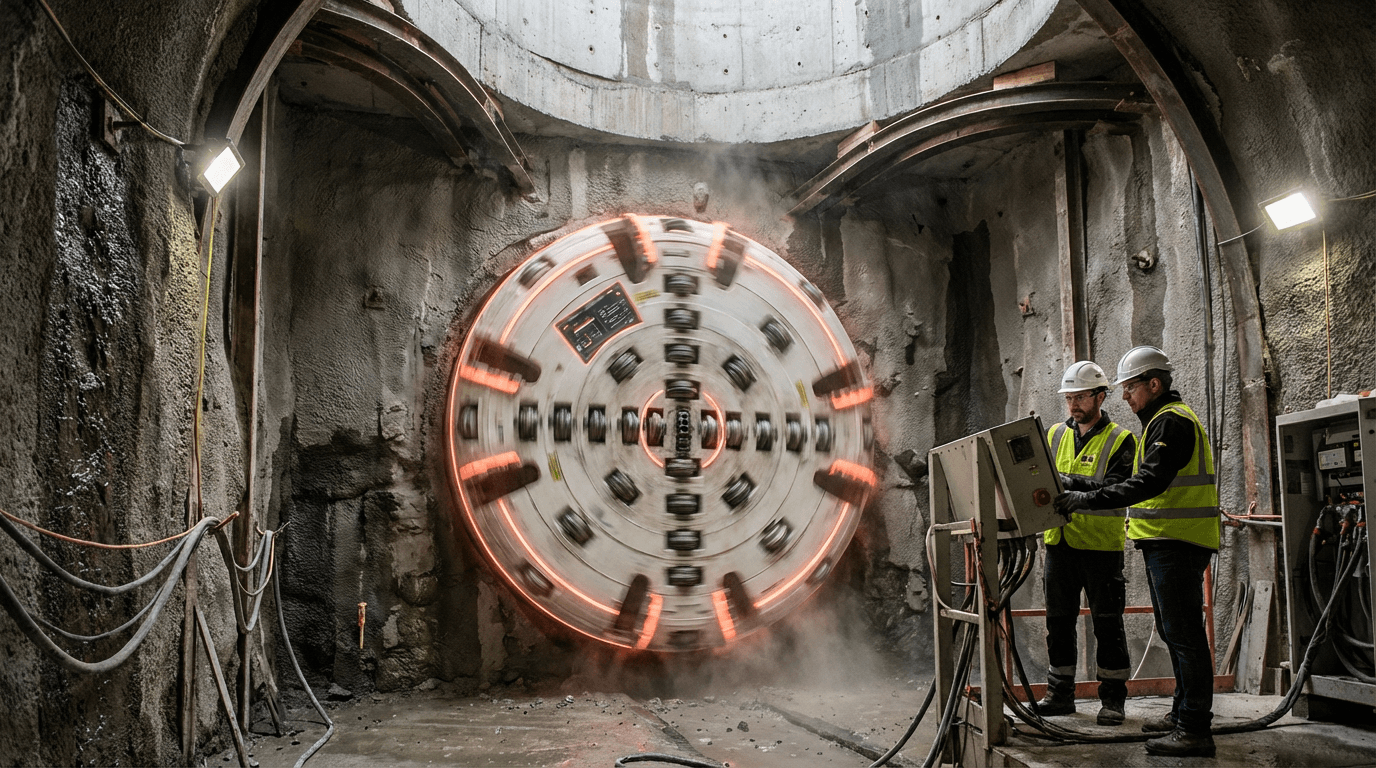
Underground construction has long been one of the most hazardous and technically demanding aspects of civil engineering, requiring precise navigation through variable geological conditions while managing risks to both workers and existing surface infrastructure. Traditional tunnel boring machines (TBMs) rely heavily on operator expertise to interpret ground conditions, adjust cutting parameters, and maintain alignment, a process that becomes increasingly challenging in complex urban environments where utilities, building foundations, and varying soil compositions create a labyrinth of constraints. Autonomous tunnel boring represents a fundamental shift in this paradigm, integrating artificial intelligence, real-time sensor networks, and advanced control systems to enable TBMs and micro-tunneling rigs to navigate underground environments with minimal human intervention. These systems employ arrays of sensors that continuously monitor ground conditions, vibration patterns, cutter wear, hydraulic pressures, and spatial positioning, feeding data into machine learning algorithms that can predict geological changes, optimize cutting speeds, and adjust steering parameters with precision measured in millimeters. The technology extends beyond large-diameter TBMs to include smaller pipe-jacking and micro-tunneling equipment, which are particularly valuable in dense urban areas where surface disruption must be minimized.
The construction industry faces mounting pressure to expand underground infrastructure—from metro systems and utility corridors to stormwater management and emerging applications like deep geothermal energy extraction—while simultaneously reducing project timelines, costs, and safety incidents. Autonomous systems address these challenges by dramatically improving steering accuracy, which reduces the risk of ground settlement that can damage buildings and infrastructure above. By continuously analyzing soil resistance and adjusting thrust forces in real-time, these systems minimize the differential settlement that has plagued conventional tunneling projects. The technology also enables more predictable project schedules by reducing delays caused by unexpected ground conditions, as AI systems can detect changes in geology ahead of the cutting face and adjust operations proactively. Perhaps most significantly, automation removes human operators from the immediate vicinity of the tunnel face, one of the most dangerous locations in construction, while still maintaining the ability to handle complex decision-making that previously required experienced engineers on-site.
Major infrastructure projects have begun demonstrating the viability of these systems, with deployments in metro construction and utility installation showing measurable improvements in both safety metrics and operational efficiency. In densely populated Asian cities, pilot programs using autonomous micro-tunneling rigs have successfully installed utility lines beneath congested urban areas with minimal surface disruption, completing work that would have required extensive excavation using traditional methods. The technology is particularly promising for the expansion of underground transit networks, where the ability to bore tunnels with greater precision allows for tighter curves, shallower depths, and routes that can thread between existing infrastructure. As cities worldwide confront the dual challenges of aging underground infrastructure and the need for new capacity, autonomous tunneling systems offer a pathway to accelerate construction while improving worker safety and reducing the surface-level disruption that makes urban tunneling projects politically and logistically challenging. The convergence of this technology with digital twin modeling and predictive maintenance systems suggests a future where underground construction becomes increasingly automated, enabling the kind of extensive subsurface development that will be necessary to accommodate growing urban populations.
Related Organizations
The worldwide market leader for tunnel boring machines (TBMs).

hyperTunnel
United Kingdom · Startup
A deep tech startup reinventing underground construction.

Constructs low-cost tunnels (Loop) primarily for passengers but with stated applications for freight containers.

Petra
United States · Startup
A robotics company developing trenchless utility tunneling technologies.

Spun out of Atlas Copco, Epiroc specializes in mining equipment and provides extensive automation solutions for underground loaders and trucks.

A developer and manufacturer of advanced tunnel boring machines.

Produces battery-electric loaders and trucks, bolstered by the acquisition of Artisan Vehicle Systems.

A global player in public works and infrastructure projects.

United States · University
An interdisciplinary research center focused on the underground construction industry.
Supporting Evidence
Research this in Signals
Signals turns a topic into a sourced research record you can inspect and rerun. Your first scan is free, and this one starts with Autonomous Tunnel Boring & Underground Construction already loaded, so edit it or scan as is.