AI-Driven Infrastructure Asset Management
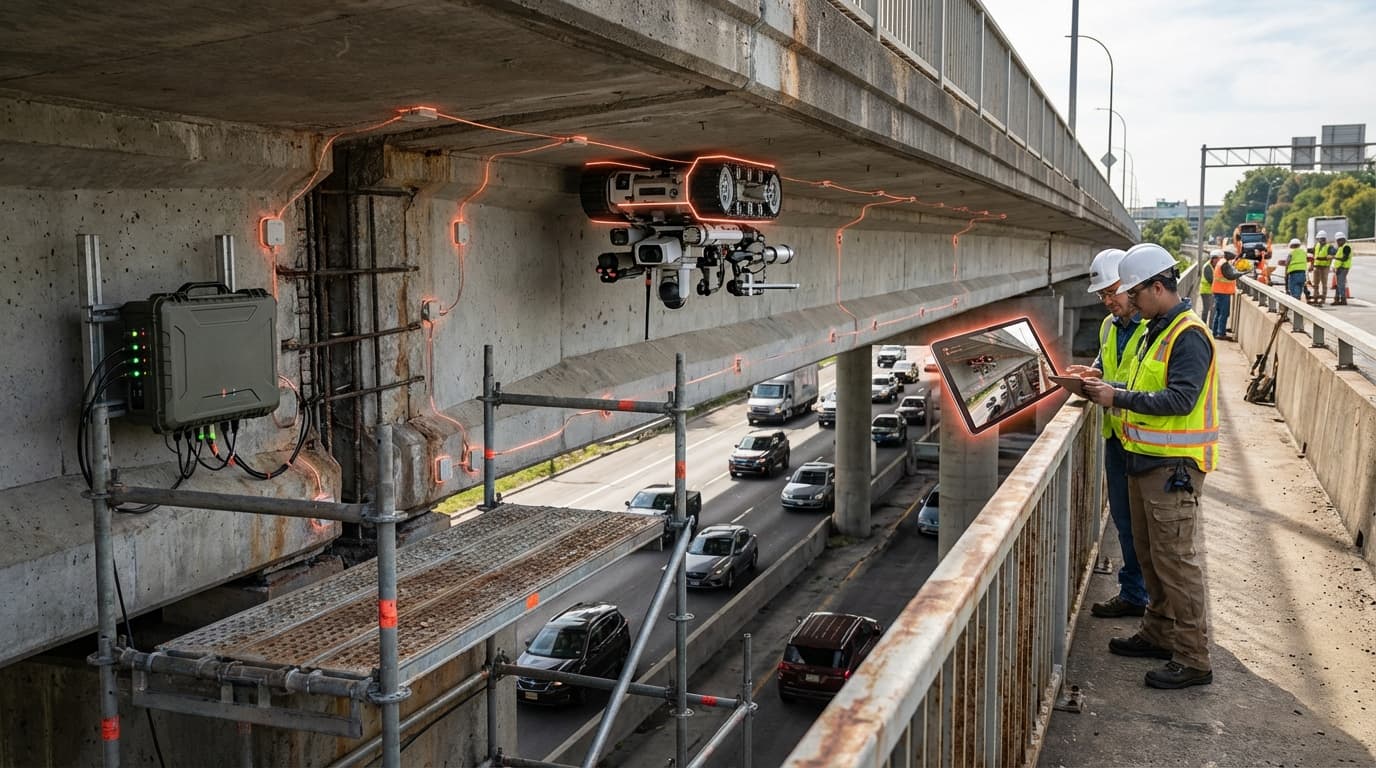
Infrastructure systems worldwide face a mounting crisis: decades of deferred maintenance, accelerating deterioration, and budgets that cannot keep pace with repair needs. Traditional inspection regimes rely on periodic visual assessments and fixed maintenance schedules, often missing critical defects until failure becomes imminent or costly emergency repairs become unavoidable. AI-driven infrastructure asset management addresses this challenge by deploying machine learning algorithms that continuously analyze multiple data streams—including sensor readings from embedded monitors, drone and satellite imagery, historical maintenance logs, and environmental conditions—to predict when and where infrastructure components will fail. These systems employ computer vision to detect cracks in concrete, corrosion on steel members, and pavement degradation, while time-series models forecast the progression of damage based on traffic loads, weather patterns, and material properties. By processing vastly more data than human inspectors could manually review, these platforms identify subtle patterns that signal emerging problems, enabling intervention before minor issues escalate into structural failures.
The shift from reactive to predictive maintenance fundamentally transforms how transportation agencies, utilities, and facility operators allocate scarce capital budgets. Rather than spreading resources evenly across all assets or waiting for visible distress, managers can now prioritize interventions based on quantified risk scores that balance failure probability, consequence severity, and repair cost-effectiveness. This approach is particularly valuable for managing large portfolios where inspection resources are limited—a single state department of transportation may oversee tens of thousands of bridges and hundreds of thousands of lane-miles. Early deployments indicate that predictive models can extend asset service life by identifying optimal intervention timing, when preventive treatments cost a fraction of eventual reconstruction. The technology also supports regulatory compliance by automating documentation requirements and ensuring that high-risk structures receive appropriate attention, reducing liability exposure for asset owners.
Transportation agencies in several North American states and European countries have begun integrating these platforms into their asset management workflows, often starting with bridge networks where failure consequences are most severe. Water utilities are similarly adopting predictive analytics to prioritize pipe replacement in aging distribution systems, where unplanned breaks disrupt service and waste treated water. The technology's trajectory points toward increasingly automated systems that combine real-time sensor networks with AI analysis, potentially enabling continuous condition monitoring rather than periodic inspections. As climate change accelerates infrastructure deterioration through more frequent extreme weather events and as fiscal constraints intensify, the ability to make data-driven maintenance decisions becomes not merely advantageous but essential for maintaining public safety and service reliability across the built environment.
Related Organizations
Provides AI-driven predictive maintenance for civil infrastructure like bridges and tunnels.

Civil infrastructure management platform using AI and computer vision.

AI platform for assessing road infrastructure (acquired by Michelin).



Geo-data specialist providing asset integrity monitoring and remote sensing for infrastructure.

Cyclomedia
Netherlands · Company
Captures and analyzes 360-degree street-level imagery.

Develops Tekla Structures, a leading BIM software for structural engineering and steel detailing, along with hardware for connecting BIM to the field.

A global technical professional services firm that designs and operates wastewater treatment facilities.
Supporting Evidence
Research this in Signals
Signals turns a topic into a sourced research record you can inspect and rerun. Your first scan is free, and this one starts with AI-Driven Infrastructure Asset Management already loaded, so edit it or scan as is.