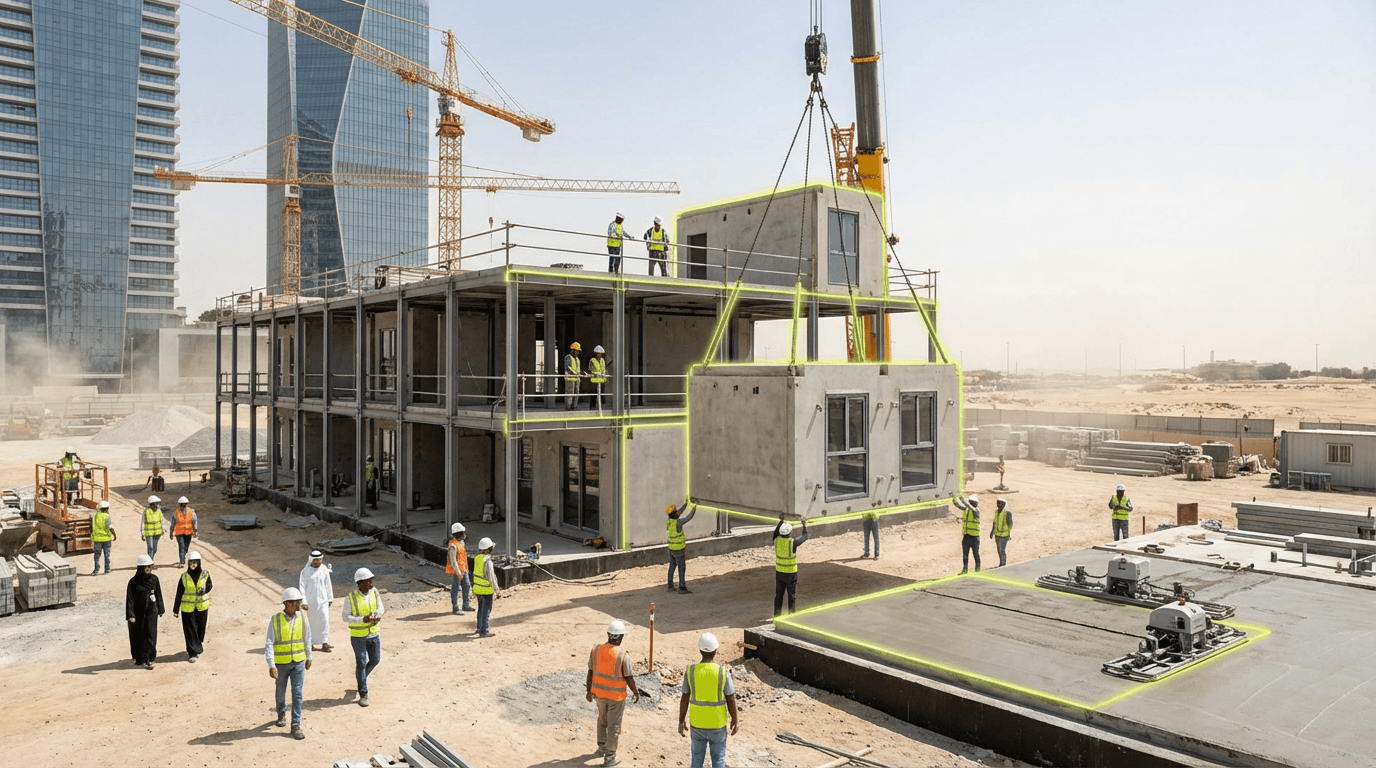
Industrialized Affordable Housing
The industrialization of affordable housing production represents a fundamental shift in how nations address housing supply challenges, moving from traditional site-built construction toward factory-based manufacturing systems. This transition matters because conventional construction methods—characterized by fragmented supply chains, weather dependencies, and variable quality—struggle to deliver housing at the pace and price points required by rapid urbanization and demographic pressures. In the Gulf context, where governments face ambitious targets to house growing citizen populations while managing construction cost inflation and labor market constraints, industrialized approaches offer a pathway to reconcile speed, scale, and affordability. The signal points to a broader recalibration of housing as a manufactured product rather than a bespoke construction project, with implications for labor markets, supply chains, and urban development patterns.
Evidence of this shift is strongest in Saudi Arabia, where the Sakani program and Vision 2030 housing commitments have catalyzed partnerships between government entities and international prefabrication firms to establish local manufacturing capacity. Industry reports indicate that modular and prefabricated systems can reduce construction timelines by 30-50% compared to traditional methods, while controlled factory environments enable tighter quality control and material waste reduction. The UAE and Qatar have piloted industrialized approaches primarily for worker accommodation and mid-market segments, testing logistics models for transporting large modules across desert terrain and integrating them with existing infrastructure networks. However, adoption remains uneven: while some projects demonstrate cost savings through economies of scale, others encounter challenges in adapting standardized designs to extreme climate requirements, navigating approval processes designed for conventional construction, and managing the capital intensity of establishing production facilities. The pattern suggests early-stage experimentation rather than wholesale transformation, with governments using procurement leverage to de-risk private sector investment in manufacturing capacity.
The implications extend beyond construction efficiency to reshape housing delivery ecosystems. If industrialized methods achieve sustained cost reductions, they could enable governments to meet housing targets without proportional budget increases, potentially freeing resources for infrastructure or social services. For construction sectors heavily reliant on migrant labor, automation in factory settings may reduce on-site workforce needs while creating demand for different skill sets in manufacturing and logistics. Urban planners will need to monitor whether standardization pressures lead to monotonous housing typologies or whether digital design tools can maintain variety within industrialized systems. Key indicators to track include the percentage of new housing units delivered through industrialized methods, the emergence of local versus imported manufacturing capacity, and whether cost savings materialize at scale or remain confined to pilot projects. The technology's trajectory will depend on regulatory adaptation, financing models that accommodate upfront capital requirements, and whether quality and climate performance meet expectations in operational conditions.
Related Organizations

A leading GCC contractor that established DuBox, a modular construction subsidiary, integrating design-build finance models to accelerate project delivery in the region.

The Saudi ministry responsible for the 'Sakani' program, which has fundamentally rebranded government housing from welfare to a lifestyle choice.

A joint venture between Skanska and IKEA providing sustainable, quality homes at a low price using industrialized modular construction.

Construction technology company using 3D printing robotics, software, and advanced materials.

A volumetric modular construction company building multifamily housing more affordably and efficiently.

A technology-driven modular housing manufacturer in the UK, focusing on design-led, sustainable homes.

Construction tech company with roots in Latin America that developed a proprietary panel system, now exporting this affordable housing tech to the US with backing from Gates' Breakthrough Energy.

Provider of large-scale 3D construction printers and materials.