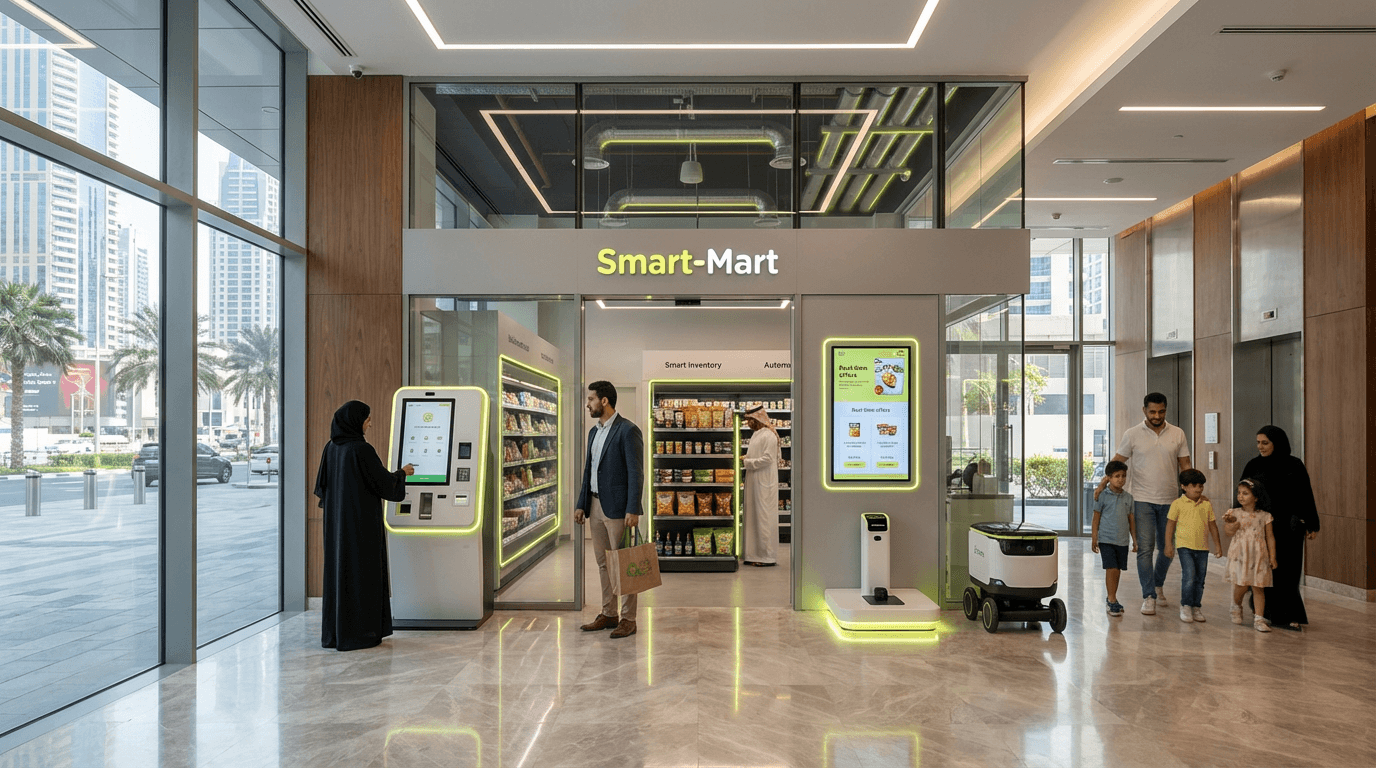
Convenience Commerce in Residential Buildings
The integration of commercial services directly into residential buildings addresses a fundamental tension in urban development: the growing demand for convenience and time efficiency amid expanding cities, traffic congestion, and evolving lifestyle expectations. Across the Gulf region, where car dependency remains high and summer heat discourages walking, residents increasingly value proximity to daily essentials. This signal reflects a shift from the traditional separation of residential and commercial zones toward mixed-use models that embed retail, services, and amenities within the residential envelope itself. Rather than simply adding ground-floor retail, developers are creating curated service ecosystems—mini markets, pharmacies, dry cleaning, cafés, and sometimes coworking spaces or fitness studios—that function as semi-private amenities for residents while potentially serving the broader neighborhood.
Early evidence of this pattern appears most visibly in Dubai's high-density corridors like Dubai Marina and Downtown Dubai, where towers increasingly incorporate convenience retail as part of their value proposition. Similar integrations are emerging in Abu Dhabi's newer master-planned communities and in Riyadh's vertical developments, where developers recognize that on-site services reduce friction in daily life and differentiate properties in competitive markets. The model is particularly appealing in areas where walkable commercial districts are sparse or where cultural preferences favor controlled, climate-conditioned environments over open streetscapes. Pilot projects suggest that residents value the time savings and perceived security of accessing services without leaving their building complex, while property managers see potential for ancillary revenue streams and higher tenant retention. However, the model's scalability depends on achieving sufficient density to support viable commercial operations, and on regulatory frameworks that permit mixed-use configurations within residential zones.
The implications extend beyond convenience. If this pattern strengthens, it could reshape urban form by reducing reliance on external retail trips, potentially easing local traffic and supporting more self-contained neighborhoods. For developers, it offers a hedge against vacancy by diversifying income sources; for commercial operators, it opens access to captive customer bases in controlled environments. Yet the model also raises questions about equity and urban vitality: will convenience commerce deepen socioeconomic divides between premium developments and underserved areas? Will it erode street-level activity and the public realm? Monitoring adoption rates in mid-market versus luxury segments, regulatory responses to mixed-use zoning, and resident satisfaction data will clarify whether this signal represents a niche amenity or a broader restructuring of Gulf residential typologies.
Related Organizations

Leading MENA food and grocery delivery platform operating 'Talabat Mart' dark stores often located within or adjacent to residential clusters for rapid delivery.

Noon
Saudi Arabia · Company
E-commerce giant operating 'Noon Minutes', a quick-commerce service delivering groceries to doorsteps in 15 minutes via local hubs.

Saudi Arabia's leading digital grocery shopping platform, operating dark stores and partnerships to serve residential districts.

Operator of Carrefour in the region, deploying 'Carrefour City' and 'Carrefour NOW' concepts specifically designed for community and quick commerce.

Global food delivery company with a strong GCC presence, operating 'Deliveroo Hop' for rapid grocery delivery.

Managed cloud kitchen platform that places food preparation hubs near residential density to enable rapid delivery.

Abu Dhabi's leading developer, with a significant recurring income portfolio from investment properties (residential and commercial).