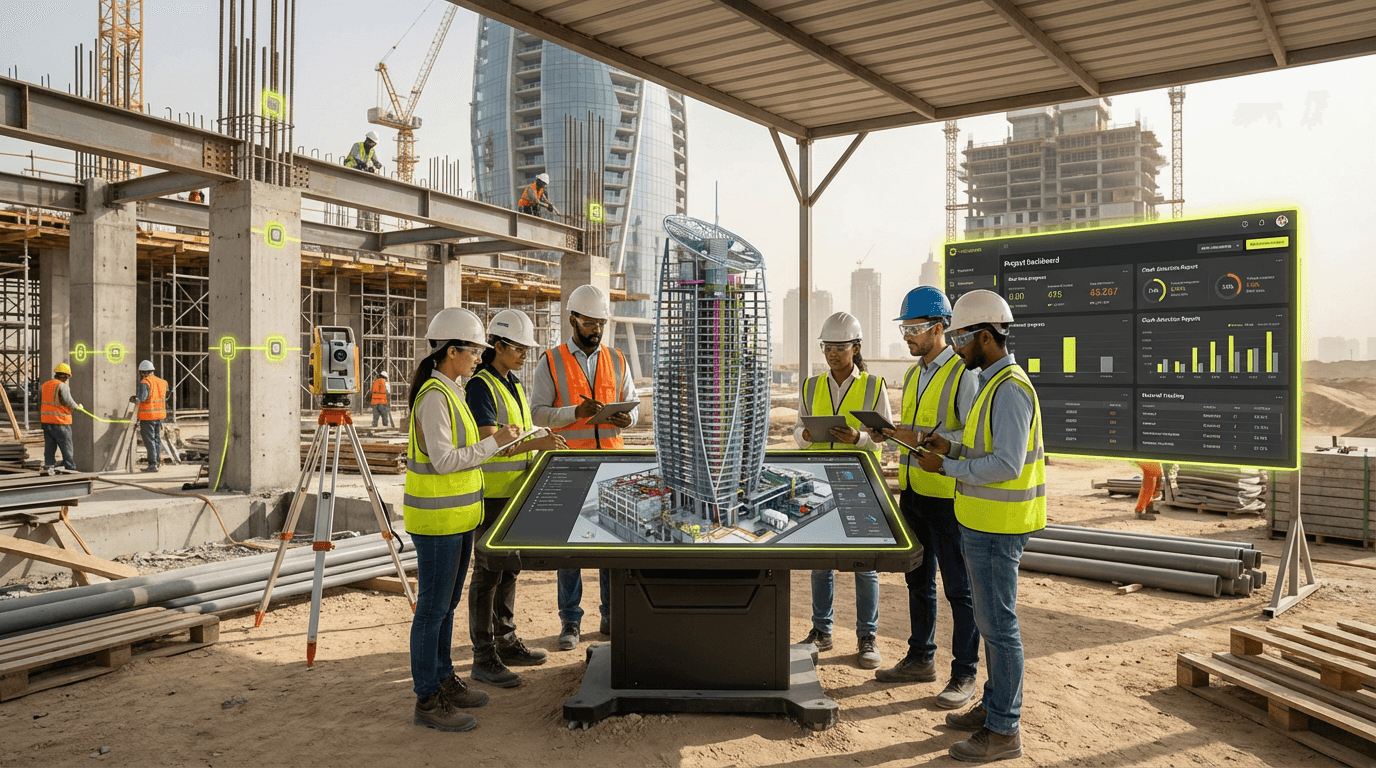
BIM & Digital Delivery
Building Information Modeling (BIM) represents a fundamental shift in how the construction industry approaches project delivery, moving from fragmented document-based workflows to integrated digital environments where design, engineering, and construction data coexist in a single coordinated model. The challenge it addresses is particularly acute in the Gulf's megaproject context: when dozens of contractors, hundreds of consultants, and thousands of workers converge on ambitious timelines, traditional coordination methods—paper drawings, siloed software, manual clash detection—become untenable. BIM solves the coordination crisis by creating a shared digital representation where conflicts between structural steel and mechanical ducts can be identified before fabrication, where design changes propagate automatically across disciplines, and where construction sequences can be simulated before ground is broken. For nations building entire districts, airports, and mixed-use towers simultaneously, this coordination capacity is not merely efficiency-enhancing but project-enabling.
The Gulf's adoption trajectory demonstrates both policy-driven acceleration and market-driven necessity. UAE federal mandates requiring BIM for public projects above certain thresholds, coupled with similar requirements emerging in Saudi Arabia's Vision 2030 portfolio, have compressed what might have been a decade-long transition into a few years. Major developers and contractors report that BIM workflows have become baseline expectations for competitive bids on significant projects, with sophisticated clients demanding not just design coordination but full 4D scheduling integration, 5D cost modeling, and handover packages that feed directly into facilities management systems. Early implementations focused primarily on clash detection—preventing the costly rework that occurs when ductwork collides with structural elements—but the practice has matured toward lifecycle thinking. Projects increasingly deliver not just buildings but digital twins: operational models that continue evolving post-construction, integrating sensor data, maintenance records, and performance analytics. Industry observers note that the most advanced implementations now link BIM models to procurement systems, prefabrication workflows, and even robotic construction equipment, creating genuinely integrated digital delivery chains.
The implications extend beyond individual project efficiency toward systemic transformation of how the region builds. As BIM adoption deepens, it creates new professional requirements—information managers, model coordinators, digital delivery specialists—while potentially disrupting traditional consultant hierarchies and contractual relationships. The technology enables new procurement models where design-build-operate contracts leverage continuous digital threads, and where performance-based specifications replace prescriptive drawings. For monitoring, watch whether BIM mandates expand to include specific data standards and interoperability requirements, whether digital twin handovers become contractually enforceable, and whether the integration extends upstream to urban planning systems and downstream to smart building platforms. The critical threshold is whether BIM remains primarily a coordination tool or becomes the foundation for genuinely data-driven construction industrialization, with implications for productivity, labor requirements, and the region's construction sector competitiveness.
Related Organizations

Owner of the Arnold renderer, which integrates AI denoising to optimize high-end VFX workflows for film and TV.

Red Sea Global
Saudi Arabia · Company
Developer of The Red Sea and Amaala projects, implementing high-standard modular housing for construction staff.


A leading vendor of software for the AEC industry, owning major BIM brands like Graphisoft (Archicad), Allplan, and Vectorworks.

An integrated collaboration platform for 3D and 2D workflows, specializing in issue tracking and clash detection.

Develops Tekla Structures, a leading BIM software for structural engineering and steel detailing, along with hardware for connecting BIM to the field.

A world-leading design, engineering and project management organization (formerly SNC-Lavalin/Atkins).


Provider of Aconex, a cloud-based collaboration solution for construction project management.

Global leader in construction management software, connecting teams and data to improve project efficiency.