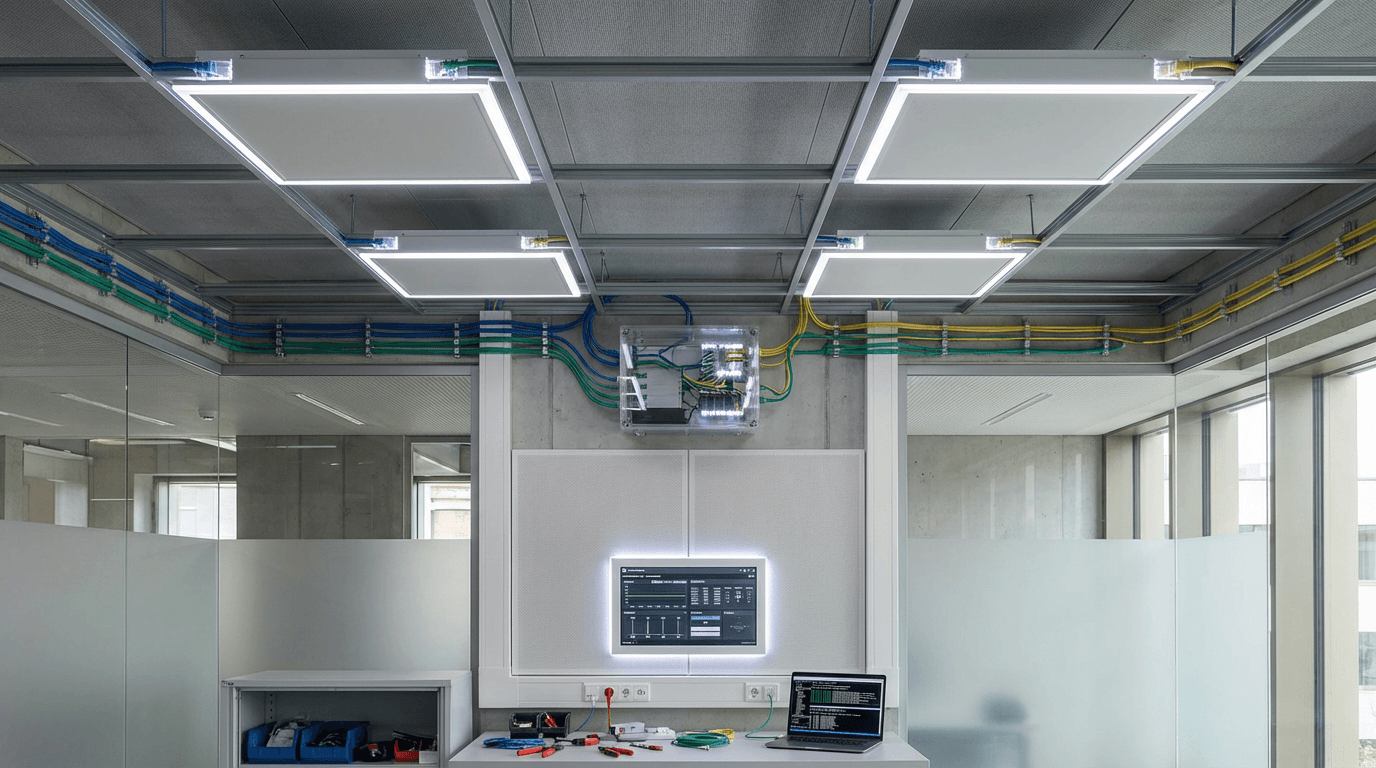
Power-over-Ethernet (PoE) Lighting
Power-over-Ethernet (PoE) lighting represents a fundamental shift in how buildings deliver both electrical power and control signals to lighting fixtures. Unlike traditional AC-powered lighting systems that require separate electrical wiring and control infrastructure, PoE lighting uses standard Ethernet cables to simultaneously transmit low-voltage DC power and bidirectional data to each luminaire. This convergence is made possible by IEEE 802.3 standards that allow network switches to inject power directly into Ethernet cables, typically delivering between 15 and 90 watts per port depending on the PoE class. Each light fixture becomes an individually addressable network node with a unique IP address, enabling granular control and real-time monitoring at the device level. The low-voltage DC nature of the system eliminates the need for traditional electrical infrastructure in many applications, allowing IT professionals rather than licensed electricians to deploy and reconfigure lighting layouts with the same flexibility as computer networks.
The commercial building sector faces mounting pressure to reduce energy consumption while simultaneously gathering more detailed occupancy and environmental data to optimize space utilization. Traditional lighting systems struggle to provide the granular control and sensing capabilities needed for modern smart building applications, often requiring expensive retrofits and proprietary control protocols that create vendor lock-in. PoE lighting addresses these challenges by transforming the ceiling grid into a distributed sensor network where each fixture can host additional devices such as occupancy sensors, temperature monitors, air quality detectors, and even security cameras. This infrastructure consolidation reduces installation costs by eliminating redundant cabling and power supplies while enabling sophisticated analytics that were previously impractical or prohibitively expensive. The network-native architecture also facilitates remote firmware updates, predictive maintenance through continuous health monitoring, and seamless integration with building management systems and IoT platforms. Organizations can implement zero-trust security models at the lighting layer, segmenting fixtures into virtual networks and applying the same cybersecurity protocols used for other IT assets.
Early deployments of PoE lighting have concentrated in commercial office environments, educational institutions, and healthcare facilities where the combination of energy efficiency and data collection capabilities delivers compelling return on investment. Industry analysts note that the technology is particularly well-suited for open-plan offices undergoing activity-based working transformations, where lighting zones must adapt dynamically to changing occupancy patterns throughout the day. The ability to correlate lighting usage data with occupancy sensors provides facility managers with unprecedented visibility into how spaces are actually used, informing decisions about real estate optimization and workplace design. As PoE standards continue to evolve toward higher power delivery capabilities, the technology is expanding beyond basic illumination to support a broader ecosystem of ceiling-mounted devices, positioning the lighting infrastructure as the backbone of the intelligent building. This convergence of lighting, networking, and sensing represents a significant step toward buildings that can autonomously optimize their own performance while providing occupants with more responsive and personalized environments.
Related Organizations

Manufacturer of a wide range of PoE-native lighting fixtures and control software.

Offers the CoreSync platform, a comprehensive PoE lighting and sensor ecosystem for smart buildings.

Specializes in PoE lighting controls and software, enabling granular building automation.

Offers Webex Hologram, an augmented reality meeting solution that projects photorealistic 3D holograms of participants into the room.
United States · Company
Design-build firm specializing in low-voltage DC buildings and PoE lighting implementation.

Offers the PowerHUBB platform, an enterprise-level PoE lighting and control solution.
Indian lighting major offering smart lighting solutions powered by PoE, often in partnership with Cisco.

Developer of BodyCom technology, which uses the human body as a secure communication channel via electric fields.

Leader in automatic controls for openings and closures in homes and buildings.