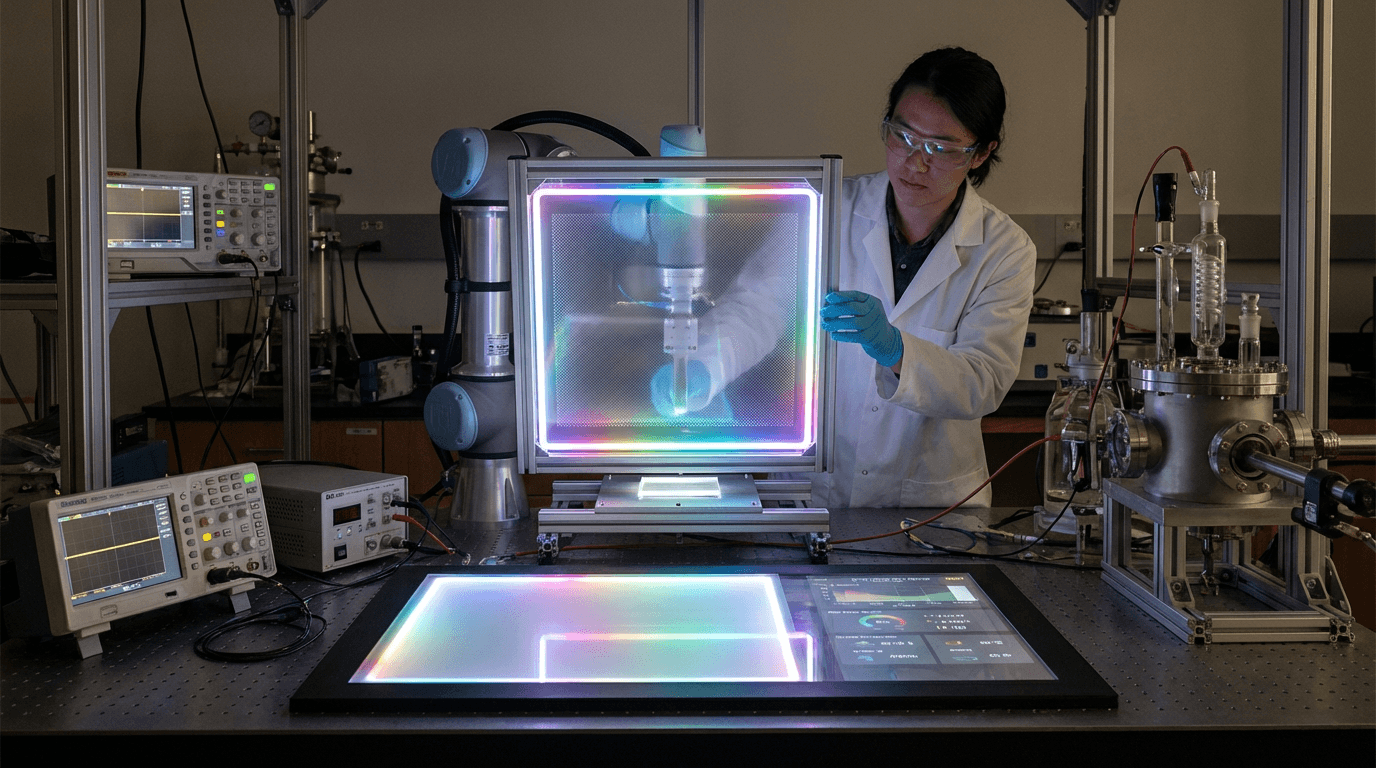
Perovskite LEDs (PeLEDs)
Perovskite Light-Emitting Diodes represent a breakthrough in solid-state lighting technology, leveraging metal-halide perovskite materials that exhibit exceptional photoluminescence properties. These materials, typically composed of organic-inorganic hybrid structures with a general formula of ABX₃ (where A is an organic cation, B is a metal cation, and X is a halide anion), can be precisely tuned across the visible spectrum by adjusting their chemical composition. Unlike traditional LED technologies that require complex, high-temperature manufacturing processes, perovskite materials can be deposited from solution at relatively low temperatures, enabling compatibility with flexible substrates and potentially reducing production costs. The key technical advantage lies in their narrow emission bandwidth—often less than 20 nanometers—which translates to exceptionally pure, saturated colors that surpass conventional phosphor-based white LEDs and even compete with quantum dot technologies in color gamut performance.
The lighting industry faces persistent challenges in balancing energy efficiency, color quality, manufacturing cost, and form factor flexibility. Traditional LED technologies, while energy-efficient, often struggle to achieve both high color rendering and narrow spectral output simultaneously, particularly in applications requiring precise color control such as display backlighting or architectural accent lighting. PeLEDs address these limitations by offering inherently narrow emission spectra that can be precisely positioned anywhere in the visible range through compositional engineering. This capability opens new possibilities for solid-state lighting applications where color purity is paramount, including advanced display technologies, horticultural lighting with optimized spectral output for plant growth, and architectural installations requiring vivid, tunable illumination. The solution-processable nature of perovskite materials also enables novel manufacturing approaches, including inkjet printing and roll-to-roll processing, which could dramatically reduce capital expenditure for lighting manufacturers while enabling previously impractical form factors such as large-area flexible light panels.
Research institutions and early-stage technology developers have demonstrated PeLEDs with external quantum efficiencies exceeding 20 percent in laboratory settings, approaching the performance of commercial organic LEDs. However, the primary barrier to widespread adoption remains operational stability, as perovskite materials are inherently sensitive to moisture, oxygen, and elevated temperatures. Current research efforts focus on developing robust encapsulation strategies, exploring more stable perovskite compositions, and understanding degradation mechanisms at the fundamental level. Industry observers note that successful commercialization will likely emerge first in niche applications where color purity justifies premium pricing, such as museum lighting or specialized display technologies, before expanding to general illumination markets. As the global lighting industry continues its transition toward solid-state technologies and smart, tunable systems, PeLEDs represent a promising pathway toward achieving the long-sought goal of efficient, color-rich illumination that can adapt to diverse human needs and environmental contexts.
Related Organizations

Joint spin-out from Oxford and Cambridge Universities commercializing perovskite materials specifically for light-emitting applications.

Research group led by Prof. Richard Friend, credited with key discoveries in polymer and perovskite light-emitting diodes.
Institute of Advanced Materials, a major hub for perovskite LED research in China led by Academician Wei Huang.
Linköping University (Biomolecular and Organic Electronics)
Sweden · University
Research group led by Prof. Feng Gao, focusing on high-performance perovskite LEDs and energy materials.

Research division of the global consumer electronics company, heavily investing in inkjet-printed perovskite LEDs for next-gen displays.
Kyushu University (OPERA)
Japan · University
Center for Organic Photonics and Electronics Research, led by Chihaya Adachi, exploring advanced emitters including perovskites.
Singapore-based advanced materials company developing perovskite-based color enhancement films for displays and lighting.
Conducts advanced research into cryogenic CMOS and quantum computing interconnects.

Pioneers in inkjet-printed flexible perovskite solar cells for IoT and building-integrated photovoltaics (BIPV).