Quantum-dot Color Conversion
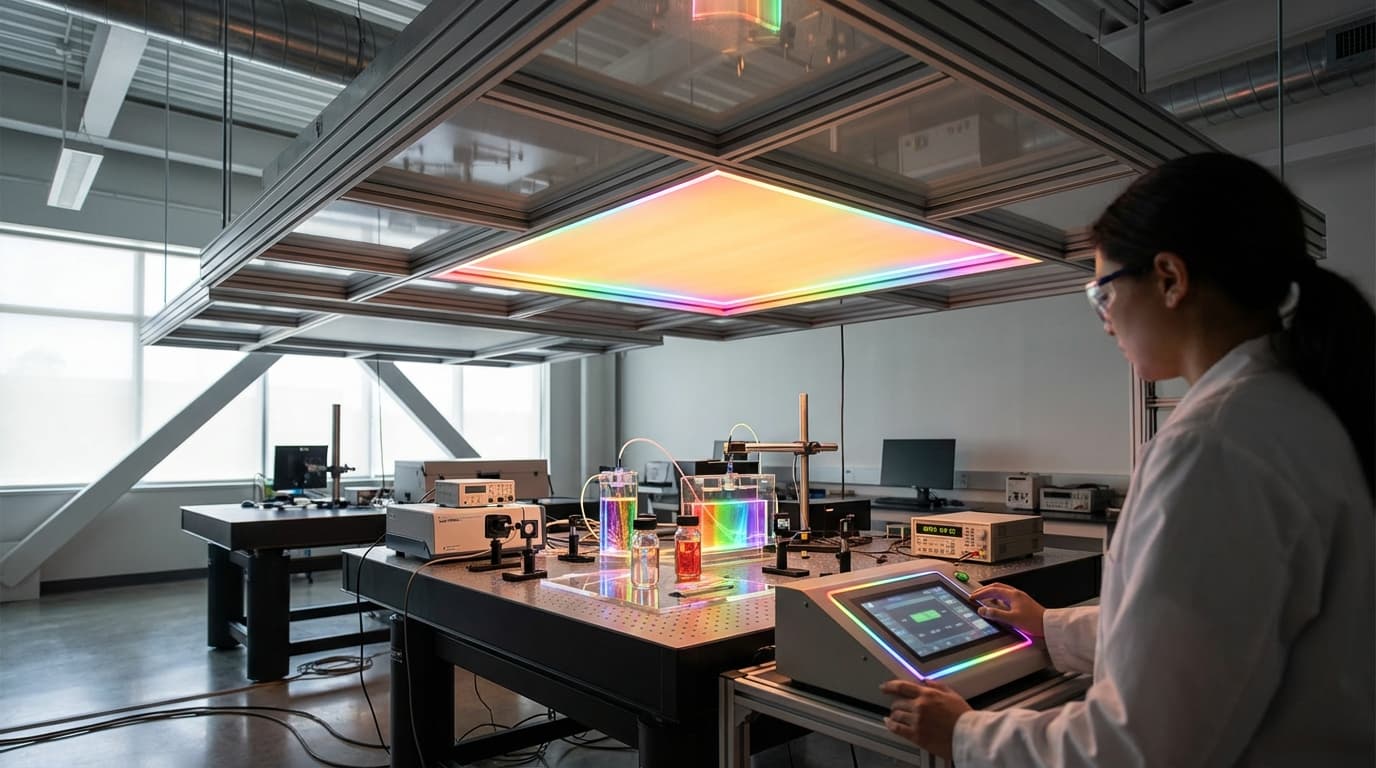
Quantum-dot color conversion represents a sophisticated approach to spectral engineering in solid-state lighting, leveraging the unique optical properties of semiconductor nanocrystals to achieve unprecedented control over light quality. Unlike traditional phosphor-based white LEDs that produce broad emission spectra, quantum dots—typically ranging from 2 to 10 nanometers in diameter—exhibit size-dependent photoluminescence, allowing manufacturers to precisely tune emission wavelengths by adjusting particle dimensions during synthesis. When excited by a primary light source, usually a blue or ultraviolet LED, these nanocrystals absorb high-energy photons and re-emit light at longer, narrower wavelengths determined by quantum confinement effects. This conversion process can be implemented through various architectures, including on-chip configurations, remote phosphor films, and edge-lit lightguide systems, each offering distinct thermal management and optical efficiency trade-offs. The resulting emission spectra can be engineered with exceptional precision, enabling the creation of custom spectral power distributions that combine multiple quantum dot populations to achieve specific lighting objectives.
The lighting industry has long grappled with the fundamental tension between energy efficiency and color quality, a challenge that quantum-dot technology directly addresses. Conventional LED lighting often sacrifices color rendering index (CRI) and spectral richness to maximize luminous efficacy, resulting in illumination that can appear harsh or fail to accurately render certain hues. Quantum-dot color conversion overcomes this limitation by delivering both high CRI values—often exceeding 95—and expanded color gamut coverage while maintaining efficacies comparable to or better than traditional phosphor systems. This capability proves particularly valuable in applications demanding precise spectral control, such as museum and retail lighting where accurate color reproduction is paramount. Furthermore, the technology enables the creation of application-specific spectral recipes: horticultural lighting can be optimized to match plant photoreceptor absorption peaks, while human-centric lighting systems can dynamically adjust circadian-effective spectra throughout the day. The narrow emission bands also reduce wasted energy in spectral regions that contribute little to visual or biological response, improving overall system efficiency.
Early commercial deployments of quantum-dot lighting have appeared in premium display backlighting and specialty architectural applications, with broader adoption accelerating as manufacturing costs decline and material stability improves. Recent advances in cadmium-free quantum dot formulations—utilizing indium phosphide and other less toxic materials—have addressed regulatory concerns that previously limited market penetration in general illumination. The technology shows particular promise in smart lighting ecosystems, where quantum-dot films can be combined with tunable LED arrays to create luminaires capable of real-time spectral adjustment without the complexity of multi-channel mixing systems. This approach ensures consistent color output across production batches, eliminating the binning challenges that plague conventional LED manufacturing. As the lighting industry continues its evolution toward personalized, biologically optimized illumination, quantum-dot color conversion stands positioned as a key enabling technology, offering the spectral precision necessary to meet increasingly sophisticated demands for light quality while maintaining the efficiency gains that drove the initial LED revolution.
Related Organizations
Bawendi Group (MIT)
United States · University
Research group led by Nobel Laureate Moungi Bawendi, pioneering the synthesis and application of colloidal quantum dots.


Major Japanese chemical manufacturer that acquired Nanosys, the leading developer of quantum dot materials, to scale production for display and lighting applications.

UK-based pioneer in the development and manufacture of cadmium-free quantum dots (CFQD) for use in lighting and displays.
Advanced materials company using quantum dots to create luminescent solar concentrator windows (WENDOW).

Produces the Eviyos hybrid LED, a multipixel light source designed specifically for high-resolution adaptive headlights and road projection.
Spin-off from Ghent University developing on-chip grade quantum dots tailored for direct integration into LED packages.

Global science and technology company supplying advanced materials, including quantum materials for display and lighting applications.
French startup developing quantum plates and dots for encapsulation in polymers, focusing on high-efficiency color conversion.

Swiss company specializing in the synthesis of high-tech materials, including perovskite quantum dots for optical applications.