







Spatial computing and the industrial metaverse
Industrial Metaverse
Persistent 3D digital twins of factories and infrastructure for real-time monitoring and control
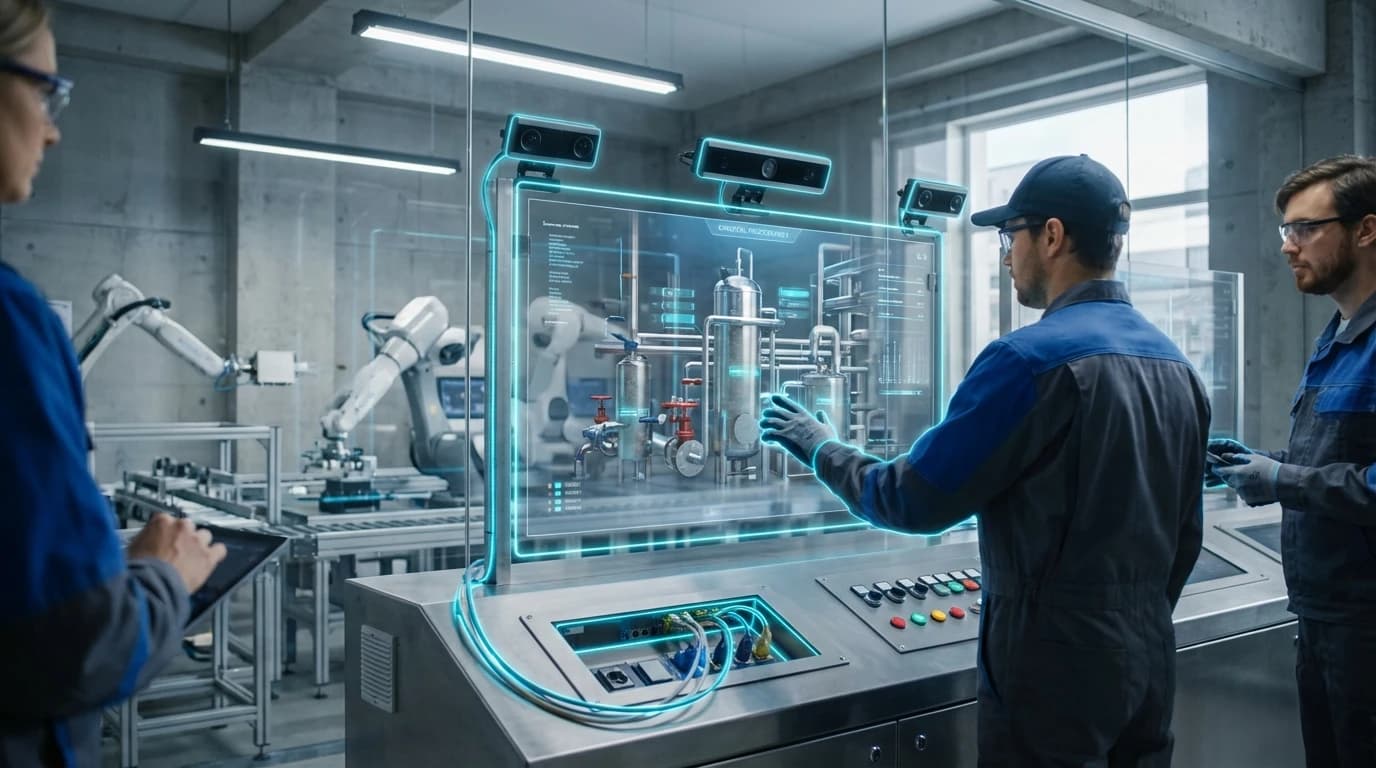
The Industrial Metaverse represents a fundamental shift in how industrial operations are visualized, managed, and optimized by creating persistent, immersive digital twins of physical manufacturing environments and infrastructure. This technology combines virtual reality (VR) and augmented reality (AR) interfaces with real-time data streams from sensors, programmable logic controllers, and industrial IoT devices to create interactive 3D representations of factories, refineries, warehouses, and other operational facilities. Unlike traditional supervisory control and data acquisition (SCADA) systems that rely on two-dimensional dashboards and control panels, the Industrial Metaverse enables operators and engineers to navigate through virtual replicas of their facilities, interact with equipment representations that reflect actual operational states, and manipulate controls within spatially intuitive environments. The underlying architecture integrates operational technology data protocols with cloud computing infrastructure, enabling the synchronization of virtual environments with physical systems at speeds necessary for meaningful operational control and monitoring.
Manufacturing and industrial sectors face mounting pressures to reduce downtime, optimize complex processes, and enable remote expertise in an era of skilled labor shortages and distributed operations. Traditional approaches to industrial management require physical presence on factory floors, making troubleshooting expensive and time-consuming when specialized knowledge is needed across multiple sites. The Industrial Metaverse addresses these challenges by allowing engineers and technicians to virtually "walk through" facilities from anywhere in the world, examining equipment conditions, reviewing process flows, and collaborating with colleagues as if they were physically present. This capability proves particularly valuable for training new operators on complex machinery without risking equipment damage or safety incidents, and for conducting virtual commissioning of production lines before physical installation begins. The technology also enables more effective collaboration between design teams and operations personnel, as proposed layout changes or equipment modifications can be visualized and tested within the context of existing operations before committing resources to physical implementation.
Early industrial deployments indicate significant potential for reducing mean time to repair and improving operational efficiency across distributed facilities. Manufacturing companies are exploring these platforms for remote maintenance support, where expert technicians can guide on-site personnel through complex repairs using shared immersive views of equipment. Energy sector organizations are investigating applications in pipeline monitoring and refinery management, where the ability to visualize vast infrastructure networks in three dimensions offers advantages over traditional mapping approaches. As 5G networks expand and edge computing capabilities mature, the Industrial Metaverse is positioned to become increasingly responsive and capable of supporting real-time operational decisions. This evolution aligns with broader industry movements toward digital transformation and smart manufacturing, where the integration of physical and digital operational layers promises to unlock new levels of productivity, safety, and adaptability in industrial environments that have traditionally been slow to adopt consumer-oriented technologies.
TRL
5/9Validated
Impact
5/5
Investment
5/5
Category
Applications
Related Organizations
Developing foundation models for robotics (Project GR00T) and vision-language models like VILA.
Developer
Industrial giant offering the 'Senseye Predictive Maintenance' suite and MindSphere IoT platform.
Developer
Provider of mobile mapping systems and reality capture software for indoor spatial intelligence.
Developer
Through Copilot and the 'Recall' feature in Windows, Microsoft is integrating persistent memory and agentic capabilities directly into the operating system.
Developer
Industrial automation leader offering FactoryTalk Analytics, which uses ML to identify equipment anomalies.
Developer
Creators of the Unity Engine and the ML-Agents toolkit, which allows researchers to train intelligent agents within game environments.
Developer
PTC
United States · Company
Offers ThingWorx, a platform that connects industrial devices, people, and systems.
Developer
Offers 'TeamViewer Frontline', an enterprise AR productivity platform (acquired from Ubimax) for logistics and manufacturing.
Developer
Spatial data company that integrated mobile LiDAR support into their capture app, democratizing real estate digital twins.
Developer
What was expected
Published forecasts about this technology, graded against what happened in Hindsight.
Metaverse and immersive internet (AR/VR)
This page is a narrower case of it.
Supporting Evidence
Evidence data is not available for this technology yet.
Research this in Signals
Scan Industrial Metaverse for yourself.
Signals turns a topic into a sourced research record you can inspect and rerun. Your first scan is free, and this one starts with Industrial Metaverse already loaded, so edit it or scan as is.