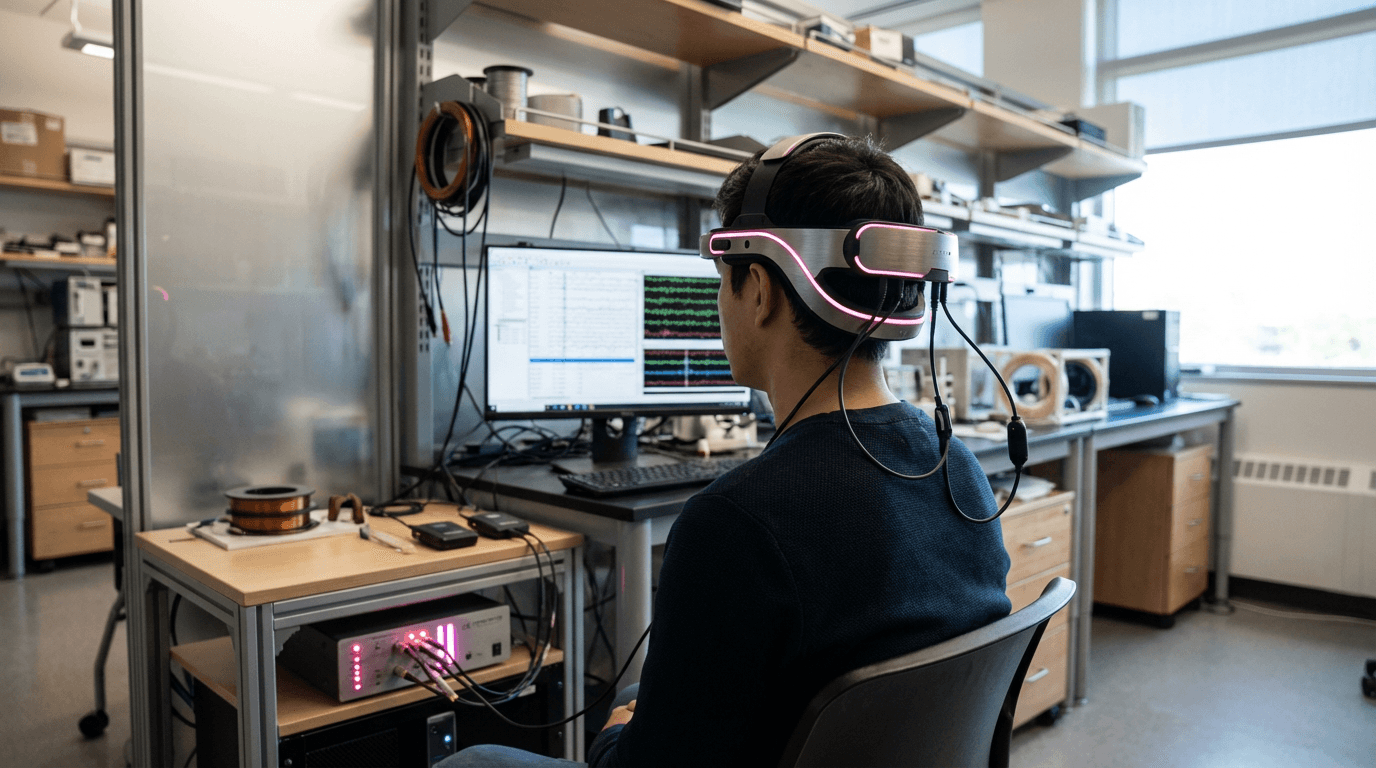
Neural Interface Headsets
Neural interface headsets represent a breakthrough in human-computer interaction, employing non-invasive brain-computer interface (BCI) technology to enable direct communication between neural activity and digital systems. These wearable devices use advanced sensors, typically based on electroencephalography (EEG) or functional near-infrared spectroscopy (fNIRS), to detect and interpret electrical signals or blood flow changes in the brain. Machine learning algorithms process these neural patterns in real-time, translating specific thought patterns, attention states, or mental commands into digital inputs. Unlike invasive BCIs that require surgical implantation, these headsets rest on the scalp, making them accessible for everyday use while still achieving meaningful signal detection. The technology relies on training both the user and the system: users learn to generate consistent neural patterns for specific commands, while adaptive algorithms become increasingly accurate at recognizing individual brain signatures over time.
The fundamental challenge these devices address is the inefficiency of traditional information retrieval methods, which require manual input through keyboards, touchscreens, or voice commands. For researchers, students, and knowledge workers who spend significant portions of their day searching through digital archives, databases, and documentation, this intermediary step creates a bottleneck between thought and access. Neural interface headsets promise to eliminate this friction by allowing users to navigate complex information systems through intention alone. This capability is particularly transformative for individuals with physical disabilities that limit traditional computer interaction, opening new pathways for equitable access to digital knowledge repositories. Furthermore, these interfaces enable a more fluid research process, where the act of formulating a question can simultaneously trigger the search for relevant information, potentially accelerating discovery and synthesis across disciplines. Early implementations suggest that thought-based navigation could reduce cognitive load by maintaining users in a state of flow, rather than interrupting their mental processes with mechanical input tasks.
Current neural interface headsets remain primarily in research laboratories and specialized pilot programs, though several companies have begun developing consumer-oriented prototypes for gaming and productivity applications. Research institutions are exploring their use in academic libraries and digital archives, where users might mentally browse collections or retrieve documents based on conceptual queries rather than keyword searches. The technology shows particular promise in fields requiring rapid access to technical documentation, such as medicine or engineering, where practitioners could mentally query reference materials while maintaining focus on their primary task. However, significant challenges remain, including improving signal accuracy in noisy environments, reducing setup time, and developing intuitive mental command vocabularies that feel natural to users. As machine learning models become more sophisticated and sensor technology advances, these headsets are likely to evolve from specialized tools into mainstream interfaces for knowledge work, fundamentally reshaping how humans interact with the expanding universe of digital information and potentially democratizing access to humanity's collective knowledge base.
Related Organizations
Creates open-source brain-computer interface tools and the Galea headset (integrating with VR) for researching physiological responses.

Develops BCI-enabled headphones that detect focus and intent to control digital experiences.

Builds AI-powered BCI headsets with AR displays for accessibility and communication.

Produces EEG headsets and the BCI-OS platform, allowing developers to build applications that respond to cognitive stress and facial expressions.

Neuroscience company developing non-invasive brain recording technology (Flow and Flux).

Develops the Muse EEG headband and software platform that adapts audio soundscapes in real-time based on the user's brain state (meditation/focus).

Develops the Quest Pro and research prototypes (Butterscotch, Starburst) focusing on foveated systems.

Develops high-performance BCI hardware, including the 'Unicorn' hybrid black interface for developers.

Develops semi-dry and dry EEG wearable devices for human behavior research and neurotechnology applications.

Develops gamified neurorehabilitation platforms for stroke and brain injury recovery.
Supporting Evidence
Research this in Signals
Signals turns a topic into a sourced research record you can inspect and rerun. Your first scan is free, and this one starts with Neural Interface Headsets already loaded, so edit it or scan as is.