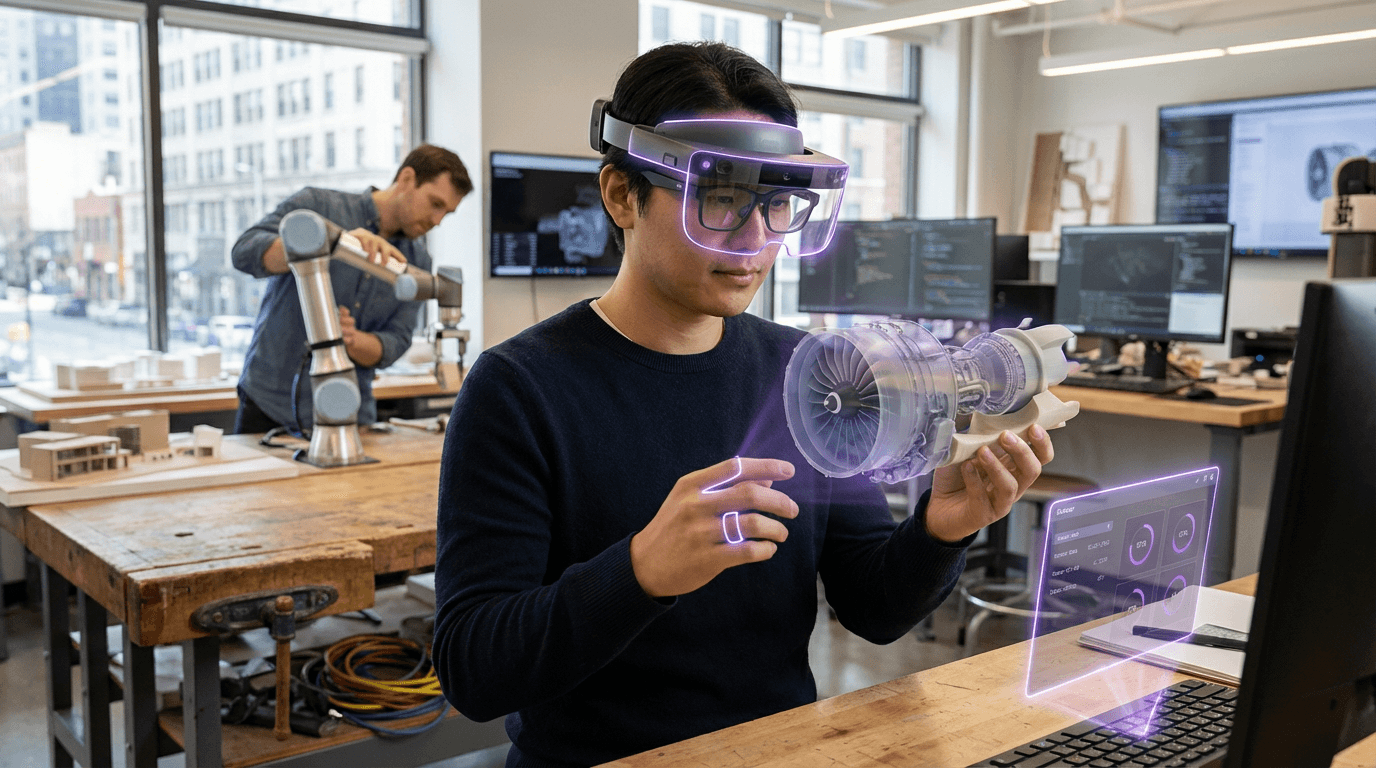
Passthrough AR Glasses
Passthrough AR glasses represent a significant evolution in augmented reality technology, moving beyond bulky headsets toward everyday wearable form factors. Unlike traditional AR devices that rely on optical see-through displays, passthrough systems capture the physical environment through high-resolution cameras and sensors, then reconstruct and blend this view with digital content on internal displays. This approach enables more sophisticated occlusion handling, where virtual objects can appear to exist behind real-world surfaces, and allows for advanced environmental understanding through computer vision algorithms. The devices integrate multiple sensor arrays—including depth cameras, spatial trackers, and inertial measurement units—to maintain precise positional awareness and enable natural interaction through hand gestures, eye tracking, and voice commands. By processing this sensor data in real-time, the glasses create a coherent spatial map of the surroundings, anchoring digital elements to specific locations and surfaces with millimetre-level precision.
The shift toward passthrough AR addresses several critical limitations that have hindered widespread adoption of spatial computing in professional and consumer contexts. Traditional optical AR systems struggle with brightness and contrast in varying lighting conditions, making digital overlays difficult to perceive outdoors or in brightly lit environments. Passthrough technology overcomes this by controlling the entire visual pipeline, ensuring consistent visibility of virtual content regardless of ambient conditions. For enterprise applications, this reliability is essential—field technicians can access repair instructions overlaid on machinery, warehouse workers can see optimised picking routes projected onto their environment, and designers can visualise full-scale prototypes in physical spaces. The always-on nature of these devices also enables persistent spatial interfaces that remember where digital content was placed, allowing users to return to virtual workspaces anchored in specific rooms or locations. This persistence transforms how people interact with information, moving from screen-bound experiences to spatially distributed interfaces that exist within the physical world.
Early commercial deployments of passthrough AR glasses are emerging across industrial, healthcare, and creative sectors, though widespread consumer adoption remains on the horizon. Manufacturing facilities are piloting these devices for quality control and assembly guidance, where workers benefit from hands-free access to technical documentation and real-time error detection. Medical training programs are exploring their use for anatomical visualisation and surgical planning, overlaying patient data directly onto the practitioner's field of view. As display technology advances and device weight continues to decrease, these glasses are positioned to become a fundamental interface layer for spatial computing environments. The convergence of improved battery efficiency, more powerful edge processing, and refined optical systems suggests a trajectory toward socially acceptable form factors that could integrate seamlessly into daily life. This evolution aligns with broader trends in ambient computing and the gradual dissolution of boundaries between physical and digital experiences, pointing toward a future where spatial information layers become as commonplace as smartphone screens are today.
Related Organizations

Developing 'Apple Intelligence', a personal intelligence system integrated into iOS/macOS that uses on-device context to mediate tasks and information.


Manufacturer of 'bionic display' headsets that use a high-density focus display inside a peripheral context display.

VR productivity software company developing the 'Visor' hardware.

Creators of the Lynx R-1, a standalone Mixed Reality headset.

Offers the AI Stack which includes tools for hardware-aware model efficiency and architecture search.

Produces VR headsets and actively partners with BCI companies (like OpenBCI and MyndPlay) to integrate brain-sensing into their hardware ecosystem.

A VR/AR hardware subsidiary of ByteDance producing the Pico 4 Enterprise with color passthrough capabilities.

An open VR world that natively supports external NFT assets and avatars.

Creators of Zapbox, an affordable mixed reality kit that uses a smartphone for video passthrough.
Supporting Evidence
Research this in Signals
Signals turns a topic into a sourced research record you can inspect and rerun. Your first scan is free, and this one starts with Passthrough AR Glasses already loaded, so edit it or scan as is.